
There is a small moment in The Odyssey that I find myself returning to more often as I get older.
I am not entirely sure why this one has stayed with me. It is not one of the famous scenes; it passes quickly, as if Homer knew its meaning required little elaboration, or perhaps as if he trusted the reader to notice it later.
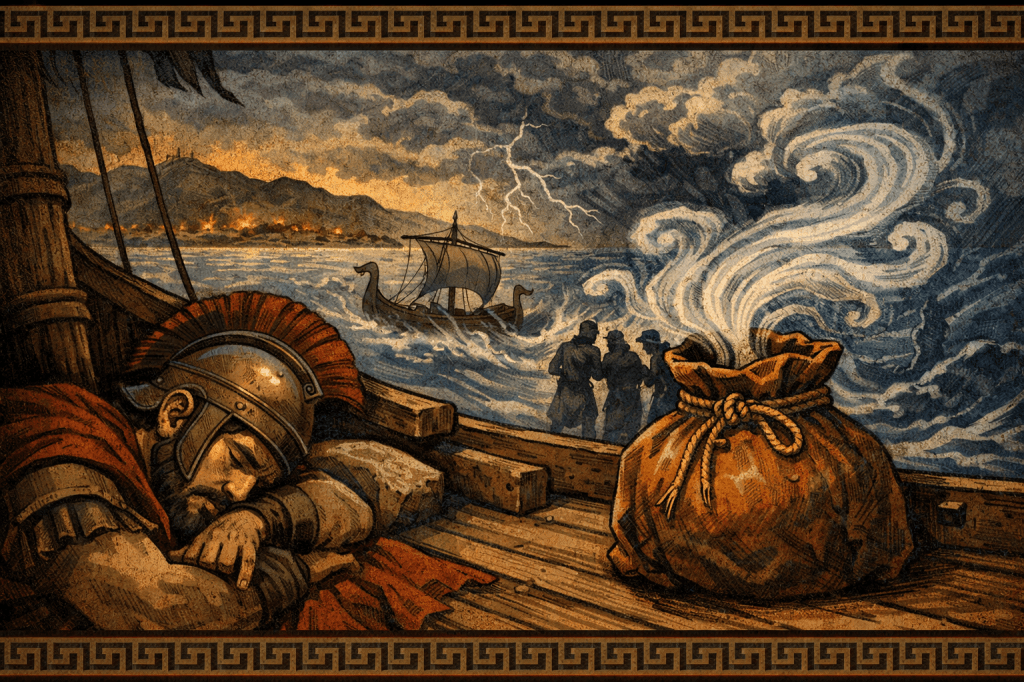
Odysseus receives a peculiar gift from Aeolus: a leather bag containing every troublesome wind of the sea. Only the gentle breeze that will carry the ships toward Ithaca is left outside the bag.
It is a strange gift, but a practical one. With the winds secured, the voyage home should be simple. At least, it appears that way.
Odysseus, however, does not seem to trust the situation. For nine days he stays awake at the helm, guiding the ship himself. I have sometimes wondered whether that decision reflects wisdom or anxiety, or whether the two are ever as separate as we like to imagine. There is a particular kind of stubbornness that comes from having seen how quickly a good outcome can be undone.
At last the coast of Ithaca appears on the horizon. Home is close enough that the fires of the island can be seen across the water. The long voyage is nearly finished. Only then, after days without sleep, does Odysseus finally give in to exhaustion.
He falls asleep. His crew begins to study the bag.
Someone suggests that it may contain treasure. The thought seems harmless at first. Sailors who have endured years of hardship together begin to wonder what their captain might be hiding from them. Gold perhaps. Silver. Something valuable that Odysseus intends to keep for himself.
I am not sure when curiosity becomes suspicion, but it seems to happen quickly, especially in confined spaces. A sealed bag begins to look less like a precaution and more like a secret. A gift becomes something withheld. Before long the matter seems obvious enough that someone decides to test the theory.
The bag is opened.
Every wind in the sea escapes at once. The storm throws the ships back across the water, carrying them far away from the island that had been within sight only hours earlier.
I have always found this one of the more believable disasters in Greek literature, though I am not certain whether that says more about the story or about us.
Nothing supernatural causes the failure. The gods do not intervene at this moment. The catastrophe unfolds through a series of impulses that are difficult to dismiss: curiosity, suspicion, and the quiet conviction that someone else possesses something that ought to belong to us.
What strikes me, each time I return to it, is that the sailors had lost nothing. The bag was not theirs. Odysseus had not deprived them of anything. Yet the mere possibility that he might possess something valuable seems to have transformed the situation into a perceived injustice, and perhaps even into one that required correction.
It is a peculiar habit of the human mind. Curiosity can become resentment with remarkable speed, though we rarely notice the transition while it is happening.
Once the suspicion takes hold, the rest seems to follow with a certain inevitability. If something valuable exists, fairness appears to demand a share. If a share is not offered, then perhaps it must be taken. By the time the bag is opened, I suspect the sailors no longer see themselves as acting wrongly. They may even believe they are restoring balance.
The Greeks, I think, understood something about this tendency, though I hesitate to say exactly what. They placed the disaster not at the beginning of the journey but at the moment of greatest promise. Ithaca is already visible.
That detail seems to matter. Greed, if that is the right word, does not always appear at the outset of an endeavor. It seems more likely to emerge when success is finally close enough to be measured, when the outcome feels almost secure.
There is also something quietly troubling about the timing of Odysseus’s sleep. The man has steered the ship himself for nine days without rest. The failure occurs at the precise moment when vigilance gives way to exhaustion. Leadership, if that is what we are meant to see here, does not always fail through incompetence. Sometimes it simply wears down.
I am not sure whether that is a comforting thought or an unsettling one.
Human endeavors often seem most fragile at that point. Institutions, partnerships, even friendships can begin to unravel when the rewards of success come into view. Someone eventually decides to open the bag, though it is rarely described in those terms.
There is, perhaps, a parallel in another tradition that has begun to feel difficult to ignore. In the account of Moses on Mount Sinai, the people below grow restless during his absence. He has gone to receive the law. The covenant, in a sense, is already within reach.
And yet the waiting proves difficult.
In his absence, the people turn to Aaron and ask for something they can see. Something immediate. Something that will go before them. The result is the golden calf.
I am not certain that the two stories are saying the same thing, but they seem to move along a similar line. In both cases, the leader departs from ordinary limits, whether through endurance or revelation. In both cases, the community is left to interpret that absence. And in both cases, the interpretation shifts.
- The sealed bag begins to look like hidden wealth.
- The invisible presence begins to require form.
What follows does not always feel, from within, like rebellion. It can feel like adjustment. Like clarification. Like restoring something that ought to have been shared or made visible all along.
That may be what makes these stories endure. The failure does not begin with open defiance. It begins with a question that seems, at first, entirely reasonable.
- What is in the bag?
- Where has he gone?
From there, the rest unfolds with a kind of quiet logic.
The story is several thousand years old, yet the pattern does not feel distant. The seas have changed, but the winds inside the bag seem familiar.
The Greeks filled their stories with gods and monsters, but some of their more enduring observations appear in quieter moments like this one. The winds in Homer’s tale are dangerous, certainly, but they are not the only danger present. There is also the quieter movement of suspicion among the crew, and it is not entirely clear which of the two proves more destructive.
- A sealed bag.
- An absent voice.
- A whisper among companions.
- And a storm waiting patiently for trust to give way.
