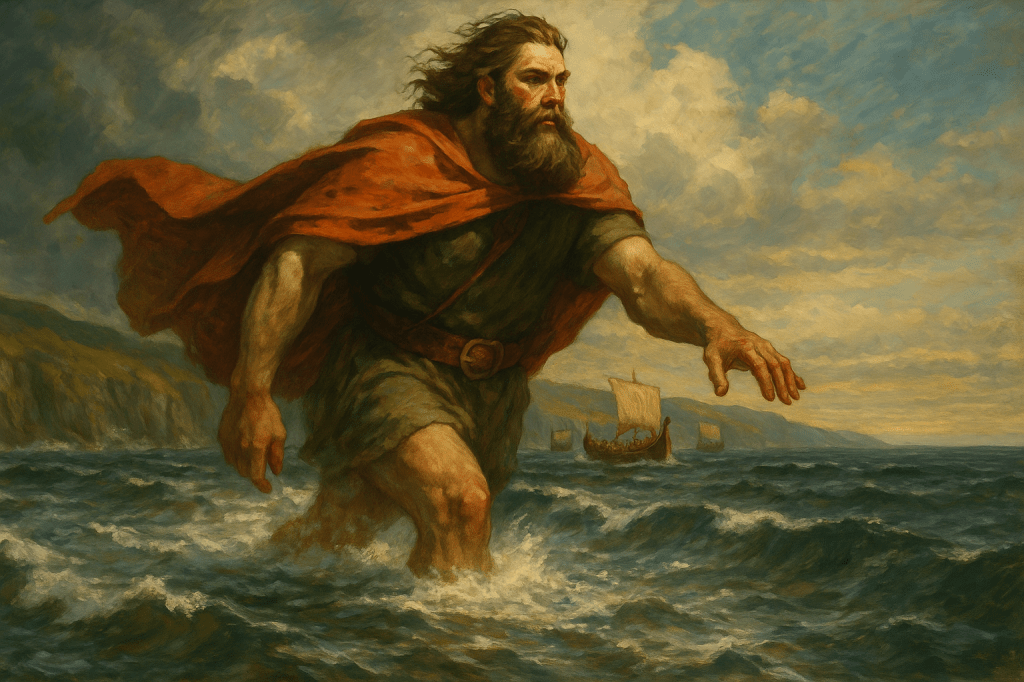
When I look at the William Blethyn Pedigree Roll, I often think about those ancestors who blur the line between history and legend—people who are part of old records but also live on in stories. One of the best examples is Brân the Blessed(Brân Fendigaid — or as its spelled in the William Blethyn Pedigree Roll, Vendigaid), a giant king from Welsh tradition whose story ties together genealogy, power, and myth.
Brân appears in the Second Branch of the Mabinogion, in the tale called Branwen, Daughter of Llŷr 1. In these stories, he is king of Britain, so massive that no ordinary house or ship can hold him2. His sister, Branwen, marries Matholwch, the King of Ireland, and Brân gives Matholwch a magical cauldron capable of raising the dead, though those revived cannot speak3. After a war breaks out in Ireland, Brân is mortally wounded, but before he dies, he instructs his men to cut off his head and carry it back to Britain. Remarkably, even in death, Brân’s head continues to speak, guiding his followers as they travel and finally burying it at White Hill in London4. During this time, his people feast at Harlech for seven years and later spend eighty years at Gwales, where time seems to pass strangely.
Brân’s family ties reinforce his legendary status. His father is Llyr, a sea-linked figure in Welsh myth5, and his sister is Branwen, the heroine of the Second Branch. He also has a brother named Manawydan and two troublesome half-brothers, Nisien and Efnysien6. Some later genealogies also link him to Caradog ap Brân, suggesting a legendary dynastic line, though this connection comes more from genealogical tradition than from the Mabinogion itself. These genealogical ties are seen the the pedigree roll. Brân’s father is listed as Lhyr Lhediaith, which according to A Welsh Classical Dictionary, means “half‑speech”7.
In the pedigree roll, Brân’s son’s name is spelled Cradog. I’ll save his story for a later post. If you’re interested in a sneak peek, A Welsh Classical Dictionary dedicates a few paragraphs to him as well, on page 1148.
Brân’s story illustrates key themes of heroism, leadership, and sacrifice. He leads his people into a dangerous war, and even in death, his head continues to care for and guide them. Though he is a mythic figure, he was incorporated into genealogical memory, becoming part of imagined ancestry in the same way many legendary kings were. His magical cauldron, speaking head, and burial under White Hill symbolize power that is both political and spiritual. In studying the Blethyn Pedigree Roll, Brân serves as a reminder that legendary figures shaped identity, inspired loyalty, and connected medieval Welsh families to a heroic past. He stands as a bridge between myth and memory, demonstrating how cultural stories were woven into family lineage.
For those interested in deeper study, Proinsias Mac Cana’s Branwen, Daughter of Llŷr: A Study of the Irish Affinities and of the Composition of the Second Branch of the Mabinogi (University of Wales Press, 1958) offers a scholarly examination of the tale9, and of course the Second Branch of the Mabinogion itself remains the primary source for Brân’s story10.
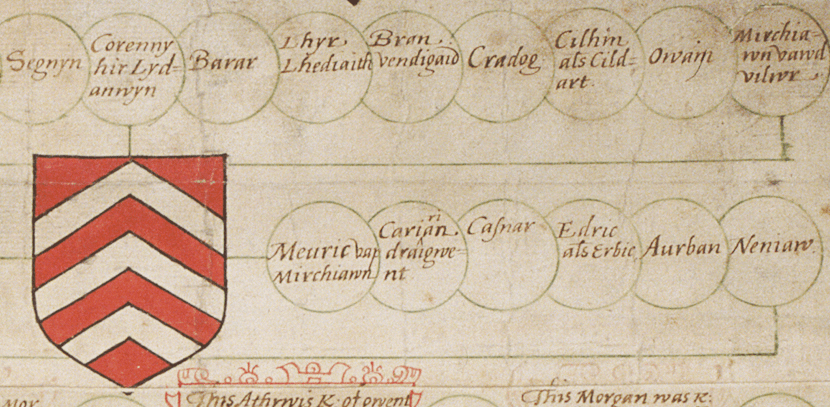
His lineage traces back to Brutus, the legendary founder of Britain, through Camber—called the king of “Wales” in the roll, though this title would have been foreign to the native Britons before the Saxon influence. Even as a seemingly minor figure in a list of names, Brân’s presence connects the legendary past to the historical imagination of later generations, linking myth to history in a way that would have resonated with figures like William Blethyn, Bishop of Llandaff, who lived within the very lands and traditions that these stories helped shape.
N.B. used ChatGPT to help locate sources and refine the grammar and flow of this post. I have read the Mabinogion—a work that deserves a post of its own someday—and have verified all the links. AI tools like ChatGPT can be incredibly useful when used thoughtfully and responsibly.
- https://www.mabinogion.info/branwen.htm ↩︎
- https://www.nantlle.com/mabinogi-translations-branch-2-branwen.htm ↩︎
- https://www.mabinogi.net/branwen.htm ↩︎
- https://timelessmyths.com/celtic/celtic-cycles/mabinogion/branwen-daughter-of-llyr ↩︎
- https://www.mabinogion.info/branwen.htm ↩︎
- https://www.roman-britain.co.uk/the-celts-and-celtic-life/celtic-religion/celtic-deities-and-heroes/bran-the-blessed ↩︎
- https://www.library.wales/fileadmin/docs_gwefan/new_structure/discover/digital_exhibitions/printed_material/welsh_classical_dictionary/07_H-LL.pdf ↩︎
- https://www.library.wales/fileadmin/docs_gwefan/new_structure/discover/digital_exhibitions/printed_material/welsh_classical_dictionary/03_C1.pdf ↩︎
- https://www.persee.fr/doc/ecelt_0373-1928_1960_num_9_1_1349_t1_0269_0000_3 ↩︎
- https://mabinogion.cymru/mabinogion/yr-ail-gainc-branwen-ferch-llyr ↩︎
