
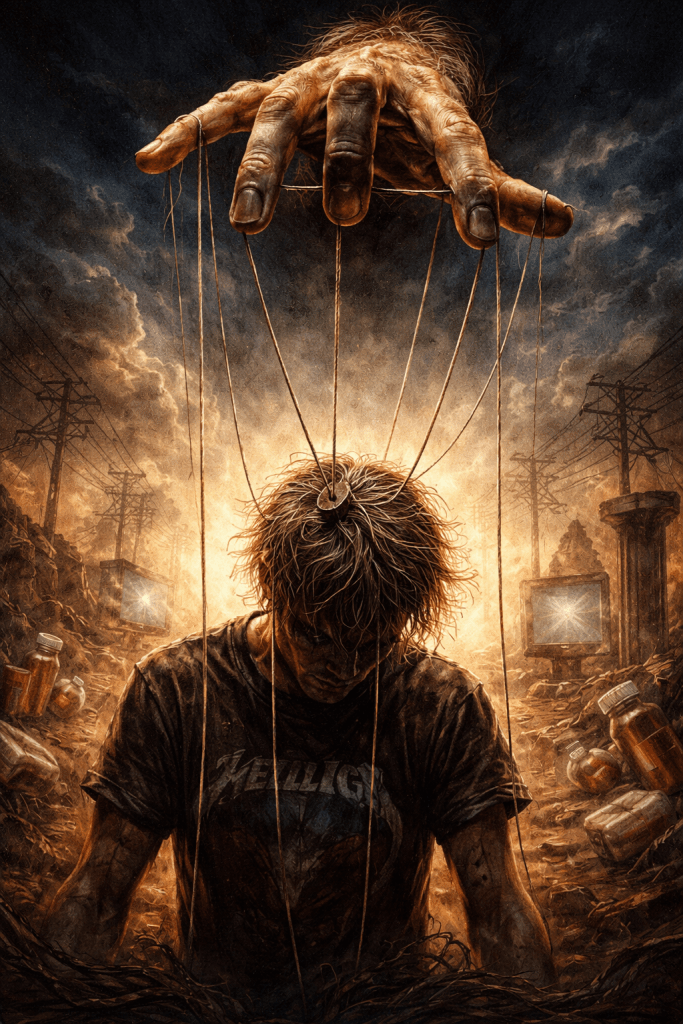
Some music ages like milk. Other music ages like iron. I am not entirely sure which quality I expected when I returned to Master of Puppets after all these years, but I suspect I did not expect to recognize myself in it.
In 1986, when the album was released, I was ten years old and nowhere near metal as a genre. I came to Metallica later, around the time …And Justice for All was released, and even then my attention was drawn more to the sound than to anything the songs were trying to say. My favorite Metallica album, then and now, is Ride the Lightning.
Master of Puppets entered my orbit gradually, almost incidentally, and whatever weight it carried did not register with me at the time. There is a kind of honesty in that kind of first encounter. One hears what one is prepared to hear.
Returning to it now, I find myself wondering whether the album has deepened, or whether I have simply caught up to it. The aggression is still there, but it no longer seems to be the point. What lingers instead is something I suspect was always present, though I had no language for it then.
What surprised me was not only that the album holds up, but that it seems, in some uneasy way, to have been waiting.
It was released in 1986, in the long shadow of the Cold War and amid a rising panic over drugs. It would be reasonable to confine it to that moment. I think I had done so without realizing it. Yet listening again, I found it difficult to keep the album in its proper decade. The concerns did not stay put.
The title track, “Master of Puppets,” is usually read as a song about addiction. The conceit is simple and effective. The substance speaks, and in doing so exposes the illusion of control. The user believes he commands; the command runs the other direction.
I remember once thinking this was a narrow metaphor, tied to a particular vice. Now I am less certain. It seems to have widened, or perhaps I have.
Modern life presents its own forms of dependency, though they rarely announce themselves as such. The systems I interact with daily are often described in neutral or even cheerful terms: engagement, retention, user experience. I use these words myself without much reflection. Yet I sometimes wonder what, exactly, is being described. The mechanisms are not hidden so much as politely named. They appeal to the same loops of attention and reward that have always governed human behavior.
If this is a kind of puppetry, it is at least one I participate in willingly, which may be the more troubling thought.
Other songs on the album seem to circle the same problem, though I am wary of imposing too neat a unity on them. “Disposable Heroes,” for instance, presents war not as glory but as movement directed from a distance. I find myself hesitating here. It is easy to say that nothing has changed, but that is not quite true. Technology has changed a great deal. And yet the arrangement, the feeling of being moved rather than moving, still feels familiar enough to recognize.
I enlisted at seventeen and spent six years in the Army National Guard. At the time, I understood my role in fairly straightforward terms. Only later did I begin to question what, exactly, that role meant. There were moments when I allowed others, often people I respected, to frame it for me in a more severe light, suggesting that even indirect participation carried a moral weight I had not fully considered.
I am not sure I ever fully resolved that tension. I turned, as I often do, to Scripture, though even there the clarity I expected did not arrive as cleanly as I might have hoped. The familiar phrasing, “Thou shalt no kill,” had always carried a kind of absolute force in my mind. Yet encountering other translations, where the command is rendered as “Thou shalt not murder,” introduced a distinction I could not easily dismiss.
The difference seems small at first glance, but it widens under scrutiny. The Old Testament contains accounts in which killing is not only permitted but commanded. I found myself uncertain how to reconcile that with the commandment as I had first understood it. It seemed unlikely that a contradiction of that kind would simply be left unresolved, and so I began to suspect that the category itself was more complicated than I had assumed.
Even then, I hesitate to draw a firm conclusion. It may be that the distinction between killing and murder is not merely linguistic, but moral in a way that resists easy definition. Figures like David, described as a man after God’s own heart, do not fit neatly into the categories I once preferred.
What I am left with is less a settled answer than a recognition that the question is heavier than I first believed. And perhaps that is part of what the song gestures toward. The experience of being moved within a larger structure is not only strategic or institutional. It can also be moral, leaving the individual to wrestle with meanings that are not fully his to define.
“Welcome Home (Sanitarium)” unsettled me more than I expected. I am less confident than I once was in drawing a firm line between care and confinement. Institutions, even well-intentioned ones, seem to carry within them a tendency to define the boundaries of the people they serve. I do not mean this as an accusation so much as an observation I cannot quite dismiss.
“Leper Messiah” gave me pause for a different reason. I do not hear it as an attack on Christianity itself, though I suspect it is often taken that way. What it seems to fix its attention on instead is a certain performance of religion, something closer to what might be called Churchianity than faith. The figure in the song resembles the televangelist, or at least a type that has become familiar, one who speaks in the language of devotion while quietly redirecting it toward himself.
I find myself uneasy here as well, not because the critique feels misplaced, but because it is difficult to keep it safely at a distance. It would be convenient to confine that kind of distortion to obvious figures, to those who appear on screens or stages. Yet the underlying dynamic, the mixture of sincere seeking and misplaced trust, seems less rare than I would like to admit.
There is a kind of vulnerability in the desire to draw near to God, especially when it is not yet well-formed. The song appears to suggest that this desire can be exploited, that authority can be assumed rather than earned, and that the line between guidance and control is not always easy to see from within it.
I am reluctant to press the point too far. Not every structure of authority is corrupt, and not every act of trust is misplaced. Still, the possibility lingers. If the album returns again and again to the image of unseen strings, this may be one of the more unsettling examples, because the movement is not enforced so much as invited.
Reflection
Listening to the album this time, I began to suspect that I was not so much analyzing its themes as noticing a pattern I was already inclined to see: how easily agency is yielded, often without any clear moment of surrender.
That suspicion led me back to something I had written recently about stolen valor. I had argued that when someone falsely claims military honors, he is drawing on a structure of trust that already exists. The uniform does not create the trust, but it carries it. What troubled me then, and still does, is how transferable that trust can be.
The comparison to Master of Puppets may not be exact, and I am not sure I would insist on it. Still, there seems to be a family resemblance. The addict, the impostor, perhaps even the ordinary participant in a system, all appear to operate within structures that quietly shape their choices. Whether they are aware of it is another matter.
It is tempting to say that the puppet does not see the strings. But I am no longer certain that is always the case. Sometimes the strings are visible enough. The question is whether seeing them changes anything.
This line of thought brought to mind a much older story. In The Odyssey, Odysseus is given a bag of winds, which he carefully guards as his ship nears home. His crew, suspecting treasure, opens it. The winds escape, and the journey is undone.
I have always found this episode slightly uncomfortable. It is easy to fault the crew for impatience, but I cannot say with confidence that I would have done differently. Suspicion, curiosity, the sense that something is being withheld, these are not rare impulses.
The Greeks seemed to understand this well. Their stories return often to the problem of appetite and the strange tendency of human beings to work against their own interests. I hesitate to call it a flaw. It may simply be a feature we have not learned how to manage.
Hearing Master of Puppets again, I had the uneasy sense that the album is making a similar observation, though in a different register. The guitars are louder, certainly, but the underlying question is not new.
Heavy metal is often dismissed as noise, and perhaps sometimes it is. But I find myself less confident now in dismissing anything so quickly. There are moments, listening closely, when the album seems less like rebellion and more like diagnosis.
If there is a conclusion here, I am not sure I trust it. It would be easy to say that human nature does not change, that the same patterns repeat across time. There is some comfort in that idea. It suggests a kind of stability.
And yet I wonder if the more accurate thought is smaller and less satisfying. Perhaps we simply encounter the same problems in new forms, and recognize them only when we are ready to see them.
The puppets may still dance. But I am no longer certain whether the more important question is who holds the strings, or why we so often fail to let them go.
