I recently finished Stephen Fry’s retelling of the Trojan War1, and as often happens with old stories, one episode lingered longer than the rest.
It is the moment when Patroclus puts on Achilles’ armor.
Achilles, in a fit of pride and grievance, has withdrawn from the fighting. Without him, the Greeks begin to lose ground. The Trojans press forward with increasing confidence. Ships burn. Lines falter. An army that once seemed unstoppable begins to look fragile.
Patroclus watches this unfold and understands what everyone on the battlefield knows, whether they can articulate it or not: Achilles’ presence changes the shape of the fight. His absence changes it even more.
So Patroclus asks for permission to wear the armor.
The proposal is simple. If the Trojans believe Achilles has returned, their momentum may falter. The Greeks may regain their footing long enough to stabilize the line. Achilles agrees, though not without warning. Drive them back from the ships, he says, but do not pursue them to the walls of Troy.
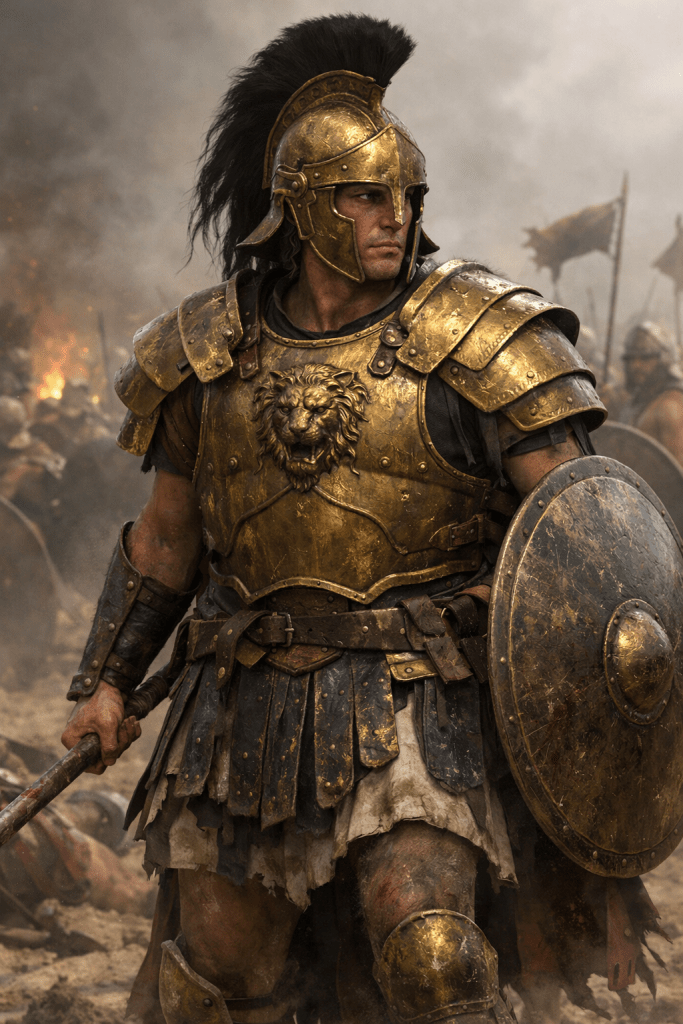
Patroclus puts on the armor. From a distance, no one sees Patroclus. What they see is Achilles. The armor moves again among the Greek ranks, and the battlefield responds accordingly. Greek morale rises. Trojan confidence wavers. Reputation, made visible, returns to the field.
On ancient battlefields, identity had to travel at a distance. Armor, shields, banners, and crests were not merely protective or decorative. They were communicative. They allowed men to recognize power, allegiance, and danger in the chaos of combat.
Achilles’ armor did more than protect the man who wore it. It broadcast a message. For a time, that message was enough.
Patroclus drives the Trojans back from the ships, just as Achilles intended. But momentum has its own logic. Success
The armor that frightened the Trojans cannot give him Achilles’ strength.
He falls. The armor remains what it always was: borrowed.
Modern culture has a phrase for a particular misuse of honor: stolen valor. It describes those who falsely claim military service or distinction in order to borrow prestige earned through sacrifice. The offense lies not only in the lie itself, but in the appropriation of something that properly belongs to another.
At first glance, Patroclus’ act appears similar. He allows others to believe Achilles has returned to the fight. But the resemblance is superficial.
Stolen valor seeks recognition. It attempts to elevate the individual making the claim.
Patroclus, by contrast, disappears inside the symbol. His success depends on not being recognized at all. The plan works only if the battlefield believes it is seeing Achilles.
He was not trying to become Achilles.
He was trying to make Achilles’ presence felt where Achilles himself would not go.
That distinction matters.
The armor functioned as an embodiment of accumulated reputation. It carried with it years of victory, fear among enemies, and confidence among allies. When it appeared, the battlefield responded not to the man inside it, but to what it signified.
Symbols can do remarkable things.
Human societies depend on them constantly. A uniform identifies the firefighter when a building is burning. A badge signals legal authority. A diploma suggests mastery. Heraldry once allowed knights to recognize one another in the confusion of battle.
These markers allow trust to operate at speed. They compress history, reputation, and competence into something visible. But they are also fragile. They work only so long as they remain connected to the realities they represent.
I have written before about this tension in different forms. Skate culture reproducing something like heraldry. Modern orders of chivalry adopting the language and regalia of older institutions. Educational systems conferring credentials before competence has fully formed.
Different domains, but the same underlying pattern.
When symbols drift too far from substance, they begin to behave like costumes.
Patroclus occupies a curious place within that tension. He was neither a fraud nor a pretender. He was a capable warrior stepping into a role for a specific purpose. The armor allowed him to project something real, even if it was not fully his own.
And yet the story reveals the limit.
Symbols can rally armies. They can frighten enemies. They can stabilize fragile situations for a time.
What they cannot do is permanently substitute for the reality they represent.
Eventually the Trojans discover the truth. The man inside the armor is not Achilles. In that moment, the symbol loses its power.
What remains is Patroclus himself. And Patroclus, brave as he was, was not Achilles.
The old stories endure because they illuminate patterns that repeat across centuries. Armor has given way to uniforms, credentials, and institutional titles, but the dynamic remains unchanged.
Borrowed armor can carry a man surprisingly far. Just not forever.
References:
- Stephen Fry. (2020). Troy: The Greek myths reimagined. Michael Joseph.
https://www.penguin.co.uk/books/111/1112816/troy/9780241424598.html ↩︎
