There is a particular kind of question that appears harmless on its face and yet carries more weight than intended. The “zombie apocalypse” prompt is one of these. It is usually asked in jest, often answered quickly, and almost never revisited with any seriousness.
Who are the three people you’d want at your side in the zombie apocalypse?
And yet, if taken even half a step further, it becomes something else entirely. It asks, in a disguised form, who you trust when the scaffolding of ordinary life falls away.
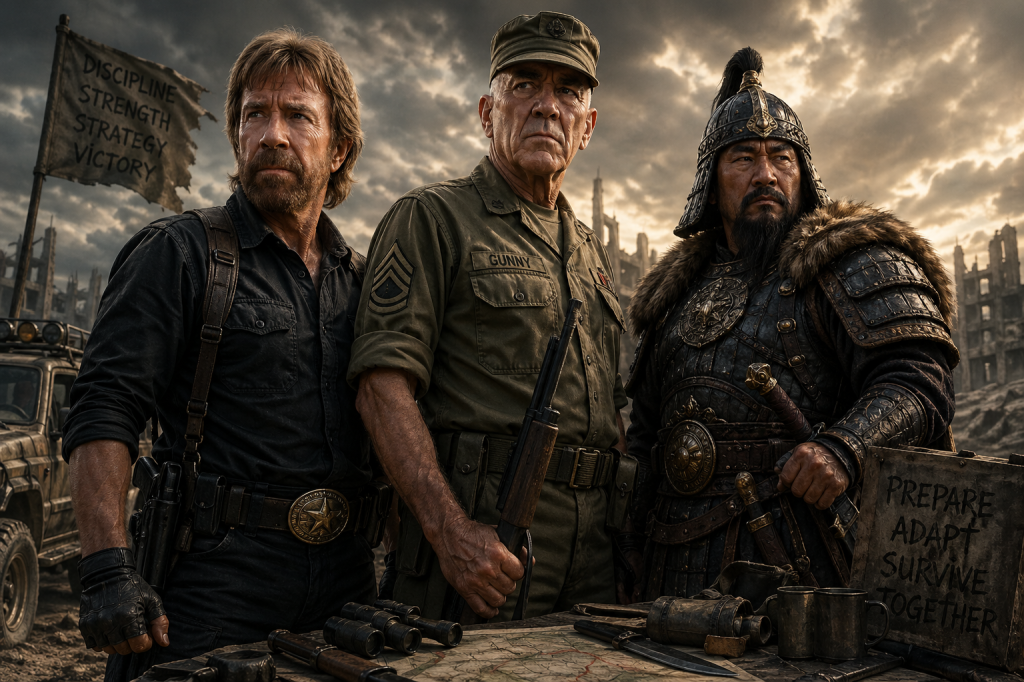
My own answer, offered initially with a degree of dry humor, was this: Chuck Norris, R. Lee Ermey, and Genghis Khan.
At first glance, it reads like a collage of caricatures. A meme, a drill instructor, and a conqueror. The sort of answer designed to get a laugh and move on. But the longer I considered it, the less accidental it seemed. Each represents not merely a person, but a type, though even that may be a little too neat.
Chuck Norris stands in for something older than cinema or internet exaggeration. He represents, at least as I understand it, the idea that there are still fixed points in the world, men who embody a kind of unyielding physical certainty. Not invincibility in the literal sense, but reliability. The sense that when something must be done, it will be done without negotiation or hesitation.
But that is only part of it.
What seems to make the figure endure is not merely strength, but strength restrained. Violence governed by something higher than impulse. In Norris, the image is not of chaos, but of force held in reserve, directed by a moral frame that is recognizably American and, more specifically, shaped by a Christian understanding of right and wrong.
I suspect part of the appeal, at least for me, is that it presents strength in a form that does not require apology. This is why the exaggerations persist. The jokes, the endless claims that he can bend reality itself, are not really about him as a man. They function more like the old stories once told about heroes. Not reportage, but illustration.
In that sense, the modern Chuck Norris meme is closer in spirit to the tales of Heracles or Samson than it is to anything like biography. It is a way of expressing, in exaggerated form, what a culture admires but rarely states directly. That a man could be strong without being lawless. That he could be capable of violence without being ruled by it.
Even his entry into film carries that mythic quality. His fight with Bruce Lee in Way of the Dragon has the feel of an initiation story. Two figures meeting not simply as actors, but as embodiments of disciplined physical mastery. It is less a scene than a kind of passage, one that carried him from practitioner into symbol.
In a world that has grown increasingly uncertain about what to do with strength, that combination still holds a certain appeal. Not because it is loud, but because it is ordered.
And that is where trust enters.
A man like that is not trusted because he is the most powerful in the room, but because his power appears to answer to something beyond himself. You trust not only that he can act, but that he will act within bounds. In a collapsing world, that distinction matters.
Because strength without restraint is just another form of danger. But strength that is governed, even imperfectly, becomes something else entirely. It becomes a kind of anchor, or at least something close to one.
R. Lee Ermey represents order imposed upon chaos through discipline. His voice, familiar to many through Full Metal Jacket, is not merely loud but structuring. It arranges men, corrects them, and sharpens them into something functional. If Norris is the fixed point, Ermey is the force that aligns everything around it.
I watched Full Metal Jacket the night before I left for Basic Training, on purpose. It seemed prudent to prepare for the worst. If that was the standard, then at least I would not be surprised. As it turned out, reality was more measured than the film, though not by as much as one might hope. This is not a criticism of the portrayal, nor of men like R. Lee Ermey. War requires a certain kind of man, and weakness in that context is not a private failing. It is a liability that can cost others their lives.
What the film captured was the intensity of transformation. It feels, in the moment, absolute.
I was reminded of that watching an old video from my own Basic Training, the one where we came out of the gas chamber. At the time, it felt like breathing in death itself. There is no poetry to it when you are inside it, only urgency.
Watching it later is a different experience. Strings of snot reaching toward the ground. Arms flapping in undignified panic. Men who imagined themselves composed, reduced to something more human than heroic.
My children were horrified when they saw it. They did not find it funny. There is no reason they should. Without having lived it, there is nothing to mediate the image.
But for those who have, the perspective shifts. The severity remains, but it is joined by a kind of rough humor. Not because it was trivial, but because it was survived. And more than that, because it was guided.
In Basic Training, you are placed in a position where trust is not optional. You trust the drill sergeant with your life, even when it does not feel like trust. He is teaching you an instinct to preserve your own life and the lives of those around you, while preparing you, if required, to take the life of an enemy. It is a hard kind of trust, built under pressure, but it is real.
That, in its own way, is what discipline does. It takes moments that feel overwhelming and renders them survivable. It creates trust not through comfort, but through repetition, correction, and shared strain.
Then there is Genghis Khan, who introduces a more uncomfortable element. Not order as we prefer it, but order as it emerges in its rawest historical form. Genghis Khan represents momentum, expansion, and the ruthless clarity of purpose that often defines those who reshape the world rather than merely endure it.
If Norris is the man you trust to stand, and Ermey the man you trust to prepare others to stand, Khan is the man you trust to act decisively when standing is no longer enough. I am less comfortable here, which may be precisely the point.That kind of trust is harder to admit. It is not built on familiarity or shared experience. It does not come with the reassurance of moral language or institutional structure. It rests instead on a recognition that there are moments in history when survival is determined not by who is most virtuous, nor even who is most disciplined, but by who can move, adapt, and impose order faster than the surrounding chaos.
Khan seems to have understood something that more settled societies, perhaps including our own, tend to forget. Order is not the default condition of the world. It is established, maintained, and, when necessary, reestablished by force that is both decisive and coherent.
What made him effective was not merely brutality, though history tends to remember him that way. It was organization. Communication across distance. Merit, at least in part, over birth in the selection of leaders. A capacity to turn disparate tribes into a unified force that could move with speed and purpose across vast terrain.
In other words, he did not simply destroy. He created something that could endure, if only for a time. There is, admittedly, a tension here.
The modern reader is inclined to recoil, and not without reason. The scale of violence associated with his campaigns is not something to be softened or excused. But to ignore the underlying competence is to miss something important. History does not remember him because he was chaotic. It remembers him because he was effective.
And effectiveness, in extremis, begins to look like a kind of trust.
Not trust in the sense of comfort, or even alignment, but trust in outcome. The belief that when a decision must be made, it will be made. That hesitation will not compound danger. That direction, once chosen, will be followed through, whether one is entirely at ease with it or not.
Placed alongside the other two, it is tempting to reduce them to something like a system. One who holds, one who forms, one who moves. That is probably too neat, but not entirely wrong. What is interesting is not whether these particular figures would be useful in a literal sense. They would not, of course, arrive together in any real crisis.
The more revealing question is why these are the instincts one reaches for.
We do not choose softness in these scenarios. We do not choose comfort. We choose, instead, the kinds of men we believe we can trust when things begin to fail.
Civilization is not as self-sustaining as we like to believe. It is maintained by trust, often quiet, often unseen, placed in people and institutions that embody these same traits in less dramatic form. The joke, then, has a way of turning back on itself. Because in answering lightly, one ends up revealing something heavier. Not about zombies, but about trust. About what kind of men one believes can carry weight when the structure gives way.
There is, however, a limit to all of this. The exercise is useful, even revealing, but it rests on an assumption that does not hold for long. These men, for all they represent, are gone. They belong to history, to film, to story. They cannot be summoned when things truly come apart, nor can any earthly figure carry the full weight we are inclined to place on them.
And that, if one is honest, is where the question quietly turns.
Because the deeper issue is not which men we would choose to stand beside us at the end of the world, but whose company we hope to keep when the world itself has ended.
The Christian answer to that question, at least as I have come to understand it, is not abstract. Christ is not an archetype among others. He is not simply a better example of strength, or discipline, or even righteous authority. He is the ground from which those things derive their meaning in the first place.
- If Norris represents strength under moral restraint, it is because there is such a thing as moral order to restrain it.
- If Ermey represents discipline that preserves life, it is because life itself has value beyond utility.
- If Khan represents decisive action in the face of chaos, it is because chaos is not the final word.
Each of these, in its own way, gestures toward something higher than itself. But none of them can sustain it.
There is a quiet temptation, especially in unsettled times, to look for saviors in forms that feel more immediate. Strong men, capable systems, decisive action. And there is a place for all of these. They are not illusions. They are, in their proper place, necessary. But they are not ultimate. Because every man, no matter how capable, reaches a point where he cannot carry what is required. Strength fails. Discipline falters. Even the most decisive action meets limits it cannot overcome.
The Christian claim is that this limit is not the end.
That the one who carries us through is not simply stronger than we are, but of a different order entirely. Not merely a man who can stand, or prepare, or act, but the one who sustains being itself, who enters into suffering rather than merely overcoming it, and who defeats death not by avoiding it, but by passing through it and returning.
It is a different kind of trust.
- Not the trust that someone will hold the line, but that the line itself is not final.
- Not the trust that we will be made ready, but that we are known even in our unreadiness.
- Not the trust that action will prevail, but that even failure is not outside the reach of redemption.
The earlier answer, then, remains what it was. A useful reflection. A glimpse into instinct. But it is not, and cannot be, the final answer. Because when the end truly comes, the question is no longer who would stand with you in the ruin, but who you will stand with when the ruin has passed.
And there, I find my answer changes, though not as cleanly as I might prefer. Not to the strong man, or the disciplined one, or even the conqueror. But to Christ. And, by His grace, to the company of those who belong to Him, which I hope to be counted among.
