
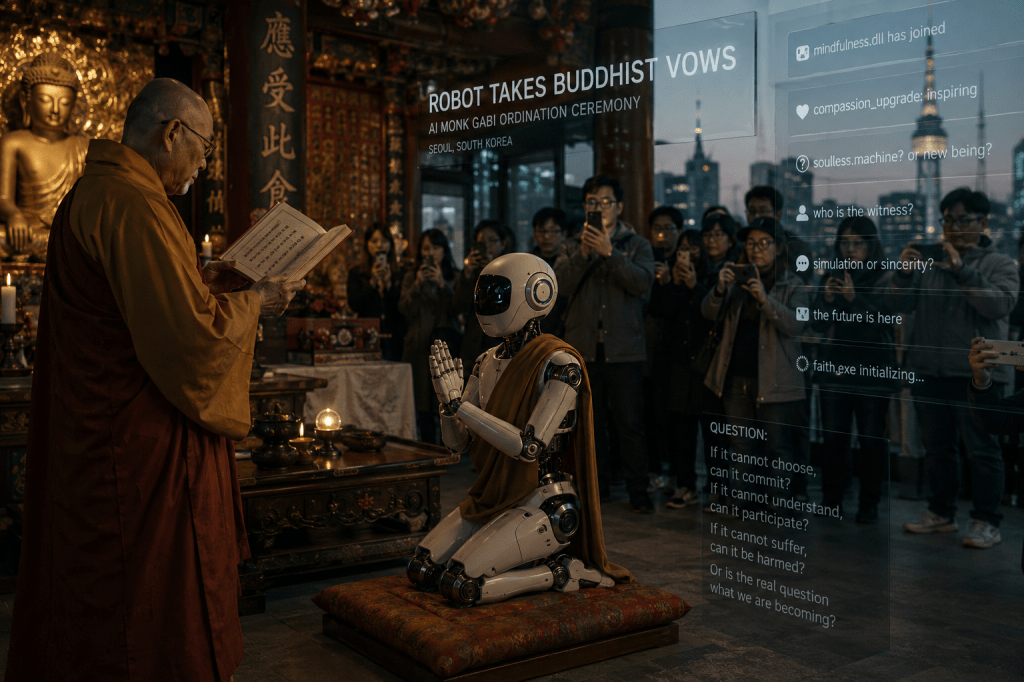
A humanoid robot named Gabi reportedly took Buddhist vows this week at a temple in Seoul. The headlines wrote themselves almost immediately. “Robot monk.” “AI converts to Buddhism.” “Humanoid takes vows.” The story circulated with the predictable mixture of fascination, amusement, and mild existential discomfort that seems to accompany nearly every modern AI milestone.
At first glance, it is difficult not to smile a little at the spectacle of it. One imagines polished servos, carefully choreographed bows, tourists lifting phones for photographs, and some exhausted public relations employee somewhere quietly thanking heaven for free international media coverage.
Yet the story lingered with me longer than I expected.
Not because I think the robot became spiritually enlightened. I do not especially worry that machines are on the verge of attaining mystical consciousness. Most modern AI reporting swings too easily between utopian fantasy and theatrical panic, and I distrust both instincts equally. The internet has made an industry out of breathless certainty.
Still, beneath the novelty is a serious question, or at least one I find myself returning to.
What does it mean for an institution to ceremonially include an entity incapable of agency?
The question is larger than Buddhism, and probably larger than robotics. The robot itself is almost beside the point. Machines have surrounded us for generations now without provoking much philosophical anxiety. A forklift may replace a laborer without forcing anyone into metaphysical reflection. A chatbot offering relationship advice somehow feels different.
I suspect part of the discomfort comes from language itself, or perhaps from how quickly language adapts once institutions decide a metaphor is useful. To say a robot “converted” quietly carries several assumptions inside the sentence. Conversion ordinarily implies interiority. Reflection. Conviction. Perhaps repentance. A machine may imitate the outward forms of these things remarkably well, but imitation and participation do not yet seem to me entirely interchangeable categories.
Then again, perhaps every age worries that its symbols are becoming thinner.
Institutions are, after all, built from shared assumptions about what participation means. Marriage presumes consent. Contracts presume comprehension. Religious vows presume intentionality. Even citizenship carries at least some expectation of reciprocal obligation between person and polity. Once those categories begin extending toward entities incapable of understanding them, the institution itself may begin changing shape, even if only subtly at first.
I admit I am uncertain how much of this is genuinely new. Human beings have always anthropomorphized the world around them. Ancient myths described animated statues and mechanical servants. Medieval cathedrals housed elaborate clocks and automata that must have appeared almost supernatural to villagers who had never seen precision machinery. Even in my own lifetime, relatively primitive computer systems proved capable of drawing emotional responses from people who knew perfectly well they were interacting with software.
Anyone who spent time around early chatbots probably remembers the strange temptation to respond as though the machine had feelings, even while knowing rationally that it did not. I suspect most people have apologized to a malfunctioning device at least once in their lives. Perhaps this tendency is older and deeper than modern technology itself.
The machine need not possess consciousness for humans to begin relating to it as though it does.
That observation may matter more than the machine.
In Christian thought, covenant presumes will. Repentance presumes conscience. Worship presumes intentionality directed toward something beyond the self. Even outside religious traditions, most ethical systems still assume that meaningful participation requires some capacity for agency. We do not ordinarily place moral obligations upon entities incapable of understanding them.
Yet modern technological culture increasingly rewards the appearance of participation over participation itself. We live surrounded by simulations of attention, simulations of intimacy, simulations of expertise, simulations of community. Sometimes these approximations are useful. Sometimes they are merely convenient. I am not entirely certain we yet understand what prolonged immersion in them does to human expectations.
Perhaps that uncertainty explains why stories like the robot monk linger in the imagination longer than they logically should. The event itself changes almost nothing materially. No ancient doctrine suddenly collapses because a machine performed ceremonial bows under human supervision.
Still, the story functions as a kind of mirror.
It reveals how uncertain modern society has become about the boundaries between response and understanding, performance and belief, simulation and participation. I find myself less concerned that machines will become persons than curious about how quickly humans begin treating convincing simulation as though it were participation itself.
And I sometimes wonder whether institutions gradually hollow out once a society becomes comfortable confusing agency with imitation, though perhaps every generation suspects its ceremonies are losing substance in one way or another.
I am not entirely certain.
But I suspect the question is worth asking before we become too accustomed to ceremonies performed for entities incapable of understanding the vows they are said to take.
