“To every thing there is a season, and a time to every purpose under the heaven…”
Ecclesiastes 3:1 (KJV)
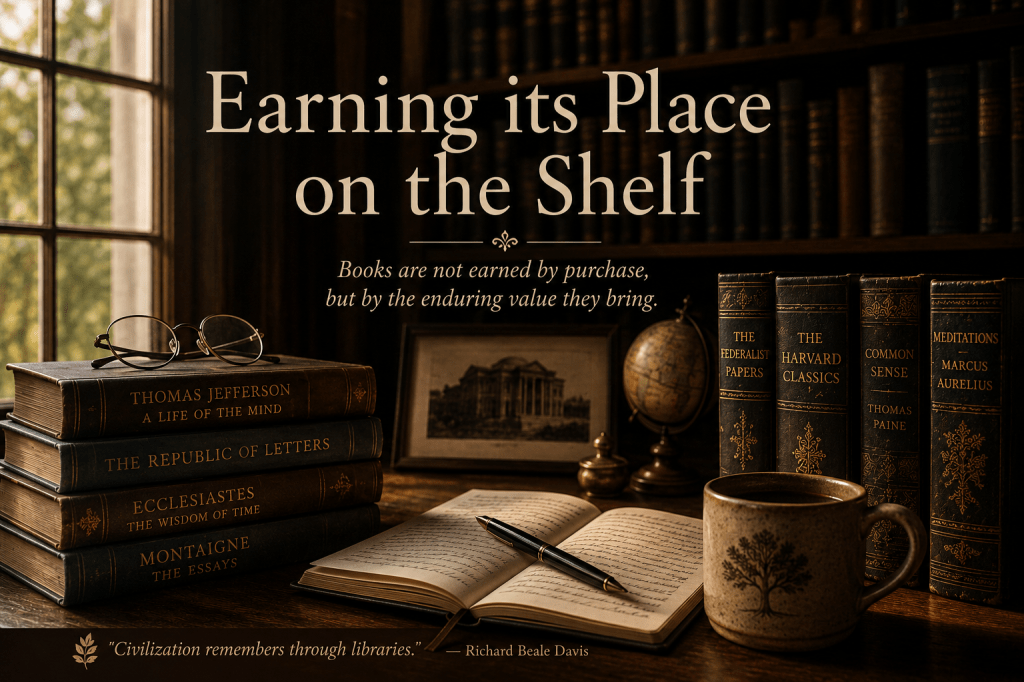
There was a time when every new book represented possibility. I bought them with the optimism that someday I would read them, understand them, and perhaps become a little wiser because of them. Some came from bookstores, others from used book sales, and a few found their way to me through the generosity of friends. Each one carried the promise that I would eventually have both the time and the discipline to absorb what it had to offer. For many years, that was enough. Acquiring books felt like investing in a future version of myself.
Lately, however, I have found myself looking at my shelves differently. Rather than asking whether there is room for another book, I find myself asking whether each book has earned the space it already occupies. That may sound ungrateful to someone who dreams of walls lined from floor to ceiling with books. I understand the sentiment because I once felt the same way. In fact, one of the moments that first inspired me to build a serious library was seeing Thomas Jefferson’s collection preserved at the Library of Congress. Standing before those volumes, I wasn’t impressed merely by their number. I was struck by the life of curiosity they represented. Jefferson’s library was not assembled to impress visitors; it was the working library of a man engaged in a lifelong conversation with history, philosophy, science, law, and theology. I left Washington wanting a library of my own—not simply a room full of books, but a room full of companions.
The more I have read about the intellectual world that shaped Jefferson, the more I have come to appreciate that a library is never merely a personal possession. Richard Beale Davis, in Intellectual Life in Jefferson’s Virginia, describes a culture sustained by schools, churches, printers, libraries, learned societies, and the steady exchange of letters and ideas. Jefferson did not emerge in isolation. He inherited a civilization that had been carefully preserved and faithfully transmitted by those who came before him. In a very small way, every personal library participates in that same work.
Universities preserve learning. Churches preserve doctrine. Courts preserve precedent. Libraries preserve civilization. A personal library serves the same purpose on a much smaller scale. It becomes a private institution dedicated to remembering what is worth remembering. Civilization remembers through libraries. Families remember through heirlooms. Individuals remember through the books they choose to keep.
That difference has become even more apparent in an age where digital storage is effectively limitless. My digital library can grow indefinitely. Hard drives fill with PDFs that cost nothing to keep, and bookmarks accumulate faster than anyone could reasonably revisit them. A physical bookshelf operates under different rules. Every volume occupies real space, and every new addition quietly asks whether it deserves to stand beside the others. Scarcity, it turns out, has a way of sharpening judgment that digital abundance never demands.
Perhaps that is why I have begun removing books from my shelves. Many of them are textbooks from college. At one time they served an important purpose. They taught me concepts that shaped my career and opened doors I could not have imagined when I first bought them. They were faithful teachers for a particular season. Some have simply completed their work, while others have been overtaken by time. A networking textbook from fifteen years ago is less a guide than a historical artifact. Recognizing that does not diminish what those books once gave me. It simply acknowledges that every season eventually comes to an end.
As I decide what remains, I have adopted a simple question: If I were building this library from scratch today, would I buy this book again? Sometimes the answer comes immediately. Some books have become trusted friends whose margins contain conversations with earlier versions of myself. They are returned to again and again, each reading revealing something I somehow overlooked before. Those books require no defense because they have already justified their place. Others remain untouched years after I acquired them. Their value exists almost entirely in the hope that I might someday read them, and I have come to realize that hope alone is a poor reason to occupy limited shelf space.
I once believed that owning the complete Harvard Classics would mark the arrival of a proper library. Their matching bindings and ambitious scope appealed to the collector in me. Today I am less certain. I find myself wondering whether I would actually read them, whether they would become trusted companions, or whether they would simply become beautiful furniture. Somewhere along the way I was reminded that perfect is the enemy of good enough. That realization has done more than save me from an expensive purchase. It has helped me stop confusing possession with wisdom.
I also find myself asking different questions than I once did. Too often I evaluate a book by asking whether it will make me more productive or improve some professional skill. Jefferson’s generation expected something more from books. They expected them to cultivate judgment, virtue, and citizenship. Perhaps the better question is not, “Will this book help my career?” but, “Will this book help me become a wiser man?” That is a far higher standard for shelf space.
The medieval monks who preserved the literature of antiquity could not save every manuscript. They copied what they believed was worth carrying into the future because they understood that preservation requires discernment. My own library is a far humbler undertaking, yet I find myself asking a similar question. If these shelves were all that remained, which voices would deserve another hearing? Every retained volume is, in its own quiet way, a declaration that this author has earned my trust and deserves to be welcomed back into the conversation.
A library is often said to reveal its owner, but perhaps the relationship works in both directions. Over the years, the books that remain begin to shape the person who remains with them. They refine his judgment, temper his convictions, and remind him that wisdom is acquired slowly, one conversation at a time. In that sense, the greatest purpose of a library is not simply to preserve books. It is to preserve the reader.
There is indeed a season for gathering books, and there is also a season for letting some of them go. Perhaps the measure of a library has never been the number of volumes it contains, but the character of the conversations it preserves. A well-loved shelf of trusted companions may ultimately be richer than a warehouse of unread possibilities.
Written in conversation with
This essay was shaped by ideas encountered in the following works:
- The Holy Bible (KJV) — Particularly Ecclesiastes 3, which frames the seasons of gathering and letting go.
- Richard Beale Davis, Intellectual Life in Jefferson’s Virginia — On libraries, learning, and the institutions that preserve civilization.
- Thomas Jefferson — Through his library and lifelong commitment to learning, as preserved by the Library of Congress.
- The Harvard Classics, edited by Charles W. Eliot — As both an aspiration and a reminder that a library should be built for use rather than display.
- Michel de Montaigne, The Essays — For the understanding that reading is an ongoing conversation with minds across generations, and that a library ultimately reflects the formation of the reader.
