
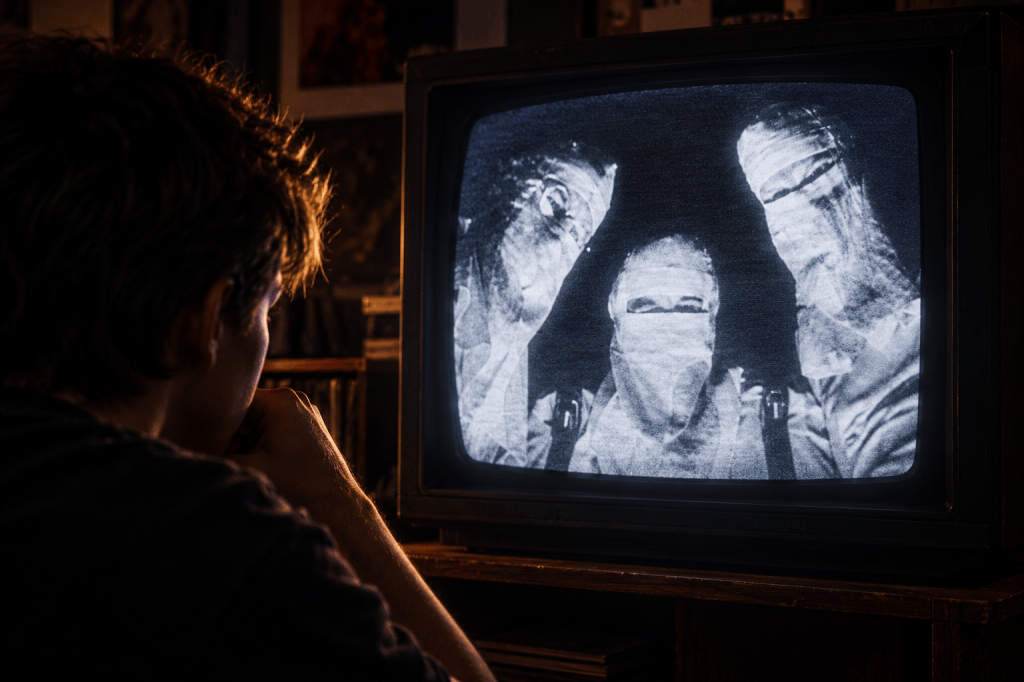
As I approach the half-century mark, I have been spending an unreasonable amount of time lately watching people react to music on YouTube. The format is simple enough: someone listens to a song, watches a performance, or encounters an album for the first time, while a camera records the experience. Sometimes the results are amusing. Sometimes the listener notices something I never considered. Every now and then, somebody makes me reconsider a piece of music I have known for most of my life.
A few of my favorite channels are Black Pegasus and The Charismatic Voice. They approach music from different directions, but I enjoy watching people who are genuinely interested in understanding what they hear. The experience is a little like watching somebody examine a familiar object under a different light. The object has not changed. The observer has brought something new to it.
The video that prompted this essay was Krizz Kaliko reacting to Metallica’s performance of “Enter Sandman” in Moscow in 1991. There is something extraordinary about that performance, quite apart from the music. Metallica stands before a vast crowd at Tushino Airfield, playing a song from the (then) recently released Black Album. The band is at the center of an event that seems almost too large to comprehend from the perspective of a screen.
I have watched the performance before. What interested me this time was watching someone else encounter it.
I discovered Metallica in middle school, sometime after Master of Puppets and before …And Justice for All. This was the 1980s, well before the Internet became part of ordinary life. Growing up in the rural South, I cannot remember exactly how I first learned about the band. I can imagine the possibilities, but the actual memory is gone. I remember discovering Metallica. I do not remember discovering how to discover Metallica.
That is a curious little gap in my personal history. Today, a person can find almost anything about a band within seconds. The music, the interviews, the recording sessions, the controversies, the biographies, and the opinions of strangers are all waiting to be retrieved. In my childhood, information moved through less visible networks. A friend knew something. Somebody passed along a tape. A record appeared in a store. A video aired on MTV. We found our way into things without necessarily knowing who had opened the door.
I have spent a fair amount of time thinking about how technology changes the way we acquire information, but this is a humbler example than most. We now have better tools for finding things, yet we may still have difficulty remembering how the important things found us.
The music remained. The route by which it entered my life disappeared.
Perhaps that is where the reaction videos become interesting to me. They are not simply entertainment, though they certainly can be that. They make cultural transmission visible. I am watching another person encounter something that has already become part of my own history, and I am reminded that the experience belongs to neither of us exclusively. The music is available to both of us. What we make of it depends on what we bring to it.
What We Hear in the Same Song
I remember when Metallica released the video for “One.” The band had resisted making music videos for years, then produced something that combined its music with footage from Johnny Got His Gun, the film adaptation of Dalton Trumbo’s novel about a soldier catastrophically injured in war. The result was powerful. The music and the images reinforced one another, and the video brought the consequences of war into a form that was difficult to ignore.
I understood the message. Metallica had already explored the subject on Master of Puppets, particularly in “Disposable Heroes.” The machinery of war, the expendability of the soldier, and the distance between those who give orders and those who suffer their consequences were not new subjects for the band. I had this in my subconscious several years later when I enlisted in the Army National Guard. The songs didn’t dissuade me from service, but they did make me cognizant of the ramifications of my choice.
But I remember “One” primarily as an experience of aggression and power. The music was forceful, the imagery brutal, and the combination unforgettable. I did not respond in quite the same way that some younger viewers do today. I have watched people become visibly distressed by the video, sometimes to the point of tears. I find that difference interesting. I do not think my reaction was necessarily less serious, nor do I think theirs is excessive. We encountered the same work from different places in our lives. The music did not change, but the circumstances of its reception did.
This is a small example of a larger problem in understanding one another. We often assume that if two people have access to the same information, they ought to arrive at the same conclusions. Yet information does not reach us in a vacuum. It arrives through experience, expectation, habit, and whatever we happen to know about the world. We can share a song without sharing an interpretation of it. We can share a history without remembering it in the same way. We can even agree on the facts and still disagree about what they mean.
The difficulty is not always a lack of information. Sometimes it is a failure to recognize that the other person is bringing a different set of experiences to the same material. I have no particular desire to settle the question of whether my generation or the younger generation responds to Metallica more appropriately. I suspect the question is badly framed. The more useful exercise is to pay attention to what each person sees, and to consider whether there might be something worth learning from it.
That requires a little humility. We have to admit that our own interpretation, however familiar, may not exhaust the meaning of the thing before us. It is an easy lesson to learn from music. It is considerably harder to apply to the rest of society.
A Band Changes, and So Do We
The Black Album arrived during my freshman year of high school. Metallica had already established itself as one of the defining bands of thrash metal, a style built around speed, technical precision, and a deliberate rejection of much of the commercial polish associated with mainstream rock.
The 1991 album was a change in direction. The songs were more concise, the production more polished, and the arrangements more accessible to a wider audience. Some listeners regarded this as a betrayal of the band’s origins. I did not. I saw it as a progression. We grow up. Our interests change. Sometimes our work changes with us. I did not see why a band should be required to remain creatively fixed in the place where I happened to discover it.
I followed the musical currents of the 1990s as grunge overtook much of the rotation on MTV. I never stopped listening to metal, especially Metallica, but my attention wandered. I did not get deeply into Load or Reload. I bought S&M when it was released and thought the pairing of Metallica with a symphony orchestra was amazing. I bought St. Anger, although I was not particularly taken with the album as a whole. I eventually watched Some Kind of Monster, but not when it first appeared. Somehow I missed it. Much like I missed the fact that Korn, Papa Roach and Disturbed were apparently part of a subgenera called “Nu Metal”. I don’t recall hearing that label used when I was hearing the music in the late 90s and early 2000s. I supposed I was too busy enjoying the music to pay attention… but I digress.
I was sympathetic to the band during the Napster controversy. The dispute raised legitimate questions about ownership, distribution, and the economics of recorded music. There were reasonable arguments to be made about how artists should respond to digital distribution, but I did not regard the desire to control one’s work as inherently unreasonable. I felt sorry for them that a portion of their fan base was turning on them. That is almost a forgotten footnote at this point in time.
None of this made me an especially devoted fan. I did not follow the members’ personal lives or keep track of every change in the band’s circumstances. When Jason Newsted left, I registered the news, but it was not a matter that occupied much of my attention. The band’s changing appearance during the Load and Reload years did not particularly concern me. I was interested in the music, not in enforcing a particular image of what Metallica ought to be.
By the 2000s, I was still listening to the band, but I had largely stopped keeping up with it. I returned to paying closer attention around the time of Atlas, Rise! and have followed its releases more closely since. There is no grand story of rediscovery here. I did not suddenly realize that I had been wrong to pay attention to other music, nor did I conclude that the records of my youth were the only ones worth hearing. My interests simply moved in different directions and eventually crossed paths with Metallica again.
I mention this because we often confuse continuity with constancy. We imagine that if something truly matters to us, we ought to give it our undivided attention. Yet much of what makes up a life does not work that way. We set things aside. We return to them. We change our minds. Some things that once seemed essential become peripheral, while other things acquire importance we could not have anticipated.
The challenge is not to preserve every interest in exactly the form it took when we first encountered it. It is to remain capable of recognizing value when it appears in a new form.
Metallica changed. I changed. Neither of us required the other to remain exactly as we had been.
Independence Is Not Isolation
As I have paid more attention to Metallica in recent years, I have become interested in something beyond the music. The band has spent decades building an enterprise around its work, and much of that history concerns questions of ownership, management, and control.
This is not usually what we think about when we hear a guitar riff. It is not what interested me when I was in middle school. But the business behind the music offers an interesting example of a principle that applies well beyond the entertainment industry: self-reliance does not mean doing everything yourself. It means developing the ability to direct your own affairs.
Metallica has worked with Q Prime, the management firm associated with Cliff Burnstein and Peter Mensch, for decades. That relationship is worth considering because it complicates the familiar image of the independent individual who answers to nobody.
No large enterprise operates entirely by itself. A band needs people who understand contracts, negotiations, touring, recording, promotion, distribution, and the many other activities that make a career possible. The question is not whether to depend on other people. The question is how to choose those people, establish a relationship of trust, and preserve the ability to make decisions about the future.
Trust is often treated as a pleasant quality in human relationships, something we invoke when we want people to get along. In practice, trust is also an economic asset. It allows people to delegate responsibility without having to supervise every action. It makes cooperation possible between people whose skills and interests are not identical. It allows an organization to accomplish things that no single member could accomplish alone.
But trust is not the same as surrender. A trusted adviser is not a substitute for judgment. The point of competent management is not to relieve an organization of responsibility for its own future, but to help it make better decisions about that future. Metallica’s long relationship with Q Prime illustrates the value of this distinction. The band did not have to become experts in every aspect of the music business to exercise control over its career. It could rely on people whose expertise complemented its own, while retaining responsibility for the decisions that defined the enterprise.
This is a more useful model of independence than the romantic notion of the self-sufficient individual who needs nobody. That person exists mostly in advertising and fiction. The rest of us live in a world of mutual dependence, whether we acknowledge it or not.
The practical question is whether our dependencies make us more capable or less capable.
A small business owner may rely on an accountant without surrendering control of the business. A community college may rely on employers to understand changing workforce needs without allowing those employers to dictate every educational decision. A family may rely on neighbors and extended relations without becoming incapable of managing its own affairs. The relationships can strengthen the people involved, provided the responsibilities remain clear and the trust is warranted.
Metallica’s history suggests that independence is not the absence of relationships. It is the ability to build the right relationships without losing sight of what one is trying to accomplish. That is a considerably more demanding form of self-reliance than simply refusing help.
Owning the Work
In 2012, Metallica announced that it had taken ownership of its master recordings under the terms of a renegotiated agreement with Warner Music Group dating to 1994. The band also established Blackened Recordings as the home for its audio and video catalog. The process took years. The result was not a dramatic escape from the music industry, but a negotiated arrangement that gave the band control over its master recordings and greater authority over how those recordings would be managed.
There is a distinction worth making here. Ownership of master recordings is not necessarily the same as ownership of every underlying songwriting or publishing right. The important point is that Metallica worked toward control of a significant part of its recorded legacy rather than assuming that the arrangements under which it had originally operated would remain adequate forever.
This is the sort of decision that can be difficult to appreciate when we look only at the finished product. We see a successful band and assume that success naturally brings independence. In reality, success can create new forms of dependence. The larger an enterprise becomes, the more complicated its contracts, supply chains, and relationships can be. Revenue can increase while control over important parts of the business remains elsewhere. A person can earn a great deal of money and still lack the freedom to make a particular decision. An organization can become enormously successful while discovering that the systems on which it depends are controlled by others.
Metallica’s approach was to work toward a different arrangement. Its relationship with Warner had itself evolved over time, and the eventual transfer of the masters was the outcome of a long business relationship rather than a simple act of defiance. The band acknowledged the importance of that relationship even as it moved into a new phase of ownership. I find that detail instructive. We tend to tell stories about independence as though they require an adversary. Sometimes they do. Often, however, independence is achieved through competent negotiation between parties that have found ways to work together.
The objective is not necessarily to defeat the other side. It is to arrive at an arrangement that allows each party to pursue its interests with greater clarity.
There is also a practical lesson in the time involved. If we want to retain control over our work, our property, or our institutions, we have to think beyond the immediate transaction. We have to consider what the present arrangement will mean ten or twenty years from now. We have to be willing to negotiate for terms that may not pay off immediately. This requires patience, foresight, and a willingness to take an interest in the machinery behind the things we value. It is not glamorous work. It rarely produces a dramatic moment that can be captured in a documentary. But it is often the work that determines whether an organization can continue to operate on its own terms.
The Machinery Behind the Music
In 2023, Metallica became the majority partner in Furnace Record Pressing, a vinyl manufacturer in Alexandria, Virginia, that had worked with the band for years. The timing was interesting. Recorded music had spent decades moving away from physical media. CDs gave way to downloads, and downloads gave way to streaming. Yet vinyl records returned to popularity, creating renewed demand for manufacturing capacity. Metallica had a substantial catalog to press, along with new albums, reissues, and box sets. The band could have treated this as a supply problem to be managed through contracts with an outside manufacturer. Instead, it took a controlling interest in a company with which it already had a long working relationship.
I do not know the details of every calculation behind that decision, and I would not pretend to. The investment may have involved considerations beyond quality control, including capacity, scheduling, and the economics of manufacturing. Still, the underlying logic is understandable. If an important part of your business depends on a physical process, there is value in understanding that process and having a meaningful stake in its future.
There is something almost quaint about a major band investing in the machinery required to press records at a time when so much of the industry has become intangible. It is also a reminder that the digital economy has not abolished the physical world. Somewhere, someone still has to manufacture the equipment, maintain the power supply, operate the machines, and produce the objects on which our supposedly weightless culture depends.
We can stream a song from a server without thinking about the infrastructure that makes it possible. We can order a physical record without thinking about the factory that produces it. The systems are often invisible precisely because they work well enough for us to ignore them. That invisibility can become a weakness. When we lose sight of the infrastructure on which we depend, we may also lose sight of the skills and relationships required to maintain it. We become consumers of systems we no longer understand.
Metallica’s investment in Furnace is not a solution to that broader problem, but it offers a useful counterexample. The band has taken an interest in the means by which its product is made, rather than treating manufacturing as an entirely external concern.
There is a DIY instinct here, although the scale is far removed from a teenager recording a demo in a garage. The underlying principle is similar: if something matters to your work, learn enough about it to make informed decisions. Where it makes practical sense, build or acquire the capacity to do it yourself. Where it does not, find people whose competence you can trust and establish a relationship that serves both sides.
The important distinction is between outsourcing a task and outsourcing all responsibility for the outcome.
We cannot do everything ourselves. Nor should we try. But we should understand enough about the things on which we depend to know whether the arrangement is working, whether it remains appropriate, and what we would do if it failed. That is true of a business, a household, a community, and perhaps even a society.
What We Choose to Build
The same interest in practical capability appears in Metallica’s charitable work. The band and its management established the All Within My Hands Foundation in 2017. Its work includes hunger relief, support for local services, and workforce education. The Metallica Scholars Initiative, launched in 2019 in partnership with the American Association of Community Colleges, provides funding to colleges seeking to strengthen career and technical education programs. By 2026, the initiative had expanded to 93 community colleges across the United States and Guam, with a new program in the United Kingdom.
I find the emphasis on trades and applied education particularly worthwhile. We have spent years discussing the importance of innovation, the digital economy, and the industries of the future. Those things matter. But a society cannot live on abstractions. It needs people who can install electrical systems, maintain machinery, manufacture components, repair equipment, and keep the ordinary mechanisms of life working.
We sometimes speak about skilled trades as though they were an alternative to serious intellectual work. This is a strange distinction. Competence in a trade requires knowledge, judgment, discipline, and experience. It requires the ability to recognize when a familiar procedure is inadequate and to respond when conditions change. The work may be physical, but it is not mindless.
A community that neglects these skills becomes dependent on capabilities it may no longer possess. It may continue to function for a while, drawing on the people and institutions that remain. Eventually, however, the cost of that neglect becomes apparent.
The Metallica Scholars Initiative directs resources toward institutions that teach practical skills and prepare people for employment. It does not solve every problem in workforce education, and charitable giving should not be mistaken for a substitute for sound public policy or effective institutions. But the program is an example of using private resources to strengthen capabilities that have value beyond the immediate interests of the donor.
There is a connection here to Metallica’s own history. The band developed through the accumulated competence of its members, the work of its collaborators, and the institutions it built around its music. It has used trusted relationships to accomplish things that would have been difficult for the musicians to do alone. Through All Within My Hands, it helps other people acquire the skills and resources needed to build their own futures. That is a more interesting model of success than the simple accumulation of wealth.
Wealth can provide comfort and freedom, but it can also remain isolated from the society that made its accumulation possible. The question is what we choose to do with the resources, skills, and influence available to us. Do we use them only to maintain our own position, or do we help create conditions in which other people can become more capable?
I would not make too much of the example. Metallica is a business, and the foundation is one part of a much larger enterprise. Its charitable work does not make every business decision correct, any more than a successful business automatically makes its owners good stewards of their communities.
Still, the program is worth noticing. It directs money and attention toward practical competence. It recognizes that communities need institutions capable of teaching useful skills, and that people need opportunities to develop those skills. The band has built something for itself. It is also helping others build something for themselves.
Trust Is Part of the Infrastructure
There is a tendency to think of trust as something personal and infrastructure as something physical. We trust a friend, a colleague, or a manager. We build factories, roads, networks, and institutions. In practice, the two are difficult to separate.
A factory depends on people who know how to operate it and organizations that can supply its materials. A business depends on contracts that establish expectations and relationships that allow those expectations to be met. A community depends on people who are willing to take responsibility for things that extend beyond their immediate interests.
Physical infrastructure can be purchased, constructed, and maintained. Trust has to be earned and renewed through conduct. Neither is sufficient on its own.
A factory without competent people is a collection of machines. A business without trustworthy relationships becomes an expensive exercise in monitoring and enforcement. A community without trust may retain its buildings, roads, and institutions while losing the willingness of its members to work together.
This is one reason I find Metallica’s history more interesting than a straightforward account of musical success. The band has not endured simply because its members have continued to perform songs that people enjoy. It has built and maintained relationships with managers, record companies, manufacturers, promoters, employees, and charitable partners. Some of those relationships have changed over time. Others have endured for decades.
The band’s relationship with Q Prime is one example of the value of trusted management. Its relationship with Warner Music Group demonstrates that a long commercial relationship can evolve into a new arrangement without necessarily becoming a story of betrayal. Its investment in Furnace shows how an established relationship can become the basis for a deeper commitment. All Within My Hands extends the same general principle into charitable work, where the band relies on educational institutions and other partners to deliver services that it could not reasonably provide on its own.
These are different relationships with different purposes. They should not be collapsed into a single moral lesson. But they share an important feature: the work depends on cooperation between people and organizations that bring different capabilities to the table.
That is how much of civilization operates. We specialize, exchange, negotiate, and rely on one another. Our independence comes not from escaping those relationships but from participating in them intelligently.
The difficulty is that trust can be misplaced. A relationship that once served us well may become unsuitable. A trusted partner may fail to perform. A contract may protect one party at the expense of another. Good intentions do not eliminate the need for judgment.
Trust, therefore, is not the opposite of prudence. It is one of the things prudence must learn to manage.
The goal is not to distrust everyone or to build a system so tightly controlled that nobody can exercise judgment. That would be exhausting and, in most cases, impossible. The goal is to know where we are dependent, to choose our dependencies carefully, and to retain enough understanding and authority to respond when circumstances change.
Metallica’s career offers an example of that balance. The band has relied on other people while taking steps to retain control over its work. It has participated in the commercial system while building some of the infrastructure needed to manage its own affairs. It has used its success to support institutions that help others develop practical capabilities.
None of this guarantees that the band will endure indefinitely. No organization has that assurance. But it does suggest that longevity is not simply a matter of repeating what worked in the past. It also requires the ability to adapt, maintain relationships, and make decisions with an eye toward the future.
Hearing It Again
This brings me back to the reaction videos.
When I first discovered Metallica, I had no idea that I would one day be watching people encounter the band through a screen. I could not have anticipated the Internet, the streaming economy, the revival of vinyl (which definitely was NOT cool in the late 80s), or the extent to which the band’s music would remain part of popular culture. I certainly did not imagine that I would be writing an essay about the relationship between Metallica’s business decisions and the broader question of how people maintain control over their lives. At the time, I was interested in the music. That was enough.
As I grew older, I became interested in other things. I drifted away from Metallica without making a decision to do so. I returned to the band without making a grand declaration about what it meant to me. I began collecting metal on vinyl and digitally, and I preordered 72 Seasons. Next summer, I will finally attend a Metallica concert.
I am looking forward to it, but I do not think the experience needs to carry the burden of representing my youth or bringing some long personal journey to its conclusion. It is a concert. I expect to enjoy the music, and I will probably think about some of these things while I am there. I may also be too busy watching the band to think about any of them.
What interests me is that the band has continued to operate while my own attention has wandered. I never quit listening, but I wasn’t necessarily attuned to the new releases. Metallica did not need me to remain a devoted fan in order to continue making music. I did not need to follow every development in the band’s business to benefit from the work it produced. We each went about our affairs, and our paths crossed again.
There is something ordinary about that, which is precisely why I find it worth considering. Much of what sustains a society happens outside our immediate field of attention. People maintain equipment, teach students, negotiate agreements, build businesses, and preserve institutions. Most of us encounter the results without knowing much about the work that produced them. Occasionally, we look behind the curtain and discover that the thing we took for granted depended on a great deal of competence and cooperation.
The reaction videos have reminded me that cultural inheritance works in much the same way. We receive songs, stories, books, and ideas from people we may never meet. We interpret them through our own experience and pass them along, sometimes deliberately and sometimes without realizing it. The next person may find something in them that we missed. The work continues to live, not because everyone agrees on its meaning, but because people continue to find reasons to engage with it.
I suppose this is also true of institutions. They are built by people who inherit arrangements they did not create, make decisions about what to preserve, and attempt to leave something useful for those who follow. The work is never entirely finished. Each generation has to decide what it can maintain, what it must change, and what it is willing to let go.
Metallica has done this with its music and its business. It has changed its sound, worked through internal difficulties, negotiated its relationships, secured ownership of its recordings, invested in manufacturing, and directed resources toward workforce education. It has neither remained untouched by the world nor surrendered entirely to it.
That is not a formula for success that can simply be copied. A rock band is not a town, a school, or a country. The circumstances are different, and the resources available to Metallica are beyond the reach of most organizations. But the underlying questions are familiar. What do we want to preserve? Which relationships are worth maintaining? What capabilities should we own, and where should we rely on others? How do we use what we have built to help those who come after us?
I do not have a universal answer to those questions. I am not sure there is one. The right balance depends on the work, the people involved, and the circumstances in which they find themselves.
Still, I find myself returning to the distinction between independence and isolation. We cannot build much of lasting value alone. We need other people, institutions, and systems. But neither can we afford to become so dependent that we lose the ability to make meaningful decisions about our own affairs.
The task is to build relationships that increase our capacity rather than diminish it, to trust without abandoning judgment, and to preserve enough practical knowledge that we can remain participants in the systems on which we depend.
That sounds rather grand for an essay prompted by a reaction video about Metallica. Perhaps it is. But ordinary things have a way of leading us toward larger questions, and music has always been one of the ways people discover what they share.
Next summer, I will stand in a crowd and listen to a band I first encountered as a boy, alongside my wife and son, who experienced Metallica earlier in his life than I did. The people around me will bring their own histories, some of which will have begun long after the albums I remember were released. We will not all hear the music in the same way. We will not need to.
The band will play. The crowd will respond. And somewhere, somebody will record the performance, upload it, and give another person the opportunity to encounter it for the first time. I hope somebody does. I would like to see what they make of it.
In Conversation with Metallica
This essay grew out of a few encounters with music, business, and the people and institutions that help us build something lasting.
- Metallica, Master of Puppets, …And Justice for All, Metallica, S&M, and 72 Seasons. The music that accompanied different stages of my life, sometimes closely and sometimes from the background.
- “One” and Johnny Got His Gun. Metallica’s treatment of the human cost of war, and the different ways the same work can affect people across generations.
- Metallica, “Enter Sandman” — Live in Moscow, 1991. The performance that prompted this essay, and Krizz Kaliko’s reaction to it.
- Q Prime Artist Management. Cliff Burnstein and Peter Mensch’s long relationship with Metallica offers an example of how trusted expertise can help an organization retain control of its own direction.
- Blackened Recordings and Furnace Record Pressing. Two parts of Metallica’s effort to exercise greater control over its recorded legacy and the means by which its music reaches listeners.
- All Within My Hands Foundation and the Metallica Scholars Initiative. An example of using success to support workforce education, skilled trades, and the practical capabilities communities need.
- The DIY tradition. Not the idea that we must do everything ourselves, but that we should understand what we depend on, choose our partners carefully, and retain responsibility for what we build.
