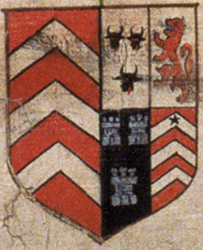
Every so often, a figure steps out of the Tudor murk with enough documentation to feel almost modern. For me, Thomas Morgan of Tredegar is one of those rare Welsh ancestors who doesn’t exist as a rumor or a scribble on a pedigree roll, but as a man who held real power in a county where power usually meant “whichever marcher lord rode through last.”
Thomas Morgan (c.1534–1603) belonged to the Morgans of Machen and Tredegar—one of those long-rooted families that managed to survive the medieval world, adjust to the Tudor one, and emerge wealthier on the other side. He inherited Machen, gained Tredegar from a cousin who died at sea, and then set about becoming the kind of man royal officials depended on1.
By the late 1500s, Thomas held just about every title Monmouthshire could give him. Justice of the Peace. High Sheriff. Deputy Lieutenant. And in 1588, Member of Parliament for the county2. These weren’t ceremonial posts. Tudor government relied on a handful of local gentry who could be trusted to keep the peace, raise militia companies, and enforce the Crown’s will without upsetting too many neighbors. Thomas excelled at that job.
His household was large—very large. Contemporary sources give him nine sons and thirteen daughters. Tudor Wales didn’t produce many family trees with that kind of demographic ambition, and the marriages that followed ripple across the region for generations.
One of those marriages matters particularly to me.
Thomas Morgan was the father-in-law of William Blethyn, son of Bishop William Blethyn of Llandaff—the Welsh bishop who spent the Elizabethan era trying to hold together a poor diocese on the edge of the kingdom. That claim would draw the Blethyn line directly into the orbit of one of Monmouthshire’s most influential Tudor families — offering a firmer shape to a branch of my own lineage that often hides behind fractured manuscripts and uncertain oral memory. I have not found a sufficiently dependable primary or archival source that confirms this marriage — the main compiled archives of the Morgan family do not definitively record it3.
Tredegar itself hadn’t yet become the grand Restoration house we picture today. In Thomas’s lifetime it was still a rising estate, a place being built—literally and politically—by a family determined to turn land into status and status into legacy. He succeeded. His son, Sir William Morgan, carried the Tredegar estate into the next century, but the foundation was Thomas’s work.
That’s what makes a figure like Thomas Morgan satisfying to write about. He is not a distant shadow or a half-mythical ancestor. He is a man whose recorded decisions shaped a region — and whose family lines, including (possibly) Blethyn, carry his legacy forward. In the fragmented world of Tudor Wales, that kind of documentary clarity is a gift.
If the past is a landscape, Thomas Morgan stands on one of its ridges: visible, documented, and still casting shadows that reach into the present.
