
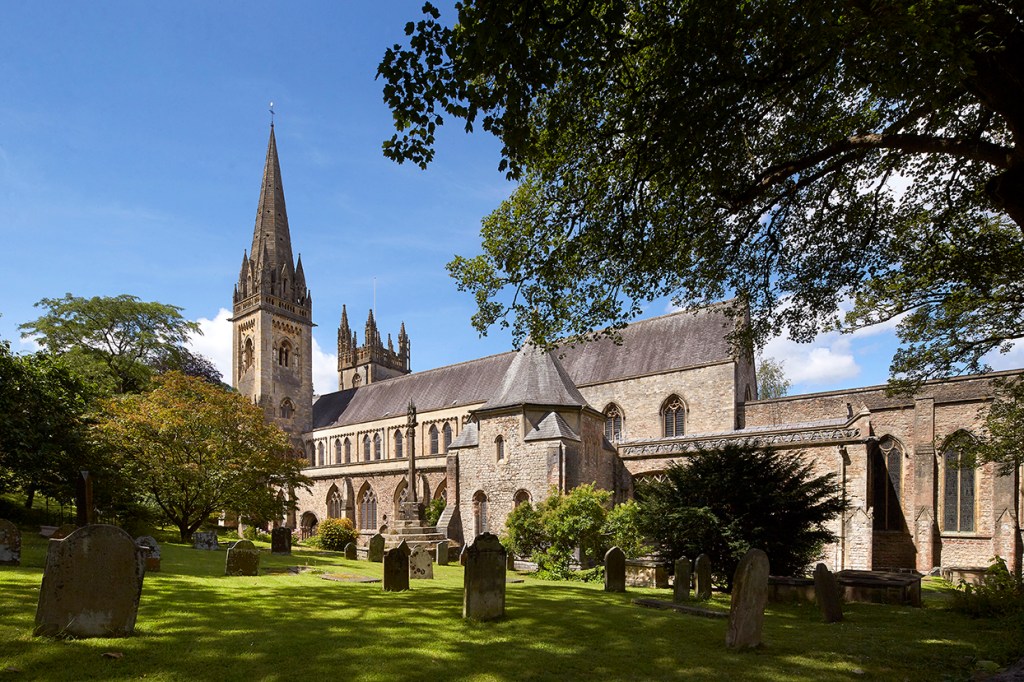
Llandaff Cathedral is, in my mind, one of Wales’s most quietly compelling monuments — a place that tells its story not in a single grand flourish, but in layers of survival, damage, and intentional repair. It’s not just a building; it’s a chronicle of Welsh faith, politics, and the tenacity of the people who kept it standing.
Origins and Medieval Foundations
The site of Llandaff Cathedral has ancient roots. According to cathedral tradition, there was a Christian presence here as early as the sixth century, tied to saints like St. Teilo and St. Dubricius1.
The present building began to take shape around 1120, under Bishop Urban2. The sculptural roundels in the sanctuary arch date to this Norman re-foundation and recall how deeply the medieval cathedral reaches into its earliest form. Over the following century, successive bishops continued shaping the cathedral: for example, Henry of Abergavenny built the early Gothic west front, and William de Braose (bishop in the late 1200s) added the Lady Chapel3.
Decline, Ruin, and Blethyn’s Stewardship
Llandaff’s story is not one of unbroken grandeur. Over time — especially after the Reformation and under Henry VIII — the cathedral’s finances collapsed4. Pilgrimage revenues dried up, and the building fell into disrepair5. By the 17th century, during the English Civil War, parts of the cathedral were reportedly repurposed for secular use: pubs, stables, and even a cowshed4.
Into that difficult context stepped William Blethin (Blethyn), Bishop of Llandaff from 1575 until his death in 1590. The Dictionary of Welsh Biography describes him as a strong administrator, someone who put in place statutes not only for worship but for the care of cathedral property, records, and its fabric6. His choice to hold other ecclesiastical livings, out of necessity, speaks of the poverty of the see — but also of his commitment: he simply could not let the cathedral collapse.
Still, the building’s physical decline continued: storms in the early 1700s brought further damage. A south-west tower fell in 1723, and more of the nave roof gave way4.
The Eighteenth- and Nineteenth-Century Rebuildings
In the 1730s, an attempt was made by John Wood the Elder (of Bath) to restore part of Llandaff — but he did so in an “Italian temple” style that many later generations would regret. The nave remained mostly ruinous while the east end was refashioned classically. It was in the 19th century, however, that Llandaff Cathedral was more fully rescued. Under John Prichard (and John Pollard Seddon), the Victorian restoration revived the Gothic character of the building, erased most of Wood’s classical experiment, and added a new south-west tower and spire in 1867–693.
Wartime Destruction and Post-War Resurrection
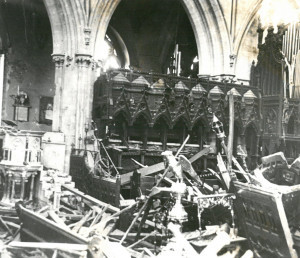
The darkest chapter may have come on 2 January 1941, during the Cardiff Blitz, when a German parachute mine struck near the cathedral. t caused catastrophic damage: the roof of the nave, south aisle, and chapter house collapsed; the chapter house itself was badly harmed; many internal furnishings—including the organ, choir stalls, and pulpit—were destroyed7.
Incredibly, despite the devastation, worship continued in makeshift spaces: first in the Deanery, then in the Lady Chapel and sanctuary, as temporary roofs were erected7. But real restoration could not begin in earnest until after the war.
That restoration was led by George Pace, who adopted a remarkably honest philosophy: repair what remained, but where new work was needed, let it speak of its own time7. His interventions include a monumental concrete arch (the “Majestas Arch”) across the nave/choir divide, topped by Sir Jacob Epstein’s Christ in Majesty (an aluminum sculpture), which remains one of the cathedral’s most striking features8.
He also designed the Welsh Regiment (St David) Chapel, memorializing those lost and wounded in later wars7. The full re-consecration was marked in 1960 by a national service attended by Queen Elizabeth II and Prince Philip8.
Stones, Stories, and Significance
Walking through Llandaff Cathedral today is like reading a palimpsest of Welsh history. The Norman sanctuary arch, the Gothic chapels, the Victorian tower, the modern concrete and bronze — each layer listens to and argues with the others.
Its stonework is itself testimony: the medieval parts use Somerset Dundry stone, while much of the later (post-Reformation) work is done in Welsh blue lias. The restored roofs use slate and lead, and the reconstruction leaned into Pennant sandstone, tying the post-war fabric to local geology9.
Inside, among the architectural features, you’ll also find artistic treasures: a triptych by Dante Gabriel Rossetti, originally made as a reredos, now relocated to the St Illtyd Chapel; stained-glass work by Edward Burne-Jones; design by William Morris; and many others10.
Why Llandaff Matters — In the Context of the Blethyn Story
For anyone tracing the story of William Blethyn (or Blethin), Llandaff Cathedral is not just a backdrop. It is part of the landscape through which his life and responsibilities moved. Blethyn wasn’t a transient churchman who happened to occupy the bishop’s chair; he inherited a chronically underfunded Welsh see and tried to hold it together in an era when simply maintaining a cathedral was an act of endurance. His statutes on governance and record-keeping weren’t abstract decrees. They were survival strategies for a diocese that had very little margin for error.
His tenure sits in that uneasy Elizabethan period when Welsh ecclesiastical life was stretched thin, and yet his records show a man working to preserve continuity where almost everything else was in flux. It’s a reminder that institutional stability is rarely the work of monuments or grand reforms. More often, it comes from patient caretaking — the kind that never earns a monument but without which the monuments collapse.
Llandaff itself tells the same story. Its ruins, restorations, and the blunt scars left by the Blitz form a kind of architectural genealogy. The building shows what many family histories quietly teach: that continuity survives not because everything goes right, but because generations keep repairing what is handed to them. The cathedral’s endurance mirrors the work of genealogy — a practice rooted not in perfection, but in persistence, fracture, and renewal.
Sources:
- https://www.nationalchurchestrust.org/sites/default/files/2020-07/ChildrensTrailCARDIFFLlandaffCathedral%28TheArtsSociety%29.pdf ↩︎
- https://www.nationalchurchestrust.org/church/llandaff-cathedral-llandaff ↩︎
- https://www.llandaffcathedral.org.uk/discover-the-cathedral/history-of-the-cathedral ↩︎
- https://medievalheritage.eu/en/main-page/heritage/wales/llandaff-cathedral ↩︎
- https://www.caerdydd.gov.uk/ENG/resident/Planning/Conservation/Documents/Draft%20Llandaff%20CA%20Appraisal.pdf ↩︎
- https://biography.wales/article/s-BLET-WIL-1590 ↩︎
- https://www.llandaffcathedral.org.uk/discover-the-cathedral/history-of-the-cathedral/cardiff-blitz-1941 ↩︎
- https://www.anglicannews.org/news/2016/01/commemoration-marks-75-years-since-cathedral-bomb.aspx ↩︎
- https://structurae.net/en/structures/llandaff-cathedral ↩︎
- https://www.patrickcomerford.com/2021/11/praying-in-ordinary-time-2021-175.html ↩︎
