
The Bumper Sticker That Started It
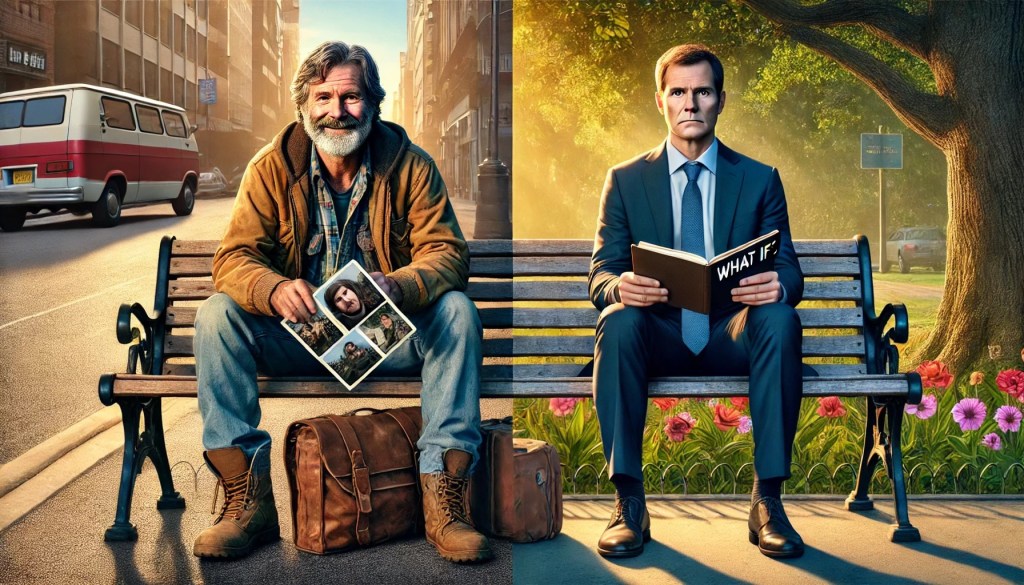
A quip I posted a while back popped up on a social media feed as a memory today, alongside a picture I’d had AI generate of a “has-been” and a “never-was.” The post referenced a minivan I’d pulled up behind at lunch, with a bumper sticker declaring, “I used to be cool.” Meant to be cute and self-deprecating, maybe even relatable, it stuck with me longer than it should have—and not for the reason the driver probably intended.
If you used to be something—cool, reckless, brave, foolish—you’re already miles ahead of the folks who never risked becoming anything at all. A has-been carries stories. A never-was carries excuses.
Growing Up on the Rough Edges
My own has-been résumé is full of dented pride and questionable choices. I grew up skirting the edges of trailer parks and rental houses—the kind of places where dogs roamed loose and every other kid had a scar for show-and-tell. As a teenager, I was a skater. Not a good one—gravity ensured that—but I tried.
The first ramp I ever dropped in on was tucked behind an old trailer park, owned by a guy running a sketchy little skate “shop” out of a spare room in his single-wide. On that first time on a ramp, I leaned too far forward, splattered at the bottom like a cartoon coyote. I broke boards, face-planted, and got speed wobbles. I got hit by a car once and bitten by a dog later the same afternoon. On another occasion I held onto the bumper of a motorcycle before letting go in fear and exhilaration. Later, my mom moved us way out into the country where there wasn’t even concrete to skate on. I found a patch of sun-baked dirt hard enough to mimic pavement and used it to practice tricks until my bearings were clogged with dust. After a summer there, we moved back a little closer to civilization. My time as a skater faded away after I began driving.
As the reality of limited future opportunities hit me, I enlisted in the Army National Guard at seventeen—the kind of decision that feels bold when you’re a kid and heavy when you look back decades later. I went to Basic Training in the Split Option program and graduated the week before my senior year started. Two weeks after graduation, while most of my friends were enjoying their last summer of youth, I was in radio school at Fort Gordon, Georgia, to complete my training. After six years of weekends in the Guard, I was honorably discharged at the ripe old age of twenty-three. The Army gave me structure, purpose, and a few hard edges, but it never shook loose the restless streak that kept me testing the limits of my own momentum. That was over half a lifetime ago.
Life moved on. I still own a skateboard, though now my kids get more use out of it than I do. The last half of my life was spent working as a defense contractor before (what my wife affectionately calls my midlife crisis) I changed careers and began teaching college full-time. Those years, with all their routines, responsibilities, and small victories, have shaped me—but they didn’t erase the lessons I learned by falling flat on my face, by trying and failing, by daring to live with a few scrapes and bruises along the way.
The Has-Beens
That’s the heart of being a has-been: we didn’t grow up shielded. We grew up scraped, bruised, stubborn, and fueled by adrenaline and questionable decisions. We learned by hitting the ground, getting back up, and pushing until something broke—sometimes the board, sometimes our pride.
Every bit of that chaos had a soundtrack. The pulse of heavy metal, the swagger of early rap, the scrappy edge of ’90s alternative—those were the voices that raised me. I remember a young Everlast commanding us to Jump Around, and years later a middle-aged, mellow Everlast seemingly asking if we still wanted to. Rage Against the Machine eventually drifted into Age Against the Machine, both inevitable and ironic, given they’d become rich by praising anti-capitalism. Time sands everything down, even the bands we once treated like prophets. But back then? Back then, the music felt like a second nervous system. Now those songs are being rediscovered by folks who didn’t live them and struggle to understand the context. Master of Puppets still hits as hard today as it did nearly fourty years ago—but now the members of Metallica are reaching AARP age.
The Never-Wases
The never-wases, though… that’s a different story.
Some people cultivate experiences without ever fully engaging in them. They sip oat-milk lattes while debating the aesthetic of reissue skateboards they’ve never rode, snap photos of street art they’ve never climbed to reach, and nod along to playlists they’ve never blasted through torn speakers in a cramped basement. Where the has-been had to feel grime under their nails and concrete against their knees—thanks in part to absentee or hands-off parents who let us roam—these “never-wases” were often raised with precision, every risk assessed, every scrape prevented by parents hovering nearby. They’ve perfected performing a lifestyle without risking living it.
The never-was doesn’t stop at curated experiences—they curate appearances too. Flannel shirts, meticulously trimmed beards, boots laced for maximum effect, and a ruggedness they’ve never earned. They look like they could fell a tree with a single swing of an axe, yet the closest they’ve come is photographing someone else’s firewood for Instagram. In a world where every mistake can be broadcast and dissected online, the stakes of trying anything real feel enormous. It’s all image, all style, and none of the raw, callused strength that comes from swinging the axe yourself.
It’s not a moral flaw. It’s just what happens when potential never meets friction. The never-was doesn’t suffer from FOMO—the fear of missing out—they suffer from FOFO: the fear of finding out. The risks of trying, failing, and learning feel too high, so they often don’t even take the plunge. Opportunities are measured against imagined consequences, and every risk is reason enough to stand still. Safety and polish replace the scrapes, bruises, and stories that shape those who dare.
A Word for Younger Generations
You’re growing up in a world obsessed with perfection and appearances—often choreographed and fake. Everything is polished, documented, optimized, and shareable. But that’s not where life happens. That’s not where stories are made. Life happens in the gaps, in the mistakes, in the moments that aren’t captured for likes or views. It’s in trying the things that scare you, failing, and trying again. It’s in the scratches on your favorite notebook, the torn shoes from running too fast, the friendships forged through shared mistakes and laughter.
Don’t be afraid to get messy, to look ridiculous, or to try something that might not work. Learn to measure progress by what you’ve dared to do, not how it looks on a screen. Build ramps out of whatever scraps you can find. Skate on dirt if you have to. Write bad songs, code terrible apps, paint over the lines, fall flat on your face, and then get up and try again. And sometimes—just sometimes—leave the phone behind. Step away from notifications, the endless scroll, the pressure to perform online. There’s a kind of magic in being fully present, in feeling the wind on your face or the sting of scraped knees without filtering it for an audience.
The point isn’t just to have stories—it’s to be the kind of person who can have them. You’ll discover resilience, creativity, and grit you didn’t know you had. And someday, those bruises, failures, and late-night epiphanies will be the stories you pass on, the evidence that you dared to live, and the memories that make your life unmistakably yours.
Step off the curb. Build something real. Take the plunge. Live unfiltered. Leave your phone in your pocket—or on the charger. The world doesn’t need more perfect people. It needs more people who live, who fail, who laugh, and who keep going. Be one of those people. Aspire to become a has-been worth telling stories about.
