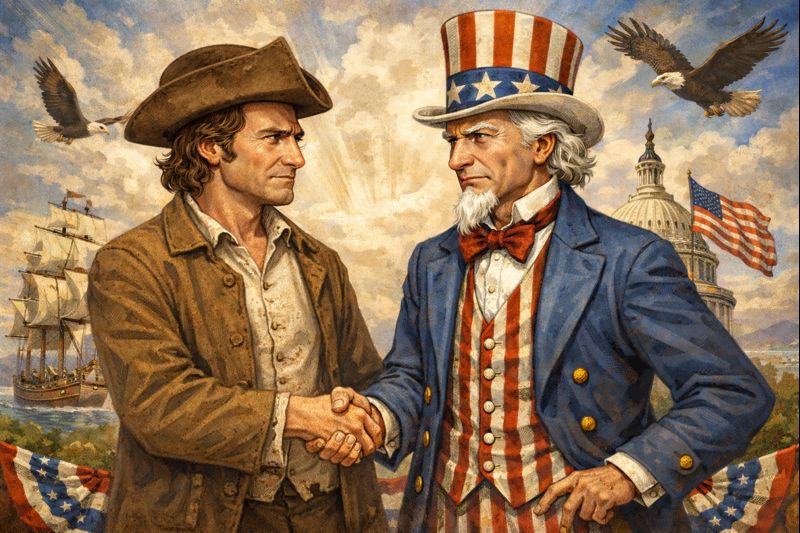
Uncle Sam is not your neighbor. He never was.
He points, he commands, he recruits. He appears when taxes are due, when wars begin, when authority needs a face. For more than a century, Americans have treated this as natural — as if the republic itself could only be imagined as a stern, aging uncle issuing orders from afar.
But America did not begin with an uncle. It began with a brother.
Before Uncle Sam monopolized the nation’s symbolic imagination, Americans personified themselves as Brother Jonathan — not a government official in human form, but a citizen. He was familiar rather than fearsome, sharp rather than solemn, and grounded in local life. Brother Jonathan did not speak for the state; he spoke back to it. Where Uncle Sam would later embody centralized authority, Brother Jonathan represented the American people in their towns, churches, militias, workshops, and meeting halls — skeptical of power, confident in self‑government, and allergic to distant control. Historians trace Jonathan’s emergence to the Revolutionary era, when American writers and cartoonists sought a native counterpart to Britain’s John Bull, using a common biblical name to signify the colonies themselves rather than any formal institution1,2.
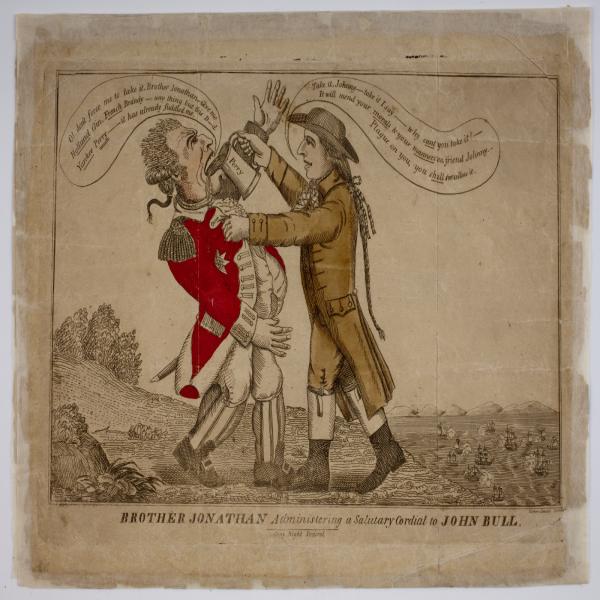
Early depictions from the late eighteenth and early nineteenth centuries show Brother Jonathan lean, plainly dressed, and quick‑witted. In political cartoons from the War of 1812, he spars verbally and symbolically with John Bull, representing a young republic that relied more on ingenuity than brute force. Unlike later national personifications, Jonathan is rarely elevated or monumental; he remains recognizably human, rooted in local custom and regional identity.
Uncle Sam’s rise followed a different path. The name appears during the War of 1812, commonly associated with Samuel Wilson, a New York meat supplier whose barrels stamped “U.S.” were jokingly said to belong to “Uncle Sam.” Whether apocryphal or not, the story reflects the truth of Sam’s origins: he emerges from logistics, supply chains, and the expanding apparatus of the federal state3. By the 1830s and 1840s, cartoonists increasingly used Uncle Sam as a shorthand for the national government itself, sometimes alongside — and eventually in place of — Brother Jonathan.
The shift accelerated as the nineteenth century wore on. Industrialization, territorial expansion, and the demands of national coordination favored a symbol that could speak with a single, authoritative voice. Brother Jonathan, tied to localism and regional autonomy, struggled to scale. The Civil War proved decisive. Mass mobilization, taxation, and centralized command reshaped the American state, and Uncle Sam flourished in this environment. By the time illustrator Thomas Nast standardized Sam’s visual features in the late nineteenth century, Jonathan had largely vanished from popular imagery1,2.
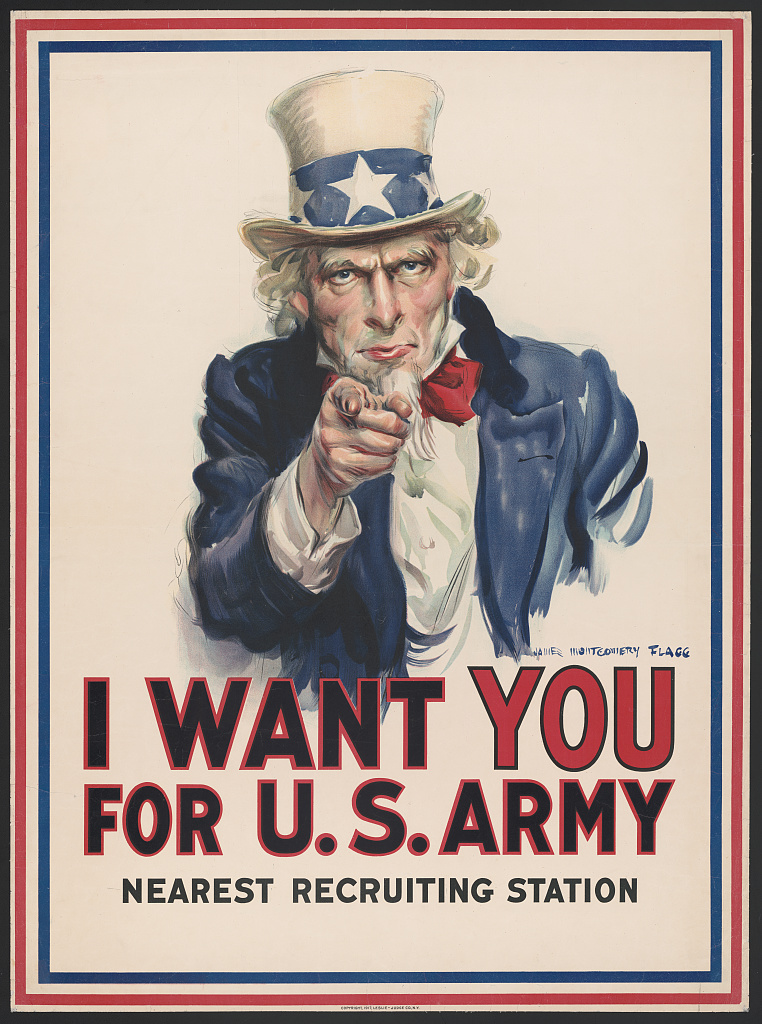
James Montgomery Flagg’s 1917 “I Want YOU” recruitment poster completed the transformation. Uncle Sam no longer merely represented the government; he commanded the citizen directly. The image fixed Sam as an enduring symbol of national authority, recognizable worldwide. Brother Jonathan survived only in historical footnotes and antique prints — a relic of an earlier civic imagination.
This evolution was not merely artistic. Symbols shape how people understand power. Replacing a neighborly brother with a commanding uncle mirrored America’s transition from a loose federation of communities into a centralized, global power. The change brought strength, reach, and coordination — but it also widened the distance between citizens and authority.
When Disaster Reveals the Difference
When hurricanes flood the Gulf Coast, ordinary citizens often mobilize before federal systems fully engage. In the aftermath of Hurricane Harvey, hundreds of spontaneous volunteer rescuers — many identifying themselves under the banner of the Cajun Navy — launched small boats from backroads and boat ramps into flooded neighborhoods, saving lives and evacuating people who might otherwise have waited hours for official help. A U.S. Naval Institute Proceedings article on disaster response specifically highlighted these spontaneous responders for the value they add, noting that such volunteer groups can operate more quickly and flexibly in the earliest moments of a crisis than large centralized agencies often can4,5.

The Cajun Navy is Brother Jonathan in practice. No uniforms. No bureaucracy. Just proximity, competence, and obligation. This does not negate the importance of FEMA or other federal agencies. FEMA represents Uncle Sam at his most characteristic: national scale, standardized procedures, and legal authority. Those qualities are essential for long‑term recovery and resource coordination. But they are also necessarily slow and impersonal.
The tension between the Cajun Navy and FEMA is not a morality tale. It is a lesson in balance. Uncle Sam brings reach and resources that Brother Jonathan cannot marshal alone. Brother Jonathan brings speed, trust, and situational awareness that Uncle Sam cannot manufacture from Washington. A healthy republic requires both.
The case for restoring Brother Jonathan to the national conscience is not a call to abolish institutions or romanticize the past. It is a reminder that civic legitimacy does not originate solely in offices and agencies. It arises from relationships, shared risk, and local responsibility. Brother Jonathan symbolized an America where authority flowed upward from communities rather than downward from abstractions.
In an era of algorithmic governance, permanent emergency, and ever‑expanding administrative systems, the absence of Brother Jonathan is keenly felt. Citizens increasingly encounter government as paperwork rather than people, compliance rather than conversation. Reintroducing Jonathan — in civic art, education, and imagination — would restore an older American instinct: that self‑government begins close to home.
Uncle Sam won because America needed scale, unity, and power. Brother Jonathan faded because he represented limits — on authority, ambition, and distance. Those limits were once understood as virtues. Remembering Brother Jonathan does not weaken the republic. It humanizes it.
America does not need fewer symbols. It needs better balance. An uncle may still speak for the nation, but a brother must speak for the people — or the conversation collapses into command alone.
References
- Tensley, B. (2023, September/October). Meet Brother Jonathan, the predecessor to Uncle Sam. Smithsonian Magazine. https://www.smithsonianmag.com/history/meet-brother-jonathan-the-predecessor-to-uncle-sam-180982818 ↩︎
- Library of Congress. (n.d.). John Bull and Uncle Sam: Four centuries of British-American relations. https://www.loc.gov/exhibits/british/ ↩︎
- Encyclopaedia Britannica. (n.d.). Uncle Sam. https://www.britannica.com/topic/Uncle-Sam ↩︎
- Pelican State of Mind. (2022, August 29). Heroes of hardship: Origins of the Cajun Navy. https://pelicanstateofmind.com/louisiana-love/heroes-of-hardship-origins-of-the-cajun-navy/ ↩︎
- Milliken, B. (2019, September). Spontaneous responders add value. Proceedings, 145(9). U.S. Naval Institute. https://www.usni.org/magazines/proceedings/2019/september/spontaneous-responders-add-value ↩︎

2 thoughts on “Brother Jonathan And Uncle Sam: Two Faces Of American Identity”