
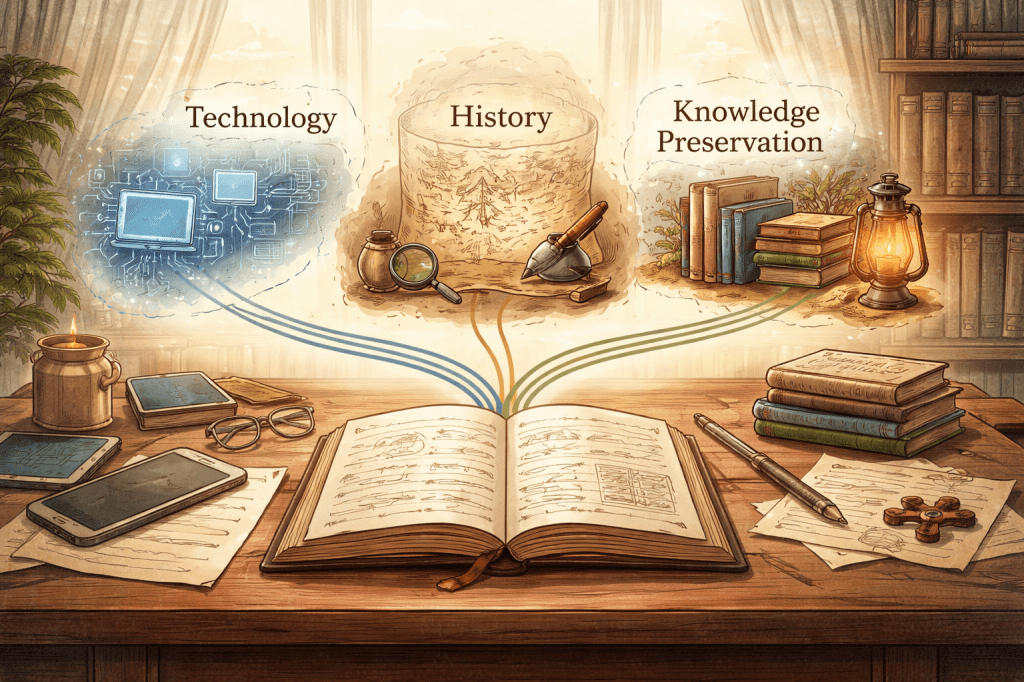
For the past year this site has explored a number of overlapping themes—technology, trust, history, genealogy, and the strange ways information moves through human systems. As the archive grows, a clearer structure has started to emerge.
Going forward, posts will generally follow a simple weekly rhythm.
Technology and Trust Systems
Sunday evenings will focus on technology, institutions, and the systems that shape modern civilization. These essays explore questions about information, trust, cybersecurity, and the fragile infrastructure that allows complex societies to function. Recent pieces such as Information as a Weapon and Credentialed and Unprepared: Systems, Persistence, and the Slow Education of a Practitioner sit squarely in this stream.
History and Genealogy
Midweek posts will move in a different direction. Wednesdays will focus on historical and genealogical research, particularly the ongoing work surrounding the William Blethyn Pedigree Roll and related historical material. These posts look more closely at manuscripts, lineage records, and the documentary fragments that connect the present to the medieval past.
At first glance these subjects may seem unrelated. One deals with modern networks and digital systems; the other with parchment rolls and family lineages recorded centuries ago. Yet both fields revolve around the same underlying question: how societies preserve and transmit trustworthy information across generations. Medieval pedigree rolls functioned as a kind of identity infrastructure for their world, just as modern networks attempt to do for ours.
RetroVersion.net
Alongside these two streams, I have also begun work on a related side project called RetroVersion. This project explores a different but connected question: if modern civilization experienced a catastrophic disruption, what knowledge would communities need in order to rebuild functioning systems?
RetroVersion is not intended to be a “prepper” project focused on stockpiling supplies. Instead, it asks a quieter and more difficult question about knowledge preservation. Which books, manuals, and technical references would be essential for helping a community bring critical capabilities back online—agriculture, medicine, engineering, communication, governance—if the systems we currently depend on were suddenly unavailable?
Modern civilization runs on layers of accumulated knowledge that most of us rarely see. RetroVersion is an attempt to think carefully about which parts of that knowledge infrastructure are most important to preserve.
JeremyBlevins.com will continue exploring the broader philosophical and historical questions that surround information, trust, and human systems. RetroVersion.net will serve as a laboratory for thinking more concretely about how knowledge itself might survive periods of disruption.
Separating these themes into distinct projects should make the work easier to follow while allowing each line of inquiry to develop more clearly.
