
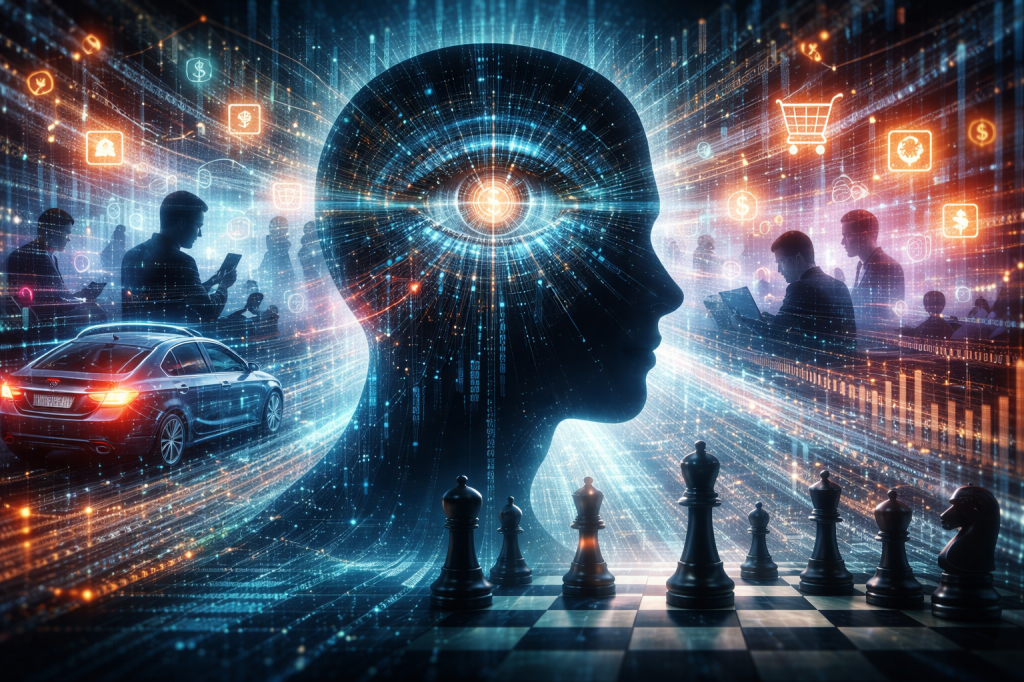
Every semester in one of my cybersecurity courses, I assign my students a short article from 1997 titled Information as a Weapon1. After they finish reading it, I ask them a simple question: Is this article still relevant today?
The reaction is usually predictable. The paper was written before social media, before ransomware gangs, before smartphones, and long before artificial intelligence began generating convincing phishing emails. In technological terms, it belongs to another era.
At first glance, it feels obsolete.
But as the discussion unfolds, the room begins to shift. The article turns out not to be about technology at all. It is about something far older—and far more unpredictable: how human beings interpret information.
When Information Became a Weapon
In the 1990s, as digital networks began connecting governments, militaries, and businesses around the world, strategists began asking whether information itself could become a weapon. If communications systems carried orders, intelligence, and coordination, then disrupting those systems might cripple an opponent. Instead of destroying infrastructure, you could disrupt decision-making. Instead of bombs, perhaps you could deploy data.
Some theorists even imagined something remarkable: victory without violence.
That idea, of course, is much older than the internet. More than two thousand years ago, Sun Tzu wrote that the supreme art of war is to subdue the enemy without fighting2. Information warfare seemed to offer a modern path to that ancient aspiration. But the more I read about the subject, the more I suspect the promise was misunderstood.
Messages Are Not Missiles
The difficulty with treating information as a weapon is that information does not behave like one. A missile follows a trajectory. It strikes a target. The result can be measured. Information behaves more like conversation. It travels through human minds—through assumptions, fears, expectations, and misunderstandings. A message that clarifies a situation for one person may confuse another. A false report might paralyze a decision-maker, or it might simply be dismissed.
Which is why the observations of Carl von Clausewitz still feel strangely modern. Clausewitz wrote about friction and the fog of war—the stubborn uncertainty that clings to every conflict3. Technology may change the tools we use. It rarely eliminates confusion.
The Myth of the Silver Bullet
Much of the excitement surrounding information warfare in the 1990s rested on a familiar technological fantasy: that a new capability might provide a clean solution to an old problem. In American English we sometimes describe that hope with the phrase silver bullet. The phrase comes from old folklore about werewolves. If ordinary weapons could not defeat the creature, perhaps a silver bullet could. Over time the metaphor evolved into shorthand for a perfect technological solution.
Serious strategists tend to use the phrase differently. They use it as a warning. There are rarely silver bullets.
When Translation Changes Meaning
I first encountered the article Information as a Weapon at a conference where I had the opportunity to speak with its author, now Dr. YuLin Bingle. During our conversation she mentioned something that has stayed with me ever since.
In 1999, two Chinese PLA Air Force colonels—Qiao Liang and Wang Xiangsui—published Unrestricted Warfare4. The book explored the idea that modern conflict might extend far beyond traditional battlefields into finance, law, media, and information systems. But somewhere along the way, a metaphor changed. The English phrase silver bullet had been translated into Chinese as magic weapon. The difference may sound small, but culturally it carries a different weight. In English strategic writing, a silver bullet often signals skepticism. In Chinese political rhetoric, a magic weapon suggests a decisive advantage. The same idea crossed languages and came back meaning something slightly different.
More than twenty-five years have passed since Unrestricted Warfare was published. In that time we have watched disinformation campaigns, influence operations, and algorithmically targeted persuasion spread across digital networks around the world. And yet it often feels as though we are still not paying very close attention. Which, in a quiet way, demonstrates the argument of the original article.
Information rarely arrives unchanged. It arrives interpreted.
The Real Battlefield
Where information warfare becomes powerful is not in breaking systems but in influencing people. A phishing email persuades someone to click a link. A manipulated dataset changes how leaders interpret events. A rumor spreading through an organization can slow an incident response faster than malware.
The battlefield, in these cases, is not the network. It is the human mind.
Cybersecurity professionals discover this quickly. Firewalls, encryption, and monitoring systems are necessary defenses, but they do not eliminate the oldest vulnerability in computing.
Human judgment
Popular culture has occasionally captured this idea better than technical writing. In The Matrix, humanity unknowingly lives inside a simulated reality designed to shape what people believe is real5. The story is science fiction, but the metaphor is familiar. Most influence operations do not need to fabricate an entire artificial world. They only need to alter a few assumptions—what we believe about events, institutions, or one another.
Another film approaches the same idea from a different direction. In They Live, a drifter played by Roddy Piper discovers a pair of sunglasses that reveal hidden messages embedded in everyday advertising6. The movie exaggerates the idea for dramatic effect, but the underlying observation feels strangely contemporary.
Influence often hides inside ordinary messages.
Distorting the Decision Cycle
The dynamic becomes clearer through the work of John Boyd, who described conflict as a contest of decision cycles known as the OODA Loop7. Success often depends on moving through this cycle more effectively than an opponent. Information attacks do not necessarily need to destroy systems to be effective. They only need to distort the cycle.
False alerts disrupt observation. Misleading data corrupts orientation. Confusion delays decisions. Rumors interfere with action. The result is not always catastrophic failure. More often it is hesitation.
When the Battlefield Is the Consumer
The weaponization of information does not remain confined to warfare. It increasingly appears in everyday economic life. Modern economies run on the quiet buying and selling of personal data. Every search query, loyalty card swipe, smartphone app, and website visit contributes to a growing profile used to shape behavior. Advertising has gradually shifted from broadcasting messages to influencing individuals. In a sense, the commercial world has adopted its own form of information warfare.
Sometimes the effects are trivial—advertisements that follow you around the internet after a single search—but occasionally the consequences become more serious.
Modern vehicles are essentially rolling computers. They collect detailed telemetry about how people drive: acceleration patterns, braking behavior, location data, and trip distances. Recent lawsuits have alleged that some automakers collected this data and shared it with brokers who then sold it to insurance companies. Drivers have claimed the result was increased premiums or even canceled policies based on information they never realized their cars were transmitting8. The lawsuits are still unfolding, but the situation raises an uncomfortable question.
If information can be weaponized against adversaries in war, what happens when similar techniques are used in everyday commerce?
Still Relevant
So when I ask my students whether a 1997 article about information warfare remains relevant today, the discussion usually begins with skepticism. The technology described in the article feels dated. But as the conversation unfolds, the room grows quieter, because the deeper ideas in the article do not feel dated at all.
Sun Tzu wrote that victory often comes from shaping the enemy’s perception. Clausewitz reminded us that confusion and uncertainty haunt every conflict. John Boyd showed how disrupting an opponent’s decision cycle can determine the outcome of a struggle. The digital age has not replaced those ideas. It has simply accelerated them.
Information now moves faster, spreads farther, and reaches deeper into daily life than any previous generation of strategists could have imagined. Yet it still passes through the same fragile filter it always has.
Human interpretation
When the conversation in class winds down, students often reach a conclusion that surprises them. The article is still relevant. Not because it predicted our technology, but because it recognized something about people.Information does not become powerful when it enters a network. It becomes powerful when someone believes it, and if that is true, then the most important battleground of the information age may not be cyberspace at all. It may simply be the human mind trying to decide what is real.
References
- YuLin G. Whitehead, “Information as a Weapon: Reality Versus Promises,” Airpower Journal 11, no. 3 (Fall 1997): 40–54. Available at Air University:
https://www.airuniversity.af.edu/Portals/10/ASPJ/journals/Volume-11_Issue-1-4/1997_Vol11_No3.pdf ↩︎ - Sun Tzu, The Art of War, trans. Samuel B. Griffith (Oxford: Oxford University Press, 1963) ↩︎
- Carl von Clausewitz, On War, ed. and trans. Michael Howard and Peter Paret (Princeton, NJ: Princeton University Press, 1976) ↩︎
- Unrestricted Warfare by Qiao Liang and Wang Xiangsui (Beijing: PLA Literature and Arts Publishing House, 1999). English translation widely circulated through U.S. defense study programs. https://www.c4i.org/unrestricted.pdf ↩︎
- The Matrix, directed by Lana and Lilly Wachowski (Warner Bros., 1999). ↩︎
- They Live, directed by John Carpenter and starring Roddy Piper (Universal Pictures, 1988). ↩︎
- John Boyd, “The Essence of Winning and Losing,” briefing slides and lecture series, 1995. Reproduced in several defense studies archives including the Project on Government Oversight Boyd collection ↩︎
- Federal Trade Commission, “FTC Finalizes Order with General Motors Regarding Collection and Sale of Drivers’ Geolocation and Driving Behavior Data,” Federal Trade Commission Press Release, January 2026.
https://www.ftc.gov ↩︎

One thought on “Information as a Weapon”