
Walk into any medieval manuscript or early armorial roll, and you might do a double-take: King Arthur’s shield, a harp-bearing King David, or a double-headed eagle for Charlemagne. How could these figures — many centuries before heraldry existed — have a coat of arms? The answer lies in a fascinating medieval practice: attributed arms.
What Are Attributed Arms?
Attributed arms, sometimes called imaginary arms, are coats of arms assigned retrospectively to historical, biblical, or mythological figures who never actually bore them. Heralds and chroniclers in medieval England and Europe created these arms to visualize the past in the symbolic language of their own time.
These assignments were more than decoration. They expressed continuity, legitimacy, and moral ideals, turning legendary figures into tangible symbols within a society increasingly structured around heraldic identity.
Why Were Arms Attributed?
Several motivations drove the practice:
- Continuity and legitimacy. Nobility and royal houses sought to link themselves to heroic ancestors — real or imagined. Assigning arms projected the notion that heraldry had always existed.
- Romance and literature. Arthurian legends, the Nine Worthies, and chivalric romances provided rich material. Heralds transformed these stories into heraldic symbols.
- Artistic expression. Manuscript illuminators, tapestries, and rolls of arms needed visually compelling imagery; attributed arms solved this problem elegantly.
- Symbolic meaning. Each charge (a harp, lion, eagle, or crown) carried a carefully chosen message, tying the figure to virtues, power, or piety.
Attributed Arms in the William Blethyn Pedigree Roll
The William Blethyn Pedigree Roll, a genealogical manuscript preserving Welsh lineages, offers a fascinating glimpse of this practice in action. Like many medieval genealogies, it does more than record descent. It visually situates legendary and historical figures within the heraldic imagination of the age.
Among the figures appearing in the roll are several whose arms appear to be symbolic or retrospectively assigned rather than historically attested. Names such as Meuric, son of Tewdrick, King of Morganwg, Corenny hir Lydanwyn, and even the legendary Brutus of Troy appear in the lineage.
For the heralds and chroniclers who compiled such works, the goal was not strict antiquarian accuracy in the modern sense. Heraldry was a living language of identity. Assigning arms to earlier figures allowed them to be understood within that language.
In this way, the manuscript does something quite remarkable. It translates the deep past — part history, part legend — into the heraldic vocabulary of the late medieval world.
Meuric, Son of Tewdrick, King of Morganwg
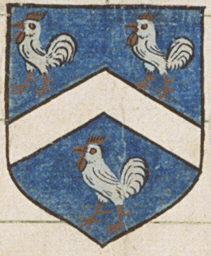
The attribution of arms to figures like Meuric illustrates how genealogy and heraldry intersected with regional memory. Medieval Welsh traditions preserved the names of early rulers and heroes, but later heraldic culture sought to express those identities visually.
A shield could serve as a kind of symbolic shorthand. Through color, charge, and composition, a figure’s story could be condensed into a single emblem. The arms did not claim to reproduce a historical shield carried in battle centuries earlier; rather, they interpreted that figure through the symbolic grammar of heraldry.
This interpretive process was common across medieval Europe. Biblical figures were granted coats of arms. Heroes of antiquity were imagined bearing heraldic devices. Even the great champions of chivalric literature, the Nine Worthies, appeared in armorial rolls with shields that spoke to their virtues and reputation.
In each case, the arms reveal as much about the medieval imagination as they do about the figures themselves.
Looking Ahead
The Blethyn Pedigree Roll preserves several such attributed arms, each one offering a small window into how medieval genealogists visualized the distant past.
In the next installment, we will examine these figures more closely — beginning with Meuric, son of Tewdrick, and the heraldic symbolism attached to his name. By looking carefully at these shields, we can begin to see how heraldry served not only as a system of identification, but also as a way of interpreting history itself.
