
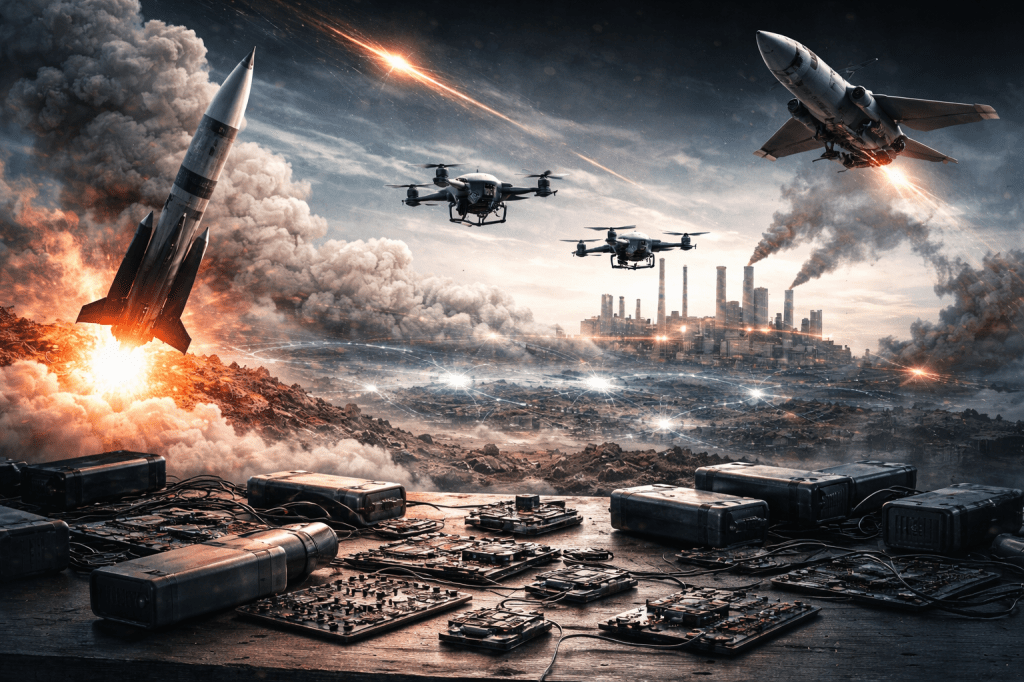
The Price of Interception
Modern warfare has developed a strange economic imbalance. A missile interceptor costing several million dollars may be launched to destroy a drone assembled from a few hundred dollars’ worth of electronics. The exchange is tactically successful yet economically unsettling, revealing how the structure of war may be changing.
In some recent engagements, the imbalance has moved beyond theory into practice. Advanced fighter aircraft and million-dollar interceptor missiles have been used to destroy slow, low-cost drones, often at a pace that strains both budgets and stockpiles. Even successful defenses reveal a deeper problem: the cost of protection may exceed the cost of the threat itself, and the exchange cannot continue indefinitely.1
Nearly a century ago, a retired Marine Corps general offered his own diagnosis of the economic forces behind modern conflict. Smedley Butler titled his short book War Is a Racket and argued that industrial warfare had become an enterprise in which weapons manufacturers prospered while citizens bore the cost.2 Historians have debated the extent of his claim. Wars do not arise from economics alone, and they rarely submit to a single explanation.3 Yet Butler identified a central feature of the twentieth century: warfare had become inseparable from the industrial systems that sustained it.
For much of that century, the pattern held. Advanced weapons demanded enormous investments in engineering, specialized materials, and carefully managed supply chains. The most sophisticated systems emerged from large defense contractors such as Lockheed Martin, RTX Corporation, and Northrop Grumman. When conflict erupted, the battlefield consumed weapons while factories slowly replaced them. President Dwight D. Eisenhower later gave this relationship a name, warning of the growing influence of what he called the military industrial complex.4
Yet something familiar has begun to reappear on modern battlefields: success at a price that cannot be sustained.
Cheap Weapons and Expensive Responses
For most of modern history, advanced military technology concentrated power in wealthy states. Battleships, jet aircraft, and precision missiles required the resources of complex industrial economies.
Inexpensive drones now challenge that assumption. A modern interceptor missile may cost several million dollars, while a drone capable of damaging vehicles or disabling radar installations might cost only a few hundred or a few thousand. The imbalance creates a clear economic asymmetry in which inexpensive systems can force extremely expensive responses.
Recent conflicts have demonstrated this dynamic clearly. In the war between Ukraine and Russia, both sides deploy large numbers of drones assembled from commercially available components.5 Cameras, lithium batteries, microprocessors, and radio transmitters—technologies originally developed for consumer electronics—now appear inside battlefield systems. The global infrastructure that produces smartphones and hobby drones quietly supplies the parts for modern weapons. Analysts increasingly note that the widespread availability of small drones is reshaping the balance between expensive military platforms and inexpensive distributed systems.6
The contrast with traditional weapons manufacturing is striking. A cruise missile may require months or years to produce. A small drone can often be assembled in days. This helps explain why many defense planners are now searching for responses that mirror the economics of the threat. Instead of relying solely on high-end interceptors, they are experimenting with lower-cost systems, drones to counter drones, electronic warfare, and even directed energy weapons. The objective is not simply to win engagements, but to restore balance to the underlying economics of defense.1
From Factories to Networks
Industrial warfare relied on centralized production systems. Battleships required shipyards, jet fighters required aerospace factories, and missiles required specialized contractors operating within carefully managed procurement systems. Military power in this environment reflected the scale and organization of industrial economies.
Drone warfare operates differently. Many drones are assembled in small workshops or local manufacturing facilities where engineers combine commercially available parts into rapidly evolving designs. Software and hardware are modified continuously in response to battlefield experience, allowing new configurations to appear within weeks rather than years. Instead of relying on a small number of massive factories producing complex systems, warfare increasingly draws upon distributed technological ecosystems in which components, designs, and innovations circulate through global networks.
This shift reflects a deeper economic pattern. The Austrian economist Ludwig von Mises observed that economics ultimately concerns human action—how individuals respond to incentives and coordinate their behavior within complex systems.¹⁵ When inexpensive electronic components, open software frameworks, and global supply chains become widely accessible, the structure through which military capability is produced begins to change along with them.
In this sense, the emerging drone ecosystem behaves less like a traditional military procurement system and more like a decentralized process of experimentation and adaptation. Engineers, hobbyists, and small manufacturers iterate rapidly, responding to feedback in ways that large bureaucratic systems often struggle to match. The resulting technologies evolve quickly because the knowledge required to improve them is dispersed across many participants rather than concentrated within a single organization.
The battlefield therefore begins to reflect the economic structure behind it. Industrial warfare concentrated production in large institutions, while networked warfare distributes innovation across many smaller actors connected by shared technological infrastructure.
The Supply Chain as Battlefield
The openness of this system introduces vulnerabilities of its own. Traditional weapons supply chains operate within tightly controlled procurement environments where components are inspected, contractors are vetted, and production processes are carefully monitored. These systems are expensive and slow, but they establish relatively narrow boundaries of trust.
Modern technological systems rely on complex global supply chains that create new opportunities for espionage and disruption.7
Drone ecosystems are far more open. Components originate in global electronics markets, firmware may be open source, and hardware designs circulate widely among engineers and hobbyists. This openness allows rapid innovation, but it also creates opportunities for manipulation.
Recent intelligence operations have demonstrated that electronic supply chains themselves can become instruments of conflict. Reports have described operations in which the intelligence service of Mossad exploited communications devices used by Hezbollah, effectively turning the supply chain into a mechanism for sabotage.
The implication is unsettling. In modern conflict, the battlefield may begin long before a weapon is deployed, emerging quietly inside factories, firmware repositories, and logistics networks where the components of technological systems circulate.
When Information Becomes the Target
Even the most sophisticated military systems are not immune to these pressures. The Lockheed Martin F-35 Lightning II represents one of the most advanced weapons platforms ever developed, integrating stealth materials, advanced sensors, and millions of lines of software code.
Yet investigators concluded more than a decade ago that significant technical information associated with the program had been accessed by cyber intruders widely believed to be linked to the government of China. Soon afterward, China introduced the Chengdu J-20, an aircraft whose configuration suggested that outside insights may have accelerated its development.8,9 U.S. counterintelligence officials have repeatedly warned that foreign intelligence services actively target American technological research and defense programs.10
The episode highlights a subtle transformation. In earlier eras, sabotaging a weapon required altering its physical components. Today it may be far more effective to compromise the information systems that design, manufacture, or operate the weapon.
Design files, firmware repositories, and supply chains have become strategic terrain.
The Fragile Ecology of Trust
These developments point toward a deeper vulnerability within modern technological systems. The global defense industrial base that produces advanced weapons systems remains one of the most complex manufacturing ecosystems ever constructed.11
Modern technological systems function only because vast networks of trust allow them to operate reliably. Engineers trust the components they install in their machines, manufacturers trust the integrity of their supply chains, and operators trust the software that guides complex systems.
These assumptions form an ecology of trust—a network of relationships that allows complex infrastructures to function smoothly. Increasingly, modern conflict targets those ecosystems directly. Supply chains may be infiltrated, firmware manipulated, networks spoofed, and design files stolen. When trust erodes, systems that once appeared robust can suddenly become fragile.
Rethinking Butler
Smedley Butler believed that the danger of modern war lay in the economic power of industrial systems that profited from conflict. The industrial structure he criticized still exists, and modern weapons remain extraordinarily expensive to design and manufacture. Precision missiles, stealth aircraft, and advanced sensor systems continue to depend on complex supply chains and vast manufacturing capabilities.
Yet technological change has begun to introduce new dynamics into that system. Cheap networked technologies such as drones, sensors, and autonomous platforms increasingly rely on distributed technological ecosystems rather than centralized industrial production. Military strategists often describe these transitions as part of broader revolutions in military affairs that reshape the structure of conflict.12
In this emerging environment, military capability no longer depends solely on the output of large factories. It also depends on networks of smaller innovators, rapidly evolving software systems, and globally distributed supply chains capable of producing adaptable technologies at remarkable speed.
Modern warfare therefore appears to be evolving from an industrial enterprise into something closer to a networked system of experimentation and adaptation. Butler’s critique of industrial war captured an important feature of the twentieth century, but the economic structure of conflict in the twenty-first century may be becoming something even more complex.
The New Contest
The future battlefield may reflect the interaction of two competing models of power. One model remains industrial, producing highly sophisticated weapons through large factories, complex procurement systems, and vast defense budgets. The other is distributed, producing large numbers of inexpensive systems assembled from commercial technologies and adapted quickly to changing conditions.
The decisive advantage may not belong entirely to either system. Industrial power still produces the most sophisticated weapons ever built, yet distributed technological networks increasingly shape how those weapons are challenged and adapted against. The future battlefield may therefore be defined less by any single platform than by the resilience of the systems that sustain them.
Seen from this perspective, modern war is no longer simply an industrial enterprise. It is a contest between technological ecosystems—between centralized institutions that manufacture precision weapons and decentralized networks that adapt and improvise around them. The outcome may depend less on which side possesses the most advanced machines than on which society maintains the most resilient infrastructure of trust behind them. If that is true, the decisive contests of the twenty-first century may unfold not only on battlefields, but within the technological ecosystems that quietly sustain modern civilization.
References
- Financial Times. (2026, March). Military briefing: The high cost of using fighters to down Iranian drones. https://www.ft.com/content/d605ebac-bfae-4cec-a7d9-8696f2a5d748 ↩︎
- Butler, S. D. (1935). War is a racket. New York, NY: Round Table Press. ↩︎
- Bacevich, A. J. (2013). Breach of trust: How Americans failed their soldiers and their country. New York, NY: Metropolitan Books. ↩︎
- Eisenhower, D. D. (1961, January 17). Farewell address to the nation. Dwight D. Eisenhower Presidential Library. https://www.eisenhowerlibrary.gov ↩︎
- Gettinger, D. (2020). Drone databook update: March 2020. Center for the Study of the Drone, Bard College. https://dronecenter.bard.edu/files/2020/03/CSD-Databook-Update-March-2020.pdf ↩︎
- Hambling, D. (2023). Swarm troopers: How small drones will conquer the world. Basic Books. ↩︎
- Singer, P. W., & Friedman, A. (2014). Cybersecurity and cyberwar: What everyone needs to know. Oxford University Press. ↩︎
- Lewis, J. A. (2013). Cyber espionage and the theft of U.S. intellectual property and technology (Testimony before the U.S. House of Representatives Committee on Energy and Commerce, Subcommittee on Oversight and Investigations). Center for Strategic and International Studies. https://docs.house.gov/meetings/IF/IF02/20130709/101104/HHRG-113-IF02-Wstate-LewisJ-20130709-U1.pdf ↩︎
- Gady, F. S. (2019, January 11). China’s J-20 stealth fighter: Strategic implications. The Diplomat.
https://thediplomat.com/2019/01/chinas-j-20-stealth-fighter-strategic-implications/ ↩︎ - Office of the National Counterintelligence Executive. (2011). Foreign spies stealing U.S. economic secrets in cyberspace. U.S. Office of the National Counterintelligence Executive. https://www.dni.gov/files/NCSC/documents/news/20111103_report_fsoe.pdf ↩︎
- U.S. Government Accountability Office. (2023). Weapon systems annual assessment (GAO-23-106132). U.S. Government Accountability Office. https://www.gao.gov/products/gao-23-106132 ↩︎
- Krepinevich, A. (2007). The military-technical revolution: A preliminary assessment. Center for Strategic and Budgetary Assessments. https://csbaonline.org/uploads/documents/2007.10.02-Military-Technical-Revolution.pdf ↩︎
