There is a quiet habit many of us carry without much thought. We wake, we check the news, and we assume that in doing so we are becoming informed. It feels responsible, even virtuous in a modest civic sense. A person who keeps up with events is, after all, a person who cares about the world.
Yet I have begun to suspect that this habit, as commonly practiced, gives us less than it promises.
It is not that the news is false in any simple way. It is that it arrives already arranged. Stories come with tone, with emphasis, with a kind of invisible framing that tells us what matters and how to feel about it. Even when one reads broadly, comparing outlets and perspectives, the structure often remains the same. One is still reacting to what has been selected, highlighted, and accelerated for attention.
The result is a peculiar condition. We are saturated with information and yet often uncertain what is actually happening.
That realization did not come all at once. It arrived gradually, through small frustrations. A headline that proved premature. A confident analysis that dissolved a week later. A story that seemed urgent one day and vanished the next without resolution. Over time, a pattern began to emerge. I was not lacking access to information. I was lacking a method for handling it.
So I began, somewhat tentatively, to experiment.
At first the effort was informal. I would take a developing situation and try to separate what I thought I knew from what I suspected, and both from what I had merely heard repeated. I would jot down a few questions, sometimes returning to them days later to see what had changed. Occasionally I would ask an AI system to organize my notes into something more coherent, then revise its output, often rejecting it outright.
Those early attempts were uneven. Some read like news summaries with extra steps. Others drifted toward a kind of sterile abstraction that removed all texture from the subject. A few were so overbuilt with categories that they collapsed under their own weight. There is a particular kind of failure that comes from trying to be too systematic too quickly. Still, the process was instructive.
Over several weeks, a pattern of iteration took hold. I would adjust a structure, test it against a real event, find where it failed, and refine it again. I learned to strip out unnecessary language, to insist on clearer distinctions between fact and inference, and to add simple but useful elements such as confidence levels and change-over-time comparisons. The AI proved useful in this phase, not as an authority, but as a kind of tireless assistant. It could reorganize drafts, enforce structure, and help test variations at a speed I could not match alone. I supplied the judgment. It supplied the labor.
What emerged from that process were three recurring forms that proved durable enough to keep. Before naming them, it is worth pausing for a small but important admission.
These frameworks are based on my own understanding of the ideas they borrow from. I am not trained in military intelligence. I never worked for the United States Department of State. I have no experience in a fusion center or any comparable institution. I have not read the diplomatic cable archives released by WikiLeaks. I do not claim professional standing in these domains.
What follows, then, is not an attempt to replicate official tradecraft. It is an attempt to build a disciplined civilian habit of thought. The names I chose reflect that borrowing, though carefully.
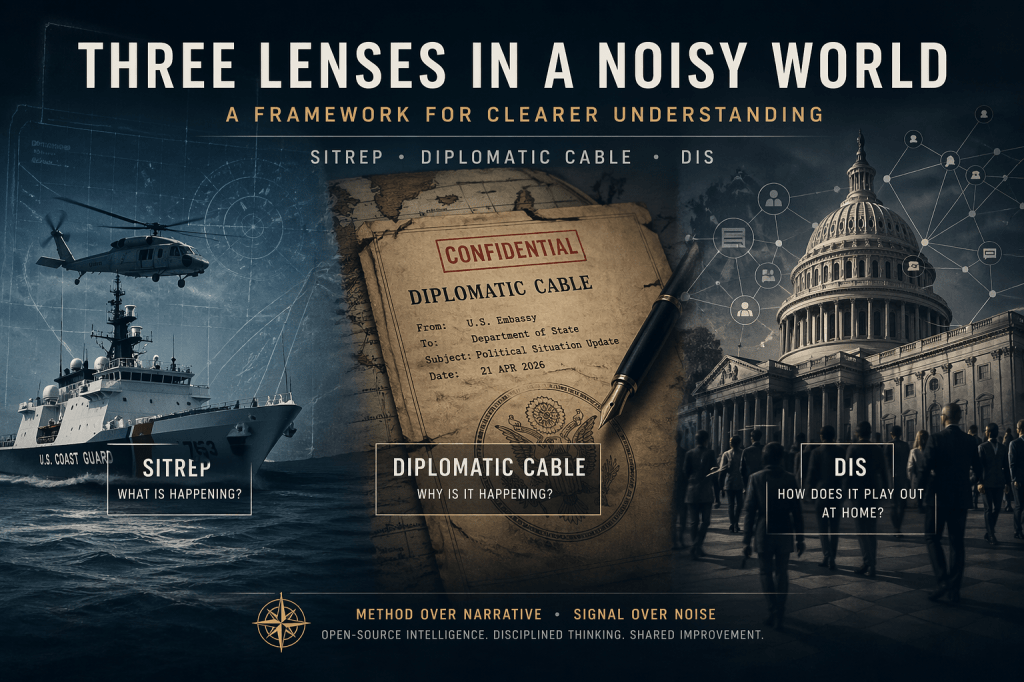
- SITREP
- Diplomatic Cable
- DIS
They are familiar terms, and that familiarity is part of their usefulness. Institutions tend to develop stable forms for recurring problems, and these names signal the kind of question being asked before the reader encounters the first line.
A SITREP, in my usage, concerns what is physically occurring in a security or military sense. It asks what forces exist, where they are positioned, what activity is observable, and what has changed. It tries, in a modest way, to look past rhetoric toward material reality.
A Diplomatic Cable turns to a different layer. It asks what states are trying to accomplish, what leverage they possess, what constraints they face, and what signals they are sending. Where the SITREP asks what moved, the Cable asks why it moved.
DIS, or Domestic Intelligence Summary, shifts the focus inward. It looks at organizations, networks, leadership figures, incentives, and messaging within a society. It is concerned with how coalitions form, how influence operates, and how internal dynamics shape public events.
These are not official products. They are simplified, open-source reflections of problems that institutions have long needed to solve. The resemblance is structural, not authoritative. What distinguishes them most from ordinary news consumption is not the content, but the posture.
News tends to be organized around events as they appear. These frameworks are organized around questions that persist whether or not an event is currently fashionable. They encourage one to ask what category of phenomenon is being observed, what evidence supports it, what has changed, and what remains uncertain. That last point matters more than it first appears. An honest acknowledgment of uncertainty is often the beginning of clarity.
None of this would matter much if the sources themselves were poorly chosen.
In practice, a significant portion of this project became an exercise in source selection. It is easy to underestimate how much interpretation is shaped before analysis even begins. If the inputs are weak, the conclusions will follow.
I found it helpful to think in layers.
Primary sources came first. Government statements, legislative texts, court filings, official reports, corporate disclosures. These are not free from bias, but they place the reader close to the actor.
Specialist sources came next. Domain experts, technical publications, regional analysts. Competence, I learned, is often narrow and must be sought where it lives.
Local reporting formed another layer. National narratives often begin as local realities, and much texture is lost as stories scale upward.
Then there are the more technical OSINT tools. Satellite imagery, maritime tracking, aviation data, archived records. These do not tell stories, but they often test them.
Other sources still have their place, but with reduced weight. Some are better understood as indicators of narrative movement than as reliable evidence of events.
Over time, a few simple principles proved useful. Direct documentation tends to outrank commentary. Independent confirmation matters. Expertise should be preferred to familiarity. Corrections matter. Transparency matters.
These are not sophisticated insights. They are simply easy to neglect.
As the method stabilized, another question emerged. If these frameworks are to be useful beyond my own use, they cannot remain entirely implicit. A method that cannot be examined becomes, in its own small way, another opaque system asking to be trusted.
For that reason, I published the working scripts, prompts, and templates in a repository on GitHub. Not as finished doctrine, but as working material. Others may find them useful, or incomplete, or worth improving. Any of those outcomes would be acceptable.
The goal is not to establish a final system, but to make the method visible.
It is worth noting what is required to adopt something like this. The list is not long. A capable language model helps. Access to reliable sources matters. Consistent templates make the work repeatable. An archive of prior reports allows for comparison. Beyond that, the requirements become less technical and more personal. Patience. A willingness to revise one’s own assumptions. A tolerance for uncertainty.
Those are not easily automated.
I still read the news. I suspect I always will. There is value in knowing what is being said, what narratives are forming, and what others are paying attention to. But I no longer confuse that activity with understanding.
Understanding requires a method, however modest.
These three frameworks are mine. They are imperfect, amateur, and open to revision. They were shaped through weeks of trial, error, and steady collaboration between human judgment and machine assistance. They will likely change again. That is acceptable. In an age of constant narration, it seems worthwhile to recover even a small measure of deliberate thought.
Below are examples of the three products.
Example SITREP — U.S. Coast Guard Operations in the Gulf of Mexico
Date: 21 April 2026
Area of Interest: Gulf of Mexico (U.S. littoral waters, approaches, and adjacent EEZ zones)
Reporting Framework: Open-Source Situation Report (Civilian OSINT Model)
Executive Summary
U.S. Coast Guard (USCG) operations in the Gulf of Mexico remain steady-state with routine emphasis on maritime security, counter-narcotics, search and rescue (SAR), and regulatory enforcement. No indicators suggest a shift to surge posture or crisis response conditions.
Operational activity reflects seasonal normalization: increased recreational vessel traffic, ongoing migrant interdiction readiness in southern approaches, and sustained counter-drug patrol patterns. Environmental and industrial monitoring remains consistent with offshore energy infrastructure protection requirements.
Confidence is moderate to high due to visibility of standard operations and absence of contradictory indicators.
Force Posture
- USCG cutters (National Security Cutters, Fast Response Cutters, and Offshore Patrol Cutters where available) maintain rotational patrol presence across the Gulf.
- Aviation assets (MH-60 Jayhawk, MH-65 Dolphin helicopters; fixed-wing surveillance aircraft) operate from coastal air stations including Texas, Louisiana, Mississippi, Alabama, and Florida.
- Sector commands (e.g., Houston-Galveston, New Orleans, Mobile, St. Petersburg) remain active with no observed surge staffing.
- Coordination with U.S. Navy assets remains limited and situational, primarily for joint exercises or specific interdiction support.
Assessment:
Posture reflects routine readiness rather than elevated alert status.
Operational Activity
Maritime Security & Law Enforcement
- Ongoing vessel boardings for safety, compliance, and fisheries enforcement
- Port security patrols near major shipping lanes and energy infrastructure
- Monitoring of commercial traffic through key transit points (e.g., approaches to Houston Ship Channel)
Counter-Narcotics Operations
- Continued interdiction operations in coordination with Joint Interagency Task Force South (JIATF-South)
- Focus on maritime smuggling routes transiting from the Caribbean into the Gulf
Search and Rescue (SAR)
- Seasonal increase in SAR cases tied to recreational boating activity
- Rapid response capability maintained across all sectors
Migrant Interdiction (Southern Approaches)
- No confirmed surge conditions, but standing readiness posture remains
- Monitoring of irregular maritime migration patterns from Caribbean corridors
Environmental & Infrastructure Protection
- Routine inspections of offshore oil and gas platforms
- Pollution response readiness maintained
- No major spill or environmental crisis observed at time of report
Strategic Assessment
Current USCG operations reflect a stable maritime security environment with predictable mission distribution:
- No significant disruption to commercial maritime traffic
- No observable adversarial naval presence within U.S. Gulf waters
- Criminal activity (drug trafficking, illegal fishing) remains persistent but controlled
- Seasonal variables (weather, tourism) driving operational tempo more than threat escalation
Overall Condition:
Stable, with routine mission execution across all domains.
Delta (Since Prior Baseline)
Changes:
- Incremental increase in SAR activity consistent with spring boating season
- Slight uptick in recreational vessel density in coastal waters
Unchanged:
- Counter-narcotics operational tempo
- Port security posture
- Aviation sortie patterns
Invalidated Assumptions:
- No indication of early-season hurricane-driven surge operations (weather remains non-disruptive at this time)
Indicators vs. Assumptions
Indicators (Observed / Reported)
- Regular cutter patrol rotations
- Ongoing interdiction reports (drug seizures consistent with baseline)
- SAR case frequency increase
- Stable port and shipping activity
Assumptions (Analytical)
- Migrant flows remain at baseline levels (limited public confirmation)
- No classified surge posture or redirected assets outside observable patterns
- Criminal networks maintaining established routes without major adaptation
Confidence Levels
- Force Posture: High
- Operational Activity: High
- Strategic Assessment: Moderate
- Forward-Looking Judgments: Moderate-Low
Confidence is limited by absence of classified data and reliance on observable patterns and reporting consistency.
Watch Items
- Early tropical weather systems impacting operational tempo
- Sudden increase in migrant maritime activity from Caribbean routes
- Changes in narcotics trafficking routes or interdiction frequency
- Industrial incidents involving offshore platforms or pipelines
- Any surge in joint operations with Department of Defense assets
Overall Assessment
The U.S. Coast Guard in the Gulf of Mexico is operating in a steady-state environment, balancing law enforcement, safety, and security missions without signs of escalation or crisis response posture.
The most meaningful changes in the near term are likely to be seasonal rather than strategic, unless disrupted by weather events or external geopolitical developments.
Sample Diplomatic Cable — State of SEC Football Ahead of the 2026 Season
Date: 21 April 2026
Subject: Strategic Landscape of the Southeastern Conference (SEC) Entering Fall 2026
Classification: Open-Source Analytical Cable (Civilian Model)
Executive Summary
The SEC enters the 2026 season as the dominant power bloc in college football, but with increasing internal stratification and external competitive pressure from the Big Ten Conference. Expansion-era dynamics continue to reshape competitive balance, media leverage, and playoff positioning.
A clear top tier led by programs such as University of Georgia Bulldogs football, University of Alabama Crimson Tide football, and University of Texas Longhorns football is contrasted by a volatile middle tier and a structurally constrained lower tier.
The 12-team College Football Playoff format has increased SEC access to postseason competition, but has also reduced the margin for intra-conference dominance as the sole pathway to national relevance.
Key Judgments
- The SEC remains the most talent-dense conference, but no longer operates in an uncontested strategic environment.
- Conference expansion (notably Texas and Oklahoma integration) has redistributed power rather than simply adding strength.
- The expanded playoff system reduces the “single-loss elimination” dynamic, increasing late-season strategic maneuvering.
- NIL (Name, Image, Likeness) ecosystems and transfer portal fluidity are now primary competitive levers, not secondary factors.
- Internal cannibalization risk remains high due to schedule density among top-tier programs.
Diplomatic Landscape (Conference Power Structure)
Top Tier (National Title Contenders)
- Georgia Bulldogs football
- Alabama Crimson Tide football
- Texas Longhorns football
- LSU Tigers football
These programs maintain:
- elite recruiting pipelines
- stable coaching structures
- mature NIL collectives
- consistent playoff positioning
Upper-Middle Tier (Playoff-Capable, Inconsistent)
- Tennessee Volunteers football
- Ole Miss Rebels football
- Oklahoma Sooners football
- Missouri Tigers football
These teams can:
- disrupt top-tier standings
- secure playoff bids in expanded format
- fluctuate year-to-year based on QB play and transfer success
Lower Tier (Structurally Constrained)
- Vanderbilt Commodores football
- Mississippi State Bulldogs football
- Arkansas Razorbacks football
These programs face:
- recruiting disadvantages
- limited NIL scale
- coaching instability risks
- reduced margin for recovery after early losses
Economic Signaling
- SEC media rights agreements continue to provide significant revenue advantages, though narrowing relative to Big Ten deals.
- NIL collectives function as quasi-economic alliances, with top programs effectively operating at semi-professional funding levels.
- Facilities investment remains high across the conference, signaling continued arms-race dynamics.
Assessment:
The SEC remains economically dominant, but the gap is no longer unassailable.
Information Environment
- National media narratives increasingly frame competition as SEC vs Big Ten parity, rather than SEC supremacy.
- Fan and booster expectations remain calibrated to national title contention, particularly among top-tier programs.
- Coaching narratives (legacy vs emerging leaders) continue to shape perception of program trajectory.
Negotiation Tracks (Playoff and Structural Influence)
- SEC leadership continues to advocate for playoff structures that reward strength of schedule, which benefits intra-conference competition.
- Ongoing negotiation with other conferences regarding automatic qualifiers vs at-large bids.
- Strategic interest in maintaining multiple playoff entries annually, rather than single representative models.
Delta Assessment (Since Prior Seasons)
Changes:
- Integration effects of Texas and Oklahoma stabilizing
- Increased reliance on transfer portal for roster construction
- Greater parity within the top 8–10 teams nationally
Unchanged:
- Recruiting dominance in the Southeast
- High coaching turnover pressure
- Importance of quarterback play as decisive variable
Invalidated Assumptions:
- SEC monopoly on playoff access no longer guaranteed
- Single-loss seasons no longer determinative in playoff qualification
Risk Matrix
| Risk | Likelihood | Impact |
|---|---|---|
| Internal cannibalization (multiple top teams eliminating each other) | High | High |
| Big Ten competitive overtake in playoff representation | Moderate | High |
| NIL regulatory changes disrupting current power balance | Moderate | Moderate |
| Coaching instability at major programs | Moderate | High |
Analytical Confidence
- Conference Structure: High
- Competitive Balance Assessment: Moderate
- Forward Projections: Moderate-Low
Confidence is limited by volatility introduced by NIL, transfer portal activity, and injury variability.
Overall Assessment
The SEC remains the most powerful conference in college football, but it is no longer operating in a unipolar environment.
The 2026 season is likely to be defined less by dominance and more by competition within strength. The conference’s greatest advantage, its depth, may also serve as its greatest constraint, as elite teams are forced into repeated high-level matchups that carry playoff consequences.
In diplomatic terms, the SEC is still the leading power, but it now governs within a more contested system.
Sample DIS — Chuck Norris
Date: 21 April 2026
Subject: Domestic Influence Profile — Chuck Norris
Classification: Open-Source Domestic Intelligence Summary (Civilian Model)
Executive Summary
Chuck Norris occupies a unique position in American cultural space as a legacy action figure, symbolic archetype, and soft-influence personality. While no longer a primary actor in entertainment or political mobilization, his name retains disproportionate cultural recognition through meme culture, prior media roles, and long-standing associations with traditional values.
His current influence is diffuse rather than centralized, operating through legacy reputation, cultural symbolism, and selective engagement rather than active organizational leadership.1
Organizational Overview
Chuck Norris is not currently affiliated with a dominant institutional structure or centralized organization. His influence is distributed across:
- Entertainment legacy (film and television)
- Martial arts community (Tang Soo Do promotion and training legacy)
- Brand and endorsement activity (historical and limited current)
- Cultural/meme ecosystems (internet-driven persistence)
He does not operate as a formal political organizer or institutional actor.
Key Figures
- Chuck Norris — Primary subject; actor, martial artist, public figure
Associated figures are minimal in a structured sense, as his influence is largely individual rather than network-driven.
Political Bias / Affiliations
Observed Leaning:
- Public alignment with conservative political and cultural values
- Past support for Republican candidates and causes
- Advocacy for traditional family structures, religious values, and limited government themes
Assessment:
Political positioning is clear but not actively operationalized in recent years. Influence is more symbolic than directive.
Funding / Support Base
- Historical revenue from entertainment career and endorsements
- No visible modern funding network tied to political or organizational mobilization
- No evidence of active donor network or coordinated financial influence operations
Messaging Themes
Recurring themes associated with Norris:
- Personal discipline and martial virtue
- Strength, resilience, and self-reliance
- Traditional morality and cultural conservatism
- Anti-decadence / pro-order undertones
Additionally, meme culture has created a parallel messaging layer:
- Hyperbolic strength narratives (“Chuck Norris facts”)
- Cultural shorthand for exaggerated competence and invincibility
Network Connections
- Weak formal network ties in current environment
- Historical connections to:
- Hollywood action film industry
- Martial arts institutions
- Conservative advocacy circles
Current influence is not network-dependent, but reputation-based.
Influence Assessment
Type of Influence
- Symbolic
- Cultural
- Legacy-based
Strength
- High name recognition
- Low direct mobilization capability
Mechanism
- Cultural recall
- Meme persistence
- Occasional public statements
Reach
- Broad but shallow
- Cross-generational recognition
Risk / Impact Assessment
| Factor | Assessment |
|---|---|
| Political Mobilization Capacity | Low |
| Cultural Influence | Moderate |
| Organizational Influence | Low |
| Narrative Impact | Moderate |
Interpretation:
Chuck Norris does not function as an operational actor in domestic political or organizational dynamics. His impact is primarily cultural and symbolic.
Confidence Levels
- Identity & Background: High
- Political Alignment: Moderate-High
- Network Influence: Moderate
- Current Operational Relevance: Moderate-Low
Overall Assessment
Chuck Norris represents a form of residual cultural authority rather than active influence. His presence in the domestic landscape is sustained through reputation, symbolic association with strength and traditional values, and continued recognition across both older audiences and internet culture.
He is best understood not as an actor within current power structures, but as a persistent cultural artifact with occasional relevance in broader social and political narratives.
- The AI model does not clearly indicate that Chuck Norris has recently passed away. Chuck Norris didn’t die, death finally found courage to meet him. ↩︎
