
Ancient Greece produced many memorable philosophers, but few left behind an observation as quietly unsettling as that of Xenophanes of Colophon1. He did not set out to dismantle religion, at least not in any modern sense. What he did instead was notice something that others, perhaps, had grown too accustomed to see.
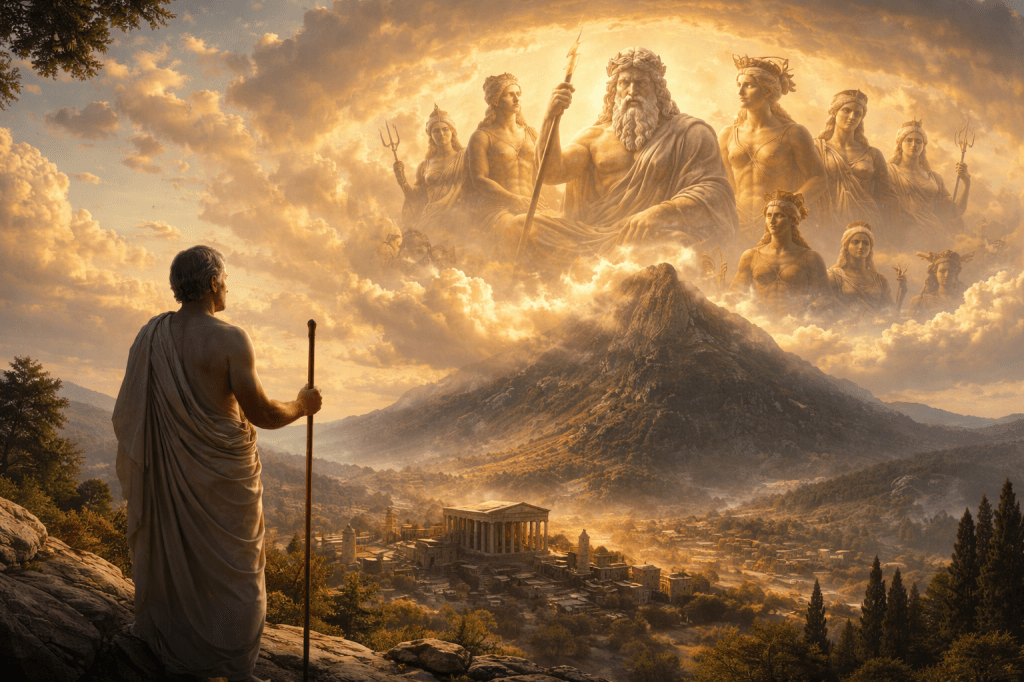
To a Greek audience formed by Homer and Hesiod, the gods were not abstractions. They were vivid, particular, and deeply familiar. The Olympians quarreled, formed alliances, pursued romances, and intervened in human affairs with a mixture of favoritism and rivalry that would not have seemed out of place among aristocratic households. They were immortal, certainly, and more powerful than any man, but they were also recognizably human in their habits and concerns.
Xenophanes’ observation begins from this point of familiarity and then turns slightly, just enough to reveal the pattern beneath it. Thracians, he noted, imagined gods with pale skin and red hair. Ethiopians imagined gods who were dark. Each people, in other words, found the divine curiously close at hand, bearing the marks of their own appearance and culture. His most memorable remark sharpens the point without quite raising its voice. If horses had hands, he suggested, they would paint their gods to look like horses.
It is easy to treat the line as a kind of clever aside, but it carries more weight than it first appears. Xenophanes was not denying the possibility of the divine. What he questioned, more carefully, was the reliability of human description. If every culture produces gods in its own image, then those images may tell us as much about the culture as they do about whatever reality lies behind them.
Once noticed, the pattern has a way of repeating itself across time. Greek religion reflected the values of the Greek world. Honor, beauty, rivalry, and reputation were not only social ideals but divine ones. The world of Mount Olympus was, in many respects, an elevated version of aristocratic life, set at a distance but not fundamentally transformed.
Later periods follow a similar path, though they arrive at different destinations. Medieval Europe, shaped by courts and kingship, often imagined God in the language of sovereignty, presiding over a structured and hierarchical order. The Enlightenment, less comfortable with divine intervention and more impressed by mechanical regularity, spoke instead of a designer who constructed the universe with precision and then allowed it to proceed according to its own internal logic. The imagery changes, but the underlying habit remains recognizable.
Even now, in a more self-consciously secular age, the instinct has not entirely disappeared. It has, perhaps, shifted its vocabulary. People speak of “the market” as though it prefers or resists certain outcomes, or of “history” as though it moves with intention toward a destination. We describe systems, often vast and impersonal, in language that quietly assigns them motives. It is not quite the same as attributing thunder to Zeus, but it arises from a similar impulse to locate agency behind events that might otherwise seem indifferent.
There is something natural in this. Human beings are, among other things, interpreters of action. We look for causes, but we also look for purposes, and the latter are often easier to grasp when they resemble our own. A storm becomes easier to understand if it can be read as anger; a turn of fortune feels less arbitrary if it can be framed as destiny. In this sense, the imagination does not so much deceive as it translates, rendering the unfamiliar in terms that can be more readily understood.
Xenophanes seems to have recognized both the usefulness and the danger in that translation. As a wandering poet and thinker, moving across the Greek world, he occupied a position that allowed for a certain distance. He could see that what appeared obvious within one city or tradition looked less certain when placed alongside another. The authority of inherited stories, so long anchored in the poetry of Homer and Hesiod, could be examined rather than simply repeated.
This shift is easy to overlook, but it marks an important moment. To question whether accounts of the gods reflect reality or merely human projection is to begin a different kind of inquiry, one that would later find fuller expression in figures like Socrates, Plato, and Aristotle. Xenophanes does not develop a system in the way they would, but he introduces a habit of mind that makes such systems possible.
What emerges from his observation is less a formal theology than a durable caution. Human beings, across times and cultures, tend to project themselves outward. Each age, confident in its own understanding, describes the structure of reality in terms that feel natural and persuasive, yet those descriptions often bear the imprint of the age itself. The heavens, it seems, are rarely imagined without some reflection of the earth below.
There are, of course, other ways of accounting for the persistence and similarity of these stories. Within the Christian tradition, texts such as the Book of Enoch2 describe the Watchers, fallen angels who move between the divine and the human in ways that resist clean categories. One can at least imagine how such accounts, if taken seriously, might offer a different explanation for the origin of pagan deities, not as pure invention, but as the distant and imperfect memory of encounters that were themselves only partially understood.
Yet even here, Xenophanes’ caution is not easily set aside. Whatever their source, such encounters would still be received, interpreted, and retold by human communities. The telling, as ever, bears the marks of the teller.
This leaves the question in a place that is perhaps less satisfying, but more honest. Human beings tend to project themselves onto the universe, but they may not be doing so in a vacuum. There may be something there that invites description, even if that description never quite escapes the limits of those who attempt it.
That does not mean that every such description is false. It does suggest, however, that confidence should be tempered with a measure of restraint. When we speak about the nature of the divine, or about the hidden direction of the universe, we may indeed be reaching toward something real. At the same time, we are working with the materials available to us, shaped by our language, our institutions, and our habits of thought.
Xenophanes leaves us, then, with a question that does not quite resolve itself. How much of what we describe lies beyond us, and how much has been quietly carried there by us? It is not a question that demands immediate skepticism so much as steady awareness.
We may, after all, be painting with the only colors we possess – those colors have a way of resembling the painter.
References
- Lesher, J. H. (1992). Xenophanes of Colophon: Fragments: A text and translation with a commentary. University of Toronto Press. https://dn721507.ca.archive.org/0/items/xenophanes-of-colophon-fragments_202308/Xenophanes-of-Colophon-Fragments.pdf ↩︎
- Charles, R. H. (1912). The book of Enoch; or, 1 Enoch: Translated from the editor’s Ethiopic text. Clarendon Press. https://archive.org/details/english-book-of-enoch-by-r.-h.-charles ↩︎
