
I have noticed that modern people speak about myths with a certain confidence, usually while participating in them. The word itself is often used dismissively, as though a myth is merely a falsehood displaced by more rational understanding. We contrast myths with facts as though the distinction resolves the matter cleanly and permanently.
And yet I am not entirely convinced human beings have ever stopped producing myths.
What changes is usually not the existence of myth itself, but the form it takes and the language surrounding it.
The longer I think about myths, the less convinced I become that they arise primarily from deception. More often, they seem to emerge where memory attempts to preserve continuity after the surrounding details have begun to disappear. A family remembers a name, a battlefield, a phrase, a landscape, or a relationship, while chronology and documentation gradually erode around them. The story then reorganizes itself around what remains emotionally or symbolically durable.
I have found myself thinking about this increasingly through old family stories, particularly stories connected to the Knightens and the Cherokee lore that circulated through parts of North Alabama when I was younger. I should probably state plainly that I do not know how much of these stories is historically true, and that uncertainty is part of why they interest me.
Part of that interest is not entirely neutral.
I suspect I want portions of the stories to be true.
Not because Cherokee ancestry carries novelty or prestige in the modern sense, but because so many Americans of European descent inherited surprisingly little continuity from the cultures that originally produced them. My English, Scottish, and Welsh ancestors arrived in a colonial world where older identities were already dissolving into something broader and more generically American. Languages disappeared. Regional customs faded. Older loyalties blurred together. By the time later generations arrived, much of the inheritance had already been flattened into census categories and surnames.
The Cherokee stories feel different somehow. They remain attached to geography, memory, and recognizable narrative continuity in ways many European ancestral identities no longer do. I am aware this may predispose me toward wanting the stories to contain more truth than the historical evidence can fully sustain. That awareness does not eliminate the bias, though it perhaps makes me somewhat more cautious around it.
Years ago, my Aunt Nancy Blevins took handwritten notes from conversations with a granddaughter of John L. Knighten. Aunt Nancy herself was originally from Ohio. My Uncle Vaughn met her after moving north during the postwar period when many Southern families left for industrial work and economic opportunity. Later, like my grandparents, they returned to Morgan County, Alabama, bringing their families back with them.
The stories were likely collected sometime in the late 1950s or early 1960s, which now strikes me as significant in itself. By then, many of the older oral traditions that once circulated naturally through proximity and family gatherings were beginning to thin. The generation carrying firsthand memories of the nineteenth century was disappearing, and much of what had survived until then still existed primarily through spoken recollection rather than formal documentation.
In that sense, Aunt Nancy was doing something more than casual note-taking. She was participating, perhaps unknowingly, in the transition from oral tradition into written preservation.
In the notes, John L. Knighten was reportedly referred to as “Johnny Lighthorse Nightingale,” a name that already feels suspended somewhere between genealogy and folklore. According to the stories, he possessed Cherokee ancestry, escaped the Removal, and later served as a Confederate scout while still a teenager.
But even that becomes complicated almost immediately.
John L. Knighten was born in 1849, after the period of Cherokee Removal itself, which raises obvious chronological problems. His father, Jeremiah Knighten, was born in 1828 in Sumter, South Carolina, far from the Cherokee heartland of that era. The more closely one examines the details, the less cleanly the stories settle into place.
And yet the stories persisted.
One version of the family lore attempts to reconcile these contradictions by claiming that somewhere earlier in the Knighten line, possibly Jeremiah himself or perhaps Jeremiah’s father, a Cherokee youth was adopted into the family. The details become uncertain depending on which branch of the story is being recalled. According to the tradition, the boy was taken in by the Knightens and raised alongside the family’s children, supposedly because he possessed exceptional skill with horses and was able to teach the white children to ride.
Even within the story itself, one can observe the instability common to oral tradition. Generations compress together. Names shift. One ancestor’s experiences gradually become attached to another. The details blur while the symbolic continuity remains.
I have no idea whether this is historically accurate. The story itself is fuzzy and incomplete, as oral traditions often are, but I find it interesting because of what it attempts to accomplish. It explains the Cherokee connection, the Knighten surname, and the persistence of Cherokee-associated memory despite sparse documentation and census records consistently identifying the family as white.
The story behaves almost exactly the way myths often behave. It does not erase contradiction so much as reorganize it into continuity. Fragments that no longer fit neatly together become connected through narrative structure rather than documentation alone.
Other fragments of the family lore attempted to place the Knightens within broader Cherokee symbolic structures as well. I remember hearing references to John L. Knighten’s people belonging to the “House of Winds,” which appears connected to the Ahni-gilohi, or Long Hair Clan, within Cherokee tradition1. In some accounts, this clan was associated with the adoption of outsiders and strangers into Cherokee society.
Again, I do not know whether such claims are historically accurate. What interests me is less the certainty of the lineage itself than the way the stories attempted to organize identity through recognizable symbolic patterns. Even the adoption narrative surrounding the Knightens seems to echo that broader structure, whether consciously or unconsciously preserved through generations of retelling.
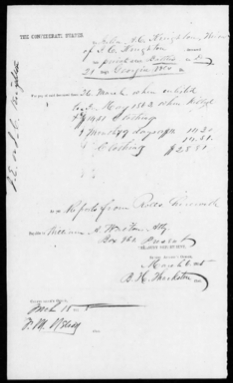
At the same time, portions of the broader family tradition are historically grounded. Jeremiah Knighten is known to have served in the Confederacy and to have been killed at the Battle of Chancellorsville. He lived in eastern Alabama near the Georgia border, which likely helps explain some of the later confusion surrounding unit affiliation, particularly since family tradition drifted between Alabama and Georgia associations over time. His widow, Julia Anne Pollard Knighten, later filed for compensation, leaving at least some documentary trace beneath the surrounding layers of oral memory. The Auditor’s Report confirmed that he had served in Company D of the 21st Regiment of the Georgia Infantry Volunteers. There appears to be some confusion over his name, even there, as it is listed as J.C. and elsewhere online as Josiah Charles2. His muster card clearly states the name as Jeremiah E. Knighton, though.
This spring, I visited the battlefield myself. The visit clarified at least one portion of the family tradition. The 21st Regiment of Georgia Volunteers was present at Chancellorsville and sustained heavy losses there, while the Alabama unit connected to later family memory was not present at the battle at all. Rangers at the visitors center helped confirm the distinction. Polk County Georgia, where Company D mustered from, isn’t too far from Calhoun County, Alabama, where he lived.
Even there, however, one can watch the process beginning.
A real battlefield slowly accumulating symbolic weight through family memory. A real death reorganized into narrative continuity. A remembered soldier gradually becoming larger than documentation alone.
That seems important to me because legends often arise precisely in these spaces where memory remains attached to real events while factual precision slowly erodes around the edges.
There were other stories as well, quieter ones that never fully developed into formal family narratives but lingered at the edges of memory. I remember hearing references to relatives whose ancestors had gone west on the Trail of Tears later returning to North Alabama to visit family in the late nineteenth or early twentieth century. I do not know whether these stories can be documented cleanly, and I suspect many details have been lost entirely.
Still, the stories themselves are revealing.
They suggest that Removal, at least in family memory, was never experienced as a perfectly final severing. The people who left did not simply disappear into abstraction. In the stories, some of them returned periodically, crossing back into the old geography where kinship and memory still remained. Whether literal, partially true, or symbolically reshaped over time, the stories preserve an older Southern understanding that families, identities, and loyalties often extended beyond the boundaries later histories tried to impose neatly upon them.
The longer these stories survive, the more difficult it becomes to separate lore from legend and legend from myth.
Lore tends to preserve inherited practices, warnings, folk knowledge, or localized customs. Much of Southern folk culture operated this way for generations. Planting by signs, weather sayings, graveyard customs, snake superstitions, hunting practices, and stories tied to specific roads or hollows all belong more naturally to lore than myth.
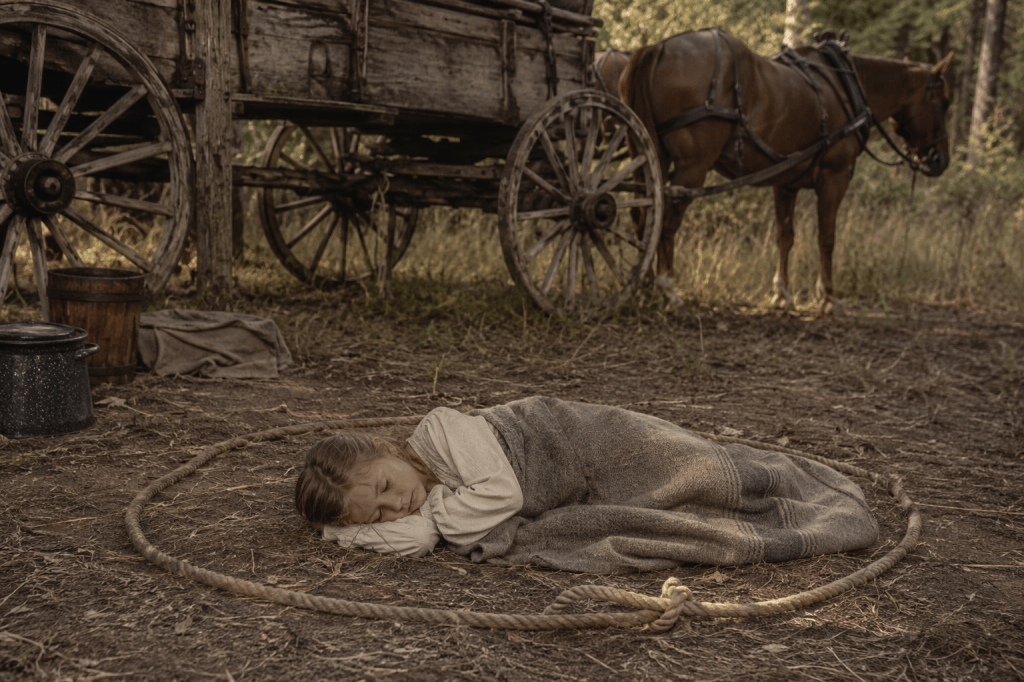
The rope-circle story fits somewhere in this category. According to the account, John L. Knighten once made his granddaughter sleep inside a circle of rope during an overnight stay in the woods because snakes would not cross it. My natural skepticism resists the story almost automatically, and I have no idea whether it is true. Still, the image itself remains strangely vivid. The rope circle survived in memory long after countless more ordinary details disappeared, and that seems significant in its own way.
Lore often survives because it feels attached to practical knowledge, however uncertain or symbolic that knowledge may later become. The story persists not because anyone can prove it, but because the image itself remains memorable enough to survive retelling.
Legends behave somewhat differently. Legends gather around people, particularly people connected to unstable historical memory. Scouts, riders, ferrymen, mountain preachers, outlaws, and frontier figures often become legendary because they already occupy the boundary between ordinary life and symbolic meaning.
The American South has produced such figures in abundance.
Johnny Lighthorse Nightingale fits naturally into that pattern, regardless of how historically precise every detail may be. A young Confederate scout with rumored Cherokee ancestry, tied to horses, frontier geography, and incomplete family memory, already possesses the structure from which legends tend to grow. The historical fragments become reorganized around symbolic coherence. A partially documented person gradually becomes a representative figure carrying meanings larger than himself.
I also recognize the possibility that parts of the Johnny Lighthorse Nightingale tradition reflect the ambiguities and temptations common to many Southern family stories involving Native ancestry. The American South contains countless inherited claims, embellishments, half-memories, and reconstructed identities layered across generations. Some undoubtedly preserve genuine continuity. Others may represent attempts to attach symbolic meaning to fragmented ancestry or uncertain family history.
And yet I am reluctant to dismiss such stories entirely, partly because oral traditions often preserve truths that formal documentation later obscures, but also because the persistence of the stories themselves reveals something important about the people who carried them forward.
Very few people alive today likely know the name “Johnny Lighthorse Nightingale” at all. The legend survives, if it survives, only within small fragments of family memory. In that sense, the story possesses neither political usefulness nor cultural prestige. It remains simply a piece of inherited lore hovering uncertainly between memory, symbolism, and history.
Myths operate at a larger level still. If lore preserves habits and legends preserve persons, myths preserve meaning. They become frameworks through which entire communities understand identity, belonging, morality, destiny, decline, survival, or continuity across generations.
Over time, however, the boundaries between all three begin to blur.
The longer I sit with these stories, the less certain I become that myths arise primarily from invention. More often, they emerge where memory attempts to preserve identity after records, chronology, and context have begun to erode.
There are broader historical realities surrounding these stories that make them difficult to dismiss entirely. It is historically known that some Cherokee families did avoid Removal by blending into surrounding populations, particularly through intermarried frontier families across the Southeast. The American frontier was rarely as administratively clean as later generations imagine it to have been. Families absorbed stepchildren, orphans, cousins, widows, and unofficial adoptions. Names shifted, records disappeared, and census categories simplified realities that were often far more complicated on the ground.
What survives generations later is not always factual precision.
Sometimes it is symbolic continuity.
One detail from the notes has remained with me for years, though I cannot fully explain why. According to the story, the granddaughter once asked John L. Knighten why the Cherokees did not believe in Jesus. He supposedly answered that they knew God, but had not heard about Jesus.
Even now, this survives only as my paraphrase of a paraphrase of a remembered conversation from more than a century ago, and yet something about it endures. Not necessarily because it is factually precise, but because it preserves a moral intuition. It reflects an attempt to reconcile cultural difference without denying divine reality altogether. Frontier Christianity often operated this way, trying to understand unfamiliar peoples without entirely placing them outside God’s order.
I think about this sometimes when passing near Fort Bluff in Morgan County, Alabama. The bluff itself still overlooks the surrounding area near Brewer High School, a rocky outcrop carrying its own accumulation of local stories and associations. My grandfather, a great-grandson of John L. Knighten, grew up at the base of the hill.
The Cherokee stories connected to the area claimed that local Cherokees once gathered there because the bluff provided visibility across the surrounding countryside. Later stories described the bluff as a hideout for outlaws and fugitives attempting to avoid discovery. Whether every detail is historically accurate, I do not know, but the geography itself encourages narrative. Standing there, one immediately understands why people attached stories to the place.
I wrote earlier this year in The Land Remembers that certain landscapes seem to retain layers of human presence long after the people themselves disappear. I am not entirely certain how literally I mean that even now, but places like Fort Bluff make the idea difficult to dismiss completely. Some locations seem to accumulate memory through repeated human use. A defensible overlook becomes a gathering place across generations precisely because the physical logic of the place remains constant even while the people and stories surrounding it change.
Over time, the stories begin layering themselves atop one another until the location itself acquires symbolic weight larger than any individual event attached to it.
The same processes do not occur only within families or regions. Nations themselves eventually construct symbolic continuity in similar ways.
Myth does not necessarily replace history.
More often it accumulates around it.
Perhaps that is why myths so often emerge around frontiers and transitional spaces. The American South, particularly Appalachia and the Tennessee Valley, remained oral far longer than modern Americans sometimes realize. Stories moved through porches, cemeteries, revival meetings, hunting camps, and family reunions long before they entered archives. By the time many were finally written down, they had already passed through generations of compression and reinterpretation.
Modern people often find this frustrating because we prefer categories to remain clean and stable. We want clear divisions between historical fact, family legend, folklore, religion, and identity, but oral traditions rarely behave that way. Stories merge. Generations compress together. One man’s experience becomes attached to another man’s name, while symbolic details survive long after dates and context disappear.
Over time, stories stop functioning merely as records and begin functioning as vessels carrying memory, values, fears, identity, and belonging.
Stories create continuity. Continuity creates identity. Identity creates cohesion.
A society stripped entirely of shared lore, legend, and myth eventually begins to feel less like a people and more like an administrative framework. Facts alone can describe a population, but they struggle to bind individuals into cultural continuity. Census categories, legal systems, and economic structures can enumerate persons with remarkable precision while still leaving them emotionally and historically disconnected from one another.
Lore, legend, and myth perform a different function. They create symbolic inheritance. They allow people to imagine themselves as participating in a continuity larger than individual lifespan or transactional association alone.
This is one of the tensions I increasingly notice within modern American life. The United States remains politically united, yet culturally fragmented in ways that make shared narrative increasingly difficult to sustain. Regional memory persists, but national mythology often feels unstable, disputed, or proceduralized.
This does not mean American mythology disappeared entirely. In some respects, it merely became institutional rather than organic.
One can see this quite literally inside the dome of the United States Capitol, where Constantino Brumidi’s Apotheosis of Washington depicts George Washington ascending into the heavens surrounded by allegorical figures representing liberty, victory, justice, commerce, science, and national virtue. Washington appears less as a conventional statesman than as a kind of American civic patriarch presiding over a symbolic republic shaped consciously through classical imagery.
The symbolism is not especially subtle once one notices it.
Washington, D.C. remains filled with monuments, ceremonial architecture, civic shrines, sacred texts preserved behind glass, and neoclassical structures consciously modeled after republican Rome and classical antiquity.
I do not mean this entirely approvingly.
Much of the symbolism reflects the complicated inheritance of the Enlightenment itself, particularly its admiration for the Roman republic and its occasional tendency toward civic humanism detached from older Christian frameworks. The founders inherited Christianity, classical antiquity, Enlightenment rationalism, Freemasonry, Protestant moral culture, and republican political theory simultaneously.
Even so, the symbolic structure remains visible.
George Washington occupies the center of that mythology in ways that resemble a mythological founding patriarch more than a merely historical administrator. Even his memorialization often carries quasi-sacral dimensions. The George Washington Masonic National Memorial in Alexandria, Virginia, for example, was intentionally designed after the ancient Lighthouse of Alexandria, one of the Seven Wonders of the Ancient World.
At vastly different scales, both local legends and national mythologies seem to emerge through similar mechanisms of symbolic preservation. Johnny Lighthorse Nightingale and George Washington obviously do not occupy the same historical category, yet both become enlarged through memory into figures carrying meanings beyond documentation alone.
The differences between the two matter as much as the similarities. Family lore preserves intimacy, inheritance, and localized continuity. National mythology attempts something far more ambitious. It seeks to bind millions of unrelated individuals into a shared symbolic order capable of surviving generations, migrations, political conflict, and geographic scale.
Johnny Lighthorse Nightingale remains obscure outside the small circles of family memory and regional storytelling where the stories survived at all. In many ways, that obscurity is precisely the point. Lore does not require national recognition to function symbolically. A family, a church, a county, or a small community may preserve stories for generations because the stories bind people together locally even when the outside world remains entirely unaware of them.
George Washington became something altogether different. His symbolic role expanded beyond biography into civic mythology itself. One belongs primarily to kinship memory. The other became part of national continuity and institutional identity.
Yet both reveal the same underlying human tendency: societies, families, and civilizations repeatedly elevate representative figures into symbolic anchors through which continuity becomes emotionally intelligible.
During a trip to Washington earlier this year, one of our stops was Mount Vernon. The estate was crowded with construction and renovation work preparing for the America 250 celebrations. My younger children had never visited before, though my wife and I had years earlier when she was pregnant with our younger daughter.
We eventually waited in line to approach the tomb of George and Martha Washington.
What struck me unexpectedly was not the tomb itself, but the behavior surrounding it. People were posing for selfies directly in front of the graves. Something about it deeply unsettled me. I felt a similar discomfort earlier while watching school groups behave rambunctiously at Arlington National Cemetery.
Part of my reaction was simply reverence for the dead. Part of it, however, reflected something larger and more difficult to articulate. Whatever one thinks of George Washington historically, he occupies a symbolic place within the American imagination that resembles a civilizational founder figure more than a mere officeholder. To stand before his tomb taking smiling self-portraits felt less like historical engagement than the inability to recognize inherited sacred space at all.
Perhaps that reaction reveals that I participate in these symbolic structures more than I sometimes admit.
Modern Americans often imagine themselves entirely post-mythological while continuing to live among monuments, rituals, civic saints, sacred anniversaries, and symbolic architecture inherited from older forms of national memory. The mythology remains present, but the habits of reverence surrounding it have weakened.
The result is not the disappearance of myth, but fragmentation. Symbols remain while shared understanding erodes.
Perhaps that is partly why older local stories still linger so stubbornly in certain families and places. Even small fragments of inherited lore can provide forms of continuity modern life often struggles to replace.
Even the legends surrounding the Founding Fathers no longer function as universally shared symbolic inheritance in the way they perhaps once did. Some Americans still approach them as civic ancestors. Others view those same narratives primarily through suspicion, revision, or detachment. I am not entirely certain which side is fully correct, but I do suspect something important is lost when a society becomes unable to sustain any common symbolic vocabulary about itself.
A purely fact-based civilization may be intellectually rigorous in certain respects, but emotionally it begins to resemble an accounting system or legal registry more than a culture. Human beings rarely live by procedure alone for very long.
And perhaps myths arise because human beings struggle to live very long without continuity of some kind. We organize ourselves through narrative partly because narrative allows fragmented experience to remain emotionally inhabitable.
The danger, of course, is that myths can preserve distortion as easily as truth. Some become stabilizing while others become destructive, and entire political movements have organized themselves around symbolic narratives detached from reality.
Still, I am not convinced the solution is to imagine ourselves beyond myth altogether. A civilization stripped entirely of symbolic imagination would likely become sterile and difficult to sustain because human beings are narrative creatures whether we admit it or not.
The more difficult task may be learning how to live among stories without surrendering ourselves completely to them.
I also find myself wondering, somewhat uncomfortably, whether essays like this participate in the very process they attempt to examine.
Aunt Nancy likely believed she was preserving the stories before they disappeared. I suspect I tell myself something similar while writing this essay.
I began wanting to clarify the stories, or at least place them into better historical context. Yet in recounting them, I may simply be carrying them forward into another generation and another medium.
“Johnny Lighthorse Nightingale” already sounds less like genealogy than folklore once written onto a page. The moment the stories are organized into narrative form, they begin acquiring coherence that oral fragments often lacked individually.
Somewhere between Aunt Nancy’s handwritten notes, Fort Bluff overlooking Morgan County, George Washington’s tomb at Mount Vernon, and the symbolic dome above the Capitol rotunda, I suspect the line between history and mythology becomes less clean than modern people prefer.
I suspect most myths are not consciously invented so much as gradually inherited, rearranged, softened, enlarged, and carried forward by people who believe they are merely preserving memory.
Perhaps that is how legends survive.
Not because anyone consciously invents them, but because each generation attempts to preserve and reinterpret the fragments it inherited. In trying to explain the stories, one may also strengthen them.
I am not entirely certain this essay clarifies the Knighten lore so much as participates in it.
