
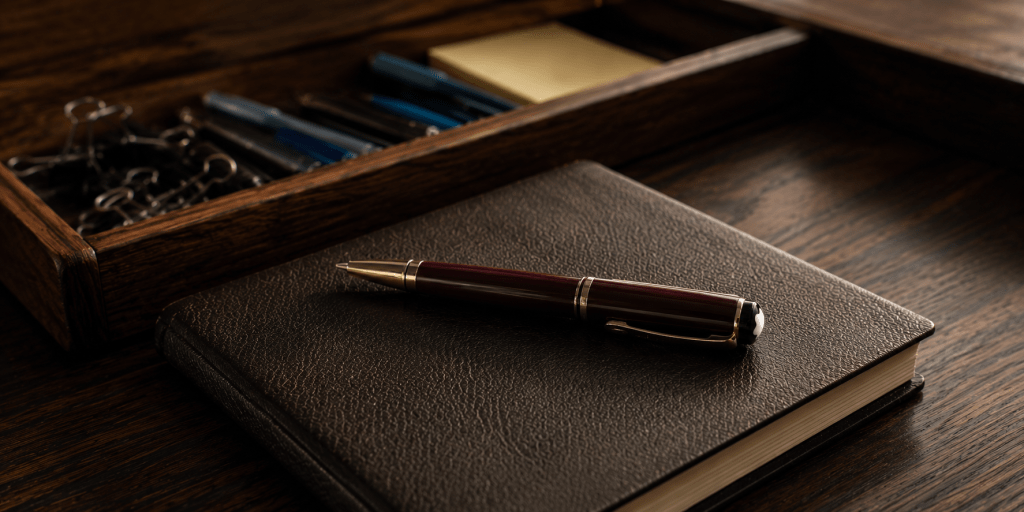
I recently started a new job. Like most new jobs, the first week was filled with orientation, unfamiliar faces, and the slow process of making an anonymous cubicle feel a little less anonymous. The top drawer in the cabinet under my desk became the natural place to keep my notebook. For the first few days, I opened that drawer several times a day without giving much thought to what else was inside. There wasn’t much. Paper clips. Rubber bands. A few forgotten sticky notes. A handful of pens lying together in the back of the drawer.
Later in the week, while reaching for my notebook, something caught my eye. Among the disposable pens with vendor logos was an old-looking burgundy pen. It wasn’t flashy. If anything, it seemed oddly out of place. I picked it up for the first time.
Then I noticed the small white snowcap on the top. I recognized it immediately. It was a Montblanc.
I suspect several people had opened that same drawer before I did. They were probably looking for a pen that still had ink. They may have even picked it up before tossing it back among the others. Unless you know what that little white emblem represents, it is simply another pen. Nothing in the drawer had changed. Only the eyes that looked into it.
My first instinct wasn’t to slip it into my pocket. I wrote with it a couple times and then put it back in the drawer. The next day, I carried it to my boss and asked if anyone knew who it belonged to. Perhaps someone had simply forgotten it while changing cubicles. Maybe they would come looking for it. Only after asking around did we conclude that its owner was no longer there. Only then did I accept it as my own.
Even then, “my own” feels too strong. I am simply its next steward. That thought has stayed with me longer than I expected.
Who carried this pen before me? Did it sign hiring papers or retirement letters? Budgets or birthday cards? Was it a gift marking a promotion? Did it become so familiar that its owner stopped noticing it? Or was leaving it behind an intentional act, a quiet way of closing a chapter of life they no longer wished to revisit? It is real, or its it a counterfeit?
As to its provenance, I’ll never know. The mystery is part of the gift. It occurred to me over the weekend that I had been asking the wrong questions. I wondered who owned it, what it was worth, and why it had been left behind. But a pen isn’t the story. It is simply the tool that puts the story to paper. This one just happened to invite mine. As I pondered, I became less interested in what the pen is worth and more interested in why I noticed it in the first place.
I keep thinking about a scene in A Gentleman in Moscow. Count Rostov joins Abram, the hotel’s elderly beekeeper, on the roof of the Metropol. Together they taste fresh honey and wonder where the bees gathered their nectar. Most of us would simply call it honey. Abram tastes apple blossoms. Rostov recognizes them too. Neither man is displaying refinement for refinement’s sake. They are simply delighting in a world richer than it first appears.
The honey hadn’t changed. The tasters had.
It occurs to me that this is true of almost everything worth loving. A musician hears harmonies that escape the untrained ear. A cabinetmaker notices the joinery before the finish. A historian sees generations of decisions in an old courthouse. An experienced cybersecurity analyst notices the one anomalous packet in a sea of ordinary traffic.
The world is the same. The eyes are different.
Perhaps education, in its highest sense, is not merely the accumulation of knowledge. Perhaps it is the cultivation of discernment. It teaches us to recognize what has been there all along.
Every craft has its trusted tools. A mechanic reaches instinctively for the wrench that has never failed him. A woodworker develops an affection for a favorite plane. A surgeon knows the balance of familiar instruments. A writer may carry the same pen for decades. The tool itself is rarely the point. It becomes an extension of the hand that has learned its craft.
While learning more about the pen, I discovered that Montblanc calls this line the Meisterstück. We usually translate the word as “masterpiece,” but the older meaning is richer. A Meisterstück was the work an apprentice presented after years of learning his craft. It wasn’t simply a beautiful object. It was evidence that the craftsman himself had been formed. There is no masterpiece without the craftsman. The masterpiece is not what makes the master. It is what affirms his mastery of a trade.
Perhaps that is true of more than craftsmanship. Our work, our habits, our judgments, and even the things we learn to notice gradually reveal the people we are becoming. Every ordinary day gives us another opportunity to refine our character, discipline our attention, and cultivate the discernment to recognize truth, beauty, craftsmanship, and goodness where they quietly appear.
We live in an age that rewards whatever shouts the loudest. Logos grow larger. Brands become more conspicuous. We are taught to notice what demands our attention.
But many of the finest things in life do not announce themselves. A forgotten pen in a desk drawer. A spoonful of honey that tastes of apple blossoms. A faithful friend. A wise teacher. A well-worn book. They wait patiently for someone who has learned how to see.
It happened to be a Montblanc. Had it been another well-made tool left behind by another careful craftsman, I suspect I would have found myself asking the same questions. The pen was never really the point. It was simply the invitation.
I wonder how many remarkable people, ideas, and opportunities pass through our lives unnoticed, not because they were hidden, but because we never cultivated the discernment to recognize them. Tomorrow morning, I’ll open that drawer again to retrieve my notebook. The pen will still be there, waiting quietly beside it. But I doubt I’ll ever look into that drawer quite the same way again.
