
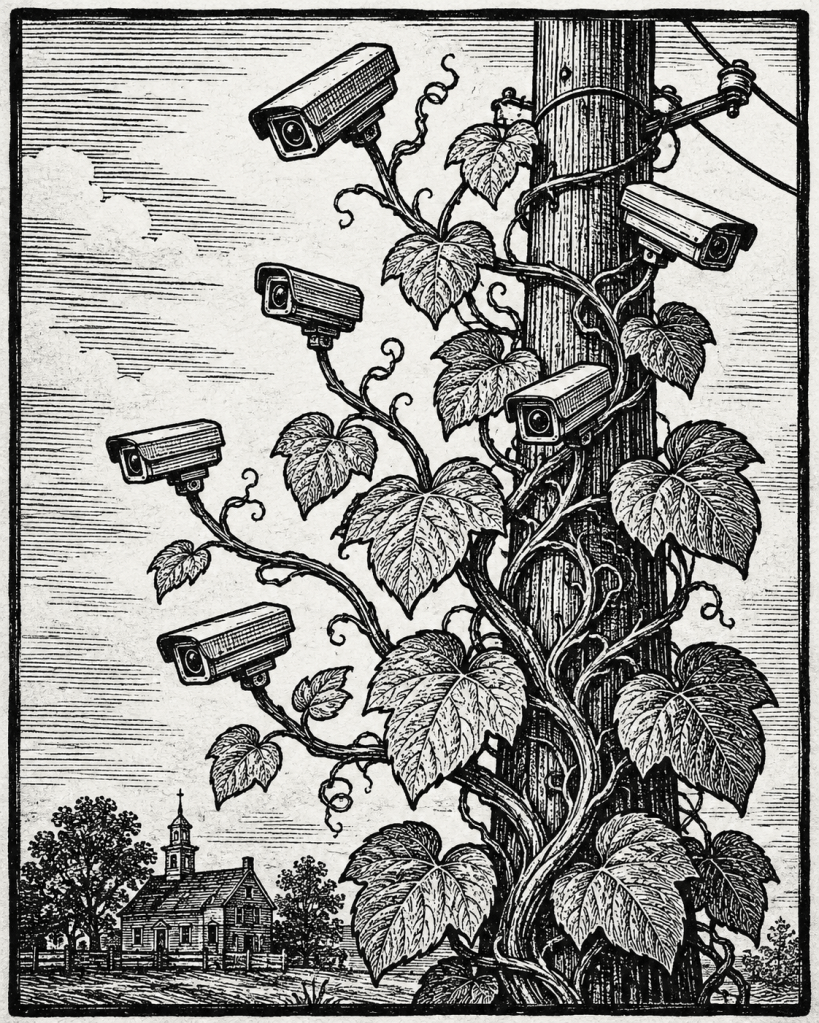
It was planted to stop erosion. It fed cattle. It was praised by experts and promoted by the government. Then it crossed the fence line. Today it covers forests, barns, telephone poles, and most of my backyard.
Kudzu never asked permission. Neither does power. Every generation invents a new reason to surrender an old liberty. Every generation insists this time will be different.
We are told that surveillance systems such as Flock cameras make us safer. We are told they recover stolen cars, find missing children, and help catch criminals. Some of that is true.
It was also true that kudzu stopped erosion.
The question is not whether a thing is useful. The question is whether it stays where it was planted.
The Constitution was written because the Founders understood the nature of power. Anyone who has fought kudzu understands it too.
Flock cameras and their ilk threaten to swallow the Fourth Amendment.
The men who wrote that amendment had seen what happened when a government claimed the authority to watch first and accuse later. They had lived under general warrants and writs of assistance. They knew that power rarely announces itself as tyranny. It arrives as necessity. It asks only for one exception. Then another.
Thomas Jefferson warned that “the natural progress of things is for liberty to yield and government to gain ground.” Two hundred and fifty years later, his words read less like history than prophecy. We were assured these systems would be used to find stolen vehicles and violent criminals. Now they are being used in some jurisdictions for ordinary traffic enforcement.
The first exception has already been made. Nor is the camera the end of the story. The same poles are becoming platforms for something larger. Cameras are joined by microphones, traffic sensors, environmental monitors, and other devices that watch, listen, record, and remember. Each new sensor is defended on its own merits. Together they form something their designers seldom describe.
Jeremy Bentham would have recognized it immediately. The Founding Fathers and Bentham lived in the same century but imagined two very different societies. Madison imagined a republic where government was restrained from searching the innocent. Bentham imagined a prison where the possibility of observation became a form of control.
One gave us the Fourth Amendment. The other gave us the Panopticon.
Bentham did not design the Panopticon out of malice. He designed it in the name of efficiency. Kudzu was planted in the name of conservation. Flock cameras were installed in the name of public safety. Every age has its own reasons for cultivating the vines that eventually overtake it.
Power seldom expands by revolution.
It expands by revision.
It expands by emergency.
It expands by exception.
We are told the measure is temporary.
We are told the threat is extraordinary.
We are told the innocent have nothing to fear.
We have been living under temporary measures for a quarter of a century.
Today, governments need not build every instrument of surveillance themselves. Increasingly, private enterprise builds the infrastructure, aggregates the data, and normalizes the practice. Government simply discovers that the machinery already exists. The Panopticon has become a marketplace.
A technocracy mistakes capability for wisdom. The Constitution does not.
The Constitution is not a grant of power. It is a restraint upon it.
Every summer I cut the kudzu back. Every summer it comes back just as thick. I’ve learned something from fighting that vine. You cannot prune kudzu into submission. You have to dig up the roots. Power, left without constitutional restraint, is much the same.
We have spent a quarter of a century pruning the branches of extraordinary power while leaving its roots untouched.
The greatest threats to liberty rarely arrive wearing the face of oppression. They arrive wearing the face of improvement. A citizen is presumed innocent. A subject is expected to be observable.
We have mistaken surveillance for security. We have surrendered citizenship for subservience.
The Constitution was never meant to be efficient. It was meant to be free.
James Madison understood that government is necessary because men are not angels. He also understood that those who govern are not angels. That is why he gave us constitutional restraints instead of constitutional promises.
James Madison and his fellow patriots did not write the Bill of Rights because they distrusted criminals. They wrote it because they distrusted power. So should we.
Benjamin Franklin is often credited with writing, “Those who would give up essential Liberty, to purchase a little temporary Safety, deserve neither Liberty nor Safety.” Historians have debated the original context and wording for years. They can continue that debate if they wish.
I think he may have been right.
In Conversation With
This essay is informed by a long tradition of constitutional thought rather than contemporary politics. It draws upon the Founders’ understanding of limited government, the dangers of concentrated power, and the enduring necessity of constitutional restraints. Among the thinkers whose ideas inform this essay are:
- James Madison, particularly his defense of separated powers, the Bill of Rights, and constitutional restraints on government.
- Thomas Jefferson, whose warnings about the natural tendency of government to expand remain remarkably relevant.
- Benjamin Franklin, whose reflections on liberty and security continue to shape the American civic tradition.
- Jeremy Bentham, whose concept of the Panopticon provides a powerful framework for understanding the relationship between observation and social control.
- Thomas Paine, whose plainspoken defense of liberty and constitutional self-government inspired the tone and structure of this essay.
- Thomas Sowell, whose emphasis on incentives, unintended consequences, and the importance of institutions over intentions informs the essay’s treatment of technological and governmental expansion.
- Justice Clarence Thomas, whose originalist approach to constitutional interpretation serves as a reminder that the meaning of constitutional rights should not fluctuate with technological change.
- Shoshana Zuboff, whose work on surveillance capitalism helps explain how private technological infrastructure and public authority increasingly reinforce one another.
The arguments presented here are my own. I cite these thinkers not as authorities to be followed uncritically, but as participants in a centuries-long conversation about liberty, power, and the constitutional limits that preserve a free republic.
