
On Telstar 1, the preservation of technological heritage, and our responsibility to remember the machines that changed the world.
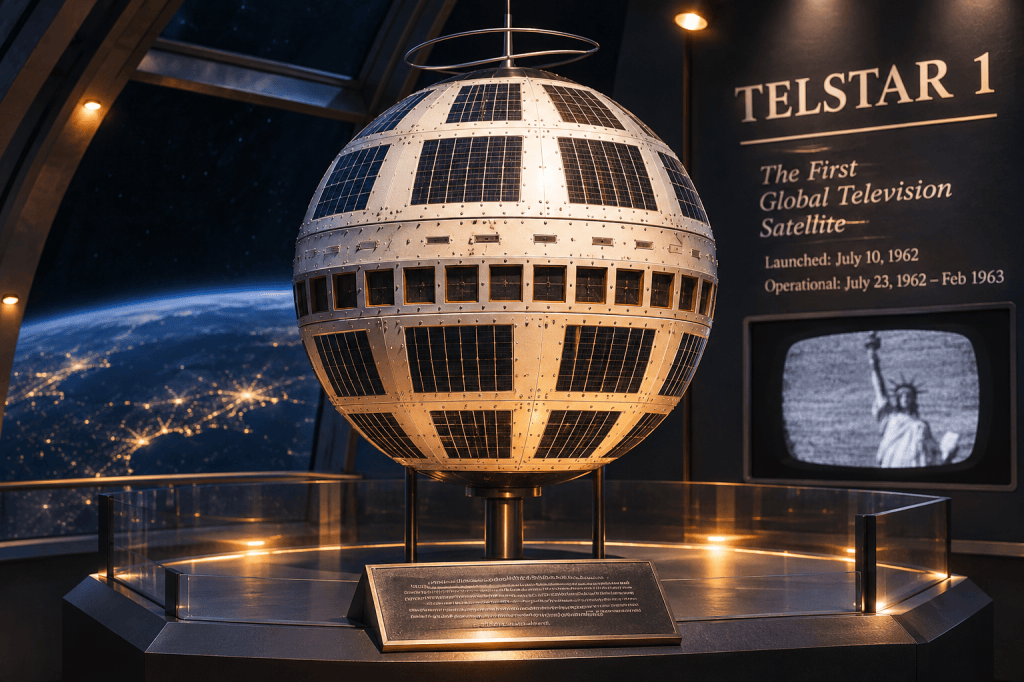
On July 10, 1962, a small metallic sphere covered in solar cells rode a Thor-Delta rocket into orbit from Cape Canaveral, Florida. It weighed approximately 171 pounds, measured just under three feet in diameter, and carried within its modest exterior some of the most sophisticated electronics of its day.
Its name was Telstar.
For a brief period, this small satellite accomplished something that had previously existed largely in the realm of imagination. It received radio signals from one side of the Atlantic, amplified them, and retransmitted them to the other. Television pictures, telephone calls, facsimile transmissions, and data could now travel between continents through an object circling the Earth.
On July 23, 1962, Telstar relayed the first publicly available live transatlantic television broadcast. Viewers witnessed images from both sides of the Atlantic, including the Statue of Liberty and the Eiffel Tower. A baseball game and remarks from President John F. Kennedy followed.
It is difficult to appreciate the significance of that achievement from our present vantage point. We have grown accustomed to instantaneous communication. A person sitting in a rural Alabama home can watch events unfolding in London, communicate with someone in Tokyo, or participate in a meeting with colleagues scattered across several continents. We regard this as ordinary… It was not always ordinary.
Before Telstar, international television required the physical transportation of recorded film. Transatlantic telephone capacity was constrained by expensive undersea cables. The prospect of transmitting live television between continents was a technological challenge that required an entirely new approach to communications infrastructure. Telstar helped change that.
More than six decades later, the original satellite is still orbiting the Earth. It no longer communicates, receives maintenance, or serves any operational purpose. Its electronics were compromised by radiation exposure in the Van Allen belts, and its useful operational life ended in February 1963. Yet the spacecraft itself remains.
And that raises a rather interesting question: What responsibility do we have to preserve the physical artifacts of the technological achievements that created the modern world?
The Things We Leave Behind
There is something peculiar about the way we treat technological history. We preserve the manuscripts of great writers, the instruments of great composers, the weapons of historic battles, and the buildings in which important events occurred. We establish museums, archives, and historical societies to ensure that succeeding generations have some tangible connection to the people and events that preceded them.
But technological history often receives a different treatment.
The machines that fundamentally alter human civilization are frequently regarded as obsolete almost as soon as their successors arrive. Their usefulness expires, their components are harvested, and their remains are discarded. The very devices that make possible our modern existence become the least likely candidates for preservation. Sometimes, even the knowledge they contain is nearly lost.
A recent discovery at the University of Utah offers a rather remarkable illustration. In the summer of 2025, a research associate named Aleks Maricq, while cleaning out a university storage room, discovered a nine-track magnetic tape labeled as containing an original copy of UNIX Version 4 from Bell Laboratories. The tape dated to 1973 and was believed to contain the only surviving copy of this particular version of the operating system. In December 2025, specialists at the Computer History Museum undertook the delicate process of recovering its contents. By January 2026, the recovery had been confirmed.
This was not simply an exercise in computer nostalgia. UNIX Version 4 represented an important turning point in operating system development, being among the earliest versions to be rewritten substantially in the C programming language. That decision helped establish the portability and architectural principles that would influence subsequent generations of operating systems, including BSD, Linux, and macOS.
The irony is difficult to overlook. A comparatively small reel of magnetic tape, containing roughly 1970s-era computing technology, held information with an influence extending into the smartphones, servers, and network infrastructure we use today. Had that tape been discarded, overwritten, or damaged beyond recovery, an important piece of computing history might have disappeared with it.
The discovery also demonstrates how fragile technological heritage can be. The tape could not simply be placed into an ordinary reel-to-reel reader. Its age and physical condition made that approach potentially destructive. Recovering the information required specialized equipment, careful handling, and the expertise to reconstruct data from an aging magnetic medium.
Consider the progression of communications technology.
The telegraph compressed distance through electrical signaling. The telephone gave the human voice an almost instantaneous reach across geographical boundaries. Radio made broadcasting possible. Television brought distant events into the living room. Then came the communications satellite, followed by fiber-optic networks, cellular systems, the Internet, and the increasingly interconnected digital infrastructure upon which modern civilization depends.
Each generation stands upon the accomplishments of the preceding one.
Yet how many people could identify the machines responsible for these transformations? How many could explain the significance of Telstar, the Interface Message Processors that formed the original ARPANET, the switching systems developed by Bell Laboratories, or the operating systems that emerged from its research?
We remember the convenience. We forget the engineering. And sometimes we nearly lose the engineering itself.
The UNIX V4 discovery is a reminder that preservation is not limited to saving physical machines. It also means preserving source code, magnetic media, technical documentation, schematics, engineering notebooks, and the accumulated knowledge of the people who created these systems. A computer without its software is little more than an assemblage of components. Software without the historical context of its development is similarly diminished.
This is not merely a problem of historical trivia. It is a problem of cultural memory. When we lose the physical artifacts and intellectual records of technological achievement, we lose opportunities to connect abstract accomplishments with the people, institutions, and ingenuity that made them possible.
A photograph of Telstar is interesting. A scale model is useful. But the original spacecraft, the actual object that completed those first transatlantic transmissions, represents something altogether different.
It is a surviving artifact of the moment when the world became smaller.
The Smithsonian National Air and Space Museum maintains a backup Telstar spacecraft in its collection. That is important and worth celebrating. But the backup is not the spacecraft that actually flew. The original remains in orbit, a silent monument to an achievement that deserves more than a passing mention in the history of telecommunications.
A Museum Without Walls
This brings me to an idea that might initially sound somewhat eccentric: Why not establish a museum in space?
Not another museum that merely displays photographs of rockets and satellites. Not another digital collection of archival materials. Rather, a deliberate effort to preserve and interpret humanity’s early space heritage, beginning with the original Telstar 1.
I recently started a petition asking Elon Musk and SpaceX to consider funding an engineering feasibility study to explore this possibility.
The choice of SpaceX is not arbitrary. Commercial spaceflight has changed the economics and practical considerations of reaching orbit. Reusable launch vehicles, commercial payload services, and the expanding Starlink infrastructure have created opportunities that would have been difficult to contemplate when Telstar first launched.
The proposal is not that SpaceX should immediately dispatch a spacecraft to retrieve Telstar. That would be an extraordinary engineering undertaking, and there are legitimate questions about its technical feasibility, cost, and preservation requirements. The first step should be considerably more modest: determine what is possible.
Could Telstar be located, approached, and safely inspected? Could its orbit be modified or stabilized? Would retrieval be feasible, or would an in-orbit preservation mission be more appropriate? What would be required to protect the spacecraft from further deterioration? What international, regulatory, and ownership considerations would have to be addressed?
These are questions for aerospace engineers, orbital mechanics specialists, historians, conservators, and communications professionals.
The answers might demonstrate that physical preservation is impractical. They might reveal that an entirely different approach is necessary. But we should at least investigate the possibility before accepting that the original Telstar must remain an anonymous object in orbit until its eventual reentry. There is also an opportunity to think beyond Telstar itself.
An orbital museum could become a platform for documenting the history of human spaceflight and the technological achievements associated with it. Its collections could include digital reconstructions, engineering documentation, archival recordings, telemetry, mission histories, and educational programming.
Starlink and other communications infrastructure could help make these collections accessible to a worldwide audience.
The museum need not require every visitor to travel into space. Indeed, the overwhelming majority of visitors would experience it from Earth. The physical artifact would remain the centerpiece, while digital exhibits would make its history accessible to students, researchers, and the general public. In time, as commercial spaceflight develops, perhaps the possibility of an actual visit could become more than an interesting thought experiment.
The point is not to create another tourist attraction. It is to establish a new way of thinking about the preservation of human achievement beyond the boundaries of Earth.
The Responsibility of Stewardship
There is a distinction between owning something and being its steward.
Ownership concerns possession. Stewardship concerns responsibility.
The distinction becomes particularly important when considering artifacts that transcend the interests of their original creators or owners. Telstar was developed by Bell Telephone Laboratories for AT&T, launched in cooperation with NASA, and operated during a period of considerable geopolitical competition. Its significance, however, extends well beyond the organizations that designed, funded, and launched it.
Telstar belongs to the history of humanity’s technological development.
Its story is simultaneously American, scientific, commercial, and international. It represents the intersection of private enterprise, government cooperation, engineering ingenuity, and the desire to overcome the limitations imposed by geography. There is something worth preserving in that story.
We should be careful not to confuse technological progress with the simple replacement of old things by new ones. Progress does not require amnesia. The arrival of a better communications satellite does not diminish the significance of the first one. The development of modern computing does not make the ENIAC irrelevant. The existence of fiber-optic networks does not render the history of copper telephone infrastructure unworthy of preservation. If anything, the more advanced our technological systems become, the more important it is to understand how we arrived here.
A society that cannot remember its technological foundations risks becoming dependent upon systems it no longer understands. It may possess extraordinary tools while losing the historical and intellectual context necessary to appreciate their significance.
There is an interesting fictional illustration of this in the Fallout universe. The Brotherhood of Steel, one of the franchise’s most recognizable factions, has made the preservation and recovery of pre-war technology central to its identity. Its members collect technical artifacts, safeguard weapons and equipment, recover lost knowledge, and maintain capabilities that much of the post-apocalyptic world has forgotten. In many respects, they have become custodians of a technological civilization that no longer exists.
Yet the Brotherhood also offers a cautionary lesson. Its reverence for technology can become an end in itself. Knowledge is guarded, access is restricted, and the preservation of technological artifacts sometimes takes precedence over the broader purpose those technologies were originally intended to serve. The Brotherhood understands that knowledge is power, but its institutional culture frequently struggles with the distinction between preserving knowledge and controlling it.
There is a useful distinction here. Preservation should not become hoarding, and historical stewardship should not become technological priesthood. The purpose of remembering how something works is not simply to possess the knowledge, but to ensure that it can be understood, improved, and responsibly applied by those who follow.
This is particularly important for younger generations. They inherit a world in which connectivity is assumed, computing is ubiquitous, and information appears to exist independently of the physical infrastructure that carries it. They interact with increasingly sophisticated systems without necessarily understanding the engineering, scientific discoveries, and accumulated human experience that made those systems possible.
We should aspire to something better than the Brotherhood of Steel. We should preserve our technological heritage not to restrict access to it, but to make certain that future generations can understand it, learn from it, and build upon it.
They deserve to know that this world was built.
It was built by engineers who solved difficult problems, technicians who maintained complicated systems, scientists who challenged accepted assumptions, and institutions willing to invest in experiments whose outcomes were far from certain. Telstar is one small, remarkably tangible example of that work.
A Monument to Curiosity
There is another reason I find the idea of preserving Telstar compelling. The early Space Age was characterized by a particular kind of optimism. It was not necessarily an uncomplicated optimism, nor was it detached from the political and military competition of the Cold War. But it reflected a willingness to attempt things that had never been done.
The people who designed Telstar did not have the benefit of six decades of satellite communications experience. They were working with comparatively primitive electronics, limited computing resources, and an incomplete understanding of the operating environment they were entering. They built something, launched it, and learned from the results.
Telstar’s operational life was short. Radiation damage compromised its electronics, and subsequent improvements were necessary. But its historical significance cannot be measured by the number of years it remained operational.
Its importance rests in what it demonstrated.
There is a lesson here for our own technological age. We frequently celebrate the newest device, the latest platform, or the next major breakthrough while giving relatively little attention to the accumulated knowledge that made those developments possible. Perhaps we should occasionally look backward before rushing toward the next horizon.
The original Telstar is still out there, circling the Earth. It is a small object, largely forgotten, but it represents a remarkable chapter in the story of human ingenuity. We have the means to study it. We have the institutions capable of preserving its history. We have commercial spaceflight companies capable of attempting missions that previous generations could only imagine.
What we lack, at least for now, is a collective decision that this particular piece of our history is worth preserving. I would like to see that change.
We should not simply leave our history floating in orbit until it disappears. We should investigate whether we can preserve it, interpret it, and make it accessible to future generations. Telstar carried the first publicly available live television signals across the Atlantic. It helped make a connected world possible. It seems fitting that we should find a way to keep its story alive.
The last broadcast need not be the end of the story.
In Conversation With
The following works and historical resources provide useful starting points for further exploration of the ideas presented here.
- NASA, “Telstar Opened Era of Global Satellite Television.” A historical account of Telstar 1’s launch, engineering, and role in establishing transatlantic television communications. An important reminder of how a relatively small spacecraft helped change the way humanity communicates.
- Smithsonian National Air and Space Museum, “Communications Satellite, Telstar.” Documentation of the engineering backup spacecraft preserved in the Smithsonian collection. The distinction between the surviving museum artifact and the original flight vehicle is particularly important to the preservation argument.
- University of Utah, “Kahlert Researchers Discover a Piece of Computing History.” The November 2025 announcement of the discovery of a nine-track magnetic tape believed to contain the only surviving copy of UNIX Version 4. The subsequent recovery by the Computer History Museum demonstrates the importance of preserving not only hardware but also the software and intellectual heritage embodied in aging storage media.
- The Unix Heritage Society, UNIX Version 4 Archive. An opportunity to examine the recovered UNIX V4 distribution itself. The November 1973 release represents an important milestone in the transition toward portable operating systems through the use of the C programming language.
- John R. Pierce, An Introduction to Information Theory: Symbols, Signals and Noise. A useful companion for considering the intellectual foundations of modern communications and the engineering principles that made systems such as Telstar possible.
- Bethesda Game Studios, “Faction Profile: The Brotherhood of Steel.” A behind-the-scenes discussion of one of the Fallout franchise’s most recognizable factions. The Brotherhood’s mission to recover, catalog, and preserve the technological knowledge of the pre-war world provides an interesting fictional examination of technological stewardship, institutional control, and the dangers of treating knowledge as something to be hoarded rather than shared.
- The Original Telstar Preservation Petition. An invitation to participate in the effort to investigate the preservation of this important artifact of the early Space Age.
