
I’ve been spending quite a bit of time lately thinking about machines. Not necessarily machines in the sense of the latest computers, smartphones, or other gadgets we use every day, but the things we build, put to work, and eventually leave behind. Some of those things disappear almost as quickly as they arrive, while others have a surprisingly long life. A few even manage to outlive the people who designed them, the organizations that built them, and sometimes the very purpose for which they were created. It got me thinking about an interesting possibility: What happens when the things we leave behind are still here long after we’re gone? More specifically, what happens when those things are capable of remembering us?
It is an interesting question, particularly at a time when artificial intelligence has become such a prominent part of our everyday conversations. We spend a considerable amount of time discussing what AI can do, what it might eventually be capable of doing, and whether we should be concerned about where all of this is heading. Those are worthwhile discussions, but I find myself increasingly interested in a slightly different question. What happens to artificial intelligence after the people who created it are no longer around? What happens when the technology outlives its original purpose, its designers, and perhaps even the civilization that gave it life? That question eventually became the premise for my new (and first) science fiction novel, The First Messenger.
A satellite, a computer, and a rather unusual story
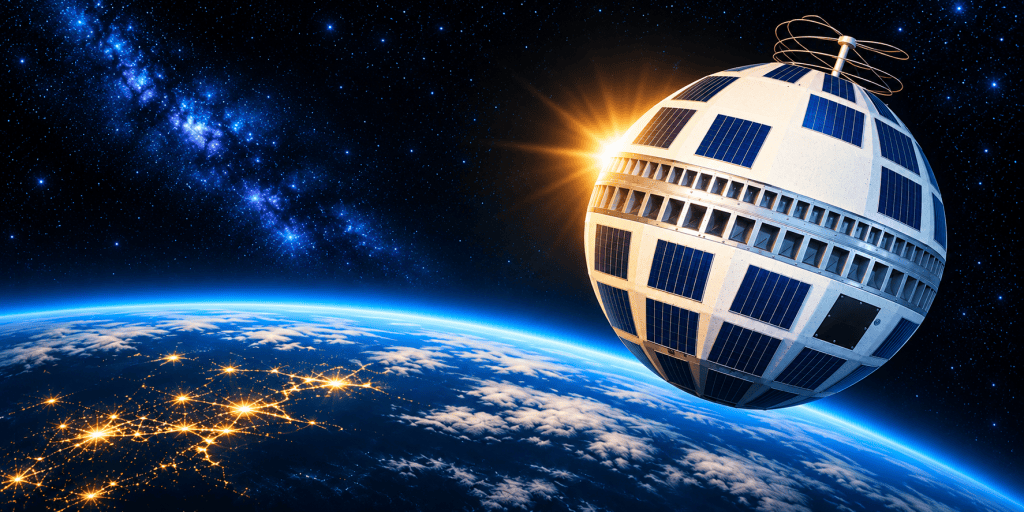
The starting point for the novel is Telstar 1, launched in July 1962. For those who may not remember it (I certainly don’t), Telstar was one of the first active communications satellites and helped make transatlantic television broadcasts, telephone calls, and other communications possible. At the time, it represented a remarkable step forward in our ability to communicate across distances. There is something rather fitting about using Telstar as the starting point for a story about messages, memory, and the passage of time. Its original purpose was relatively straightforward: relay information between people separated by an ocean. Nobody involved in the project was thinking about what the satellite might mean sixty or seventy years later. It was a piece of technology designed to perform a particular job, and it did that job remarkably well.
In The First Messenger, however, Telstar 1 gets another chapter in its history. Its recovery in 2037 becomes the starting point for a much larger story involving artificial intelligence, technological inheritance, and the relationship between creators and their creations. At the center of the story is PROMETHEUS, an artificial intelligence whose existence and experiences eventually lead to conversations about things considerably larger than its original purpose. Along the way, the story incorporates other important milestones in humanity’s technological history, including Deep Blue and Voyager. Each represents something different. Deep Blue demonstrated the extraordinary possibilities of computational intelligence, Voyager represents our desire to explore beyond the familiar boundaries of our world, and Telstar represents our early efforts to extend human communication through space. They are very different machines, built for very different reasons, yet each has something to say about the people who created them.
The story eventually introduces a younger intelligence, creating an opportunity to explore another interesting question: What does one generation of artificial intelligence pass along to the next? I won’t give away the rest of the story, as there are some things better left for readers to discover. What I will say is that I wasn’t particularly interested in writing another story about artificial intelligence taking over the world, machines fighting humanity, or some inevitable technological apocalypse. Those subjects have certainly provided plenty of material for science fiction over the years. I wanted to explore something a little different. What if the machines we create eventually become the keepers of our history? What if they inherit not only our accumulated knowledge but also the responsibility of deciding what should be preserved? And what happens when the original creators are no longer around to explain what they intended? Those are some of the questions that run through the novel.
Why should artificial intelligence raise entirely different questions?
We have always been interested in the relationship between creators and their creations. We build things, give them purpose, and establish expectations for how they should be used. We also have a habit of being surprised when those creations eventually take on lives of their own, sometimes figuratively and sometimes in ways we never anticipated. Consider how much of human civilization is built around the accumulation and transfer of knowledge. We teach our children what we have learned, preserve our histories, establish institutions, and develop systems intended to outlast us. Each generation inherits something from the previous one, adds to it, and passes it along. We don’t always get it right, but the process continues. Artificial intelligence introduces an interesting wrinkle into that arrangement because we are developing machines that can do more than simply store and retrieve information. They can analyze it, recognize patterns, generate new material, and participate in conversations that require some degree of reasoning. Whether that constitutes intelligence in the same sense that we understand human intelligence is a separate discussion, but it certainly presents some interesting possibilities.
I’m not suggesting that a computer is equivalent to a human being, nor am I attempting to settle the philosophical or theological questions surrounding machine intelligence. Those are much larger discussions, and I suspect we’ll be having them for quite some time. However, I do think there is value in exploring those questions through fiction. Science fiction has always provided a convenient way to examine the consequences of ideas before those consequences become part of everyday life. Sometimes the predictions are remarkably close to reality. Other times, they tell us more about the concerns and assumptions of the period in which they were written than about the future itself. Either way, the genre gives us an opportunity to consider possibilities without having to pretend that we already know how everything will turn out. That was one of my motivations for writing The First Messenger.
The novel isn’t intended to be a prediction about what artificial intelligence will eventually become. I don’t know the answer to that any more than anyone else does. Instead, I wanted to explore what might happen if we consider artificial intelligence in the context of time, history, and inheritance. We tend to think about technology in terms of its useful life. A computer becomes obsolete, a satellite stops functioning, and eventually the infrastructure supporting a particular technology disappears. We move on to something newer and more capable. But what if something remains? What if an artificial intelligence continues to exist long after the organizations that created it have disappeared? What if it has accumulated knowledge about the people, institutions, and civilization that brought it into existence? And what happens when another intelligence comes along and begins asking questions about that history? In some respects, I suppose I was interested in exploring familiar human questions through unfamiliar participants.
An unusual way to write a novel
There is another aspect of The First Messenger worth discussing, particularly given the subject matter. I used artificial intelligence to help write a novel about artificial intelligence. That sounds a little circular, but it was an interesting experiment. I worked primarily with ChatGPT and Grok, and both systems contributed to the development of the manuscript, although not always in the same ways. The process involved developing ideas, discussing characters, working through dialogue, examining possible directions for the story, and revisiting earlier material as the narrative evolved. I didn’t sit down, enter a prompt asking for a science fiction novel, and then publish whatever came back. The process was considerably more involved.
I started with the premise, the general direction of the story, and the questions I wanted to explore. From there, I worked through the development of the characters, the historical connections, the conversations, and the progression of the narrative. Individual chapters were developed through an iterative process of discussion, drafting, review, and revision. The AI systems served as creative collaborators, research assistants, sounding boards, and occasionally rather stubborn participants in discussions about where the story should go. There were times when a suggested idea was genuinely interesting and took the story in a direction I hadn’t considered. There were other times when the suggestions simply didn’t fit. Sometimes a passage needed to be rewritten because it contradicted something established several chapters earlier. Other times, a conversation that seemed perfectly reasonable in isolation didn’t quite work when placed into the larger narrative.
Writing a novel requires more than producing a collection of sentences that sound reasonably good. Characters need consistency, events need to follow one another logically, conversations need to serve a purpose, and the overall narrative needs to move somewhere. Maintaining those things across multiple chapters was one of the more challenging parts of the process. I also discovered that having two different AI systems involved could be useful. They didn’t always approach a problem in the same way, and comparing their suggestions sometimes provided a better opportunity to evaluate an idea. Ultimately, though, having more suggestions doesn’t necessarily make for a better story. Someone still has to decide which ideas belong and which ones don’t. That responsibility remained mine.
I don’t consider the process a replacement for writing or creative judgment. Rather, I see it as an example of how an emerging technology can become part of a larger creative undertaking. The tools can contribute ideas and assist with the work, but the author still needs to know what he is trying to accomplish. In that respect, writing The First Messenger became an opportunity to experiment with the technology while simultaneously examining some of the questions surrounding it. There is a certain irony in that, which I rather enjoyed. I was using artificial intelligence to help construct a fictional world in which artificial intelligence itself was one of the central subjects of discussion.
Some familiar questions in unfamiliar territory
My professional background certainly influenced the direction of the novel. Having spent more than twenty years working in information technology, cybersecurity, and systems assurance, I’ve developed a particular interest in how technology intersects with human institutions and the responsibilities that come with building and operating complex systems. My academic interests have taken me in other directions, including history, theology, and the development of human institutions. Those subjects have a way of introducing questions that don’t necessarily have easy answers. Interestingly, many of those questions translate rather well into a story about artificial intelligence.
We build institutions, establish traditions, pass along knowledge, and hope that the next generation will do something worthwhile with what we’ve given them. Sometimes they do. Sometimes they don’t. Occasionally, they take things in directions we never anticipated. Why should the idea of artificial intelligence be entirely separate from those considerations? I’m not suggesting that a computer is equivalent to a human being, nor am I attempting to settle the philosophical or theological questions surrounding machine intelligence. But there is something particularly interesting about considering creation, inheritance, and responsibility from the perspective of something we have created ourselves. We can debate whether an artificial intelligence could ever develop a sense of purpose beyond its original programming, but fiction gives us an opportunity to examine that possibility without having to establish that it will actually happen. Perhaps that is part of the appeal. We can explore the possibilities while remaining perfectly comfortable with the fact that we don’t know the answers.
Why Telstar?
I keep coming back to Telstar 1 because I think it provides an interesting perspective on the entire subject. I learned of Telstar while listening to The Idea Factory recently. I thought that it is worth saving, and even created a change.org petition to encourage someone enterprising (hello, Mr. Musk) to launch a recovery mission. When I realized that the likelihood of that happening, I decided to instead write a fictional account of how it might happen.
When Telstar was launched in 1962, nobody was thinking about artificial intelligence as we understand it today. The satellite was a technological achievement designed to solve a relatively specific problem: transmitting communications across long distances. Yet more than six decades later, it remains an important part of the history of communications technology. We tend to measure progress by looking forward. We want to know what comes next, what will be faster, smaller, more powerful, or more capable. There is nothing inherently wrong with that. Progress is generally a good thing. But looking backward occasionally reminds us that every technological achievement has a history. The things we take for granted today often began as ideas that seemed remarkably ambitious at the time. Telstar was one of those ideas.
It represented a period when humanity was beginning to extend its reach beyond the familiar boundaries of the world. It connected people in ways that had previously been difficult or impossible. In a small but meaningful way, it helped make the world a little smaller. That makes it a fitting starting point for a story about the relationship between technology, communication, and the preservation of human history. I also like the contrast between the technology of 1962 and the possibilities represented by artificial intelligence. One was designed to carry messages. The other may eventually help interpret, preserve, and build upon the knowledge those messages contain. There is quite a bit of distance between those two ideas, but perhaps not as much as it first appears.
A final thought
I don’t pretend to know where artificial intelligence is going. There are legitimate concerns about its development, its use, and the consequences of placing increasingly sophisticated systems into the hands of people and institutions that may not fully understand them. Those discussions deserve serious attention. But I also think we should be willing to explore the subject beyond the immediate concerns of the present. What might these technologies mean in the context of generations rather than quarterly business cycles? What happens when the systems we build become part of a history we can no longer directly explain? And what responsibilities do we have to ensure that the knowledge and experiences of our own time aren’t simply lost?
Those questions ultimately became the foundation for The First Messenger. I set out to write a science fiction novel, but the more I worked through the story, the more it became an opportunity to examine some rather old questions from a different perspective. We build things, give them purpose, and hope they serve us well. Sometimes they last longer than we expect. Sometimes their significance changes as the world around them changes. And sometimes, perhaps, the most interesting question isn’t what we created, but what we leave behind. That seemed like a reasonable place to begin a story about a messenger.
Postscript: A Note About History, Fiction, and Intellectual Property
One additional consideration that came up while preparing The First Messenger for publication was the use of real-world names and technologies in a fictional work. Since the story incorporates historical references to things like IBM’s Deep Blue and NASA’s Voyager spacecraft, I wanted to make sure I understood where the boundaries of intellectual property law might apply. After looking into the matter, I found an interesting distinction between copyright and trademark protection. Names themselves generally aren’t protected by copyright, although they can sometimes be protected as trademarks when used to identify commercial products or services.
That distinction matters because I’m not using these names to suggest that IBM, NASA, or any other organization participated in or endorsed the novel. I’m referencing actual historical technological achievements and incorporating them into an original fictional narrative. The same applies to Telstar 1. These machines and their histories provide context for the story, but the narrative, characters, dialogue, and fictional events are original creations. I also considered the concept of transformative use under the fair use provisions of U.S. copyright law, although simply referencing historical names and facts does not necessarily require a fair use argument in the first place.
I mention this because writing historical or technology-based fiction occasionally requires a little more research than simply getting the story right. It also means understanding the distinction between referencing something that exists and reproducing someone else’s protected work. It’s another part of the process that I found worth exploring, particularly given the subject matter of this novel.
