
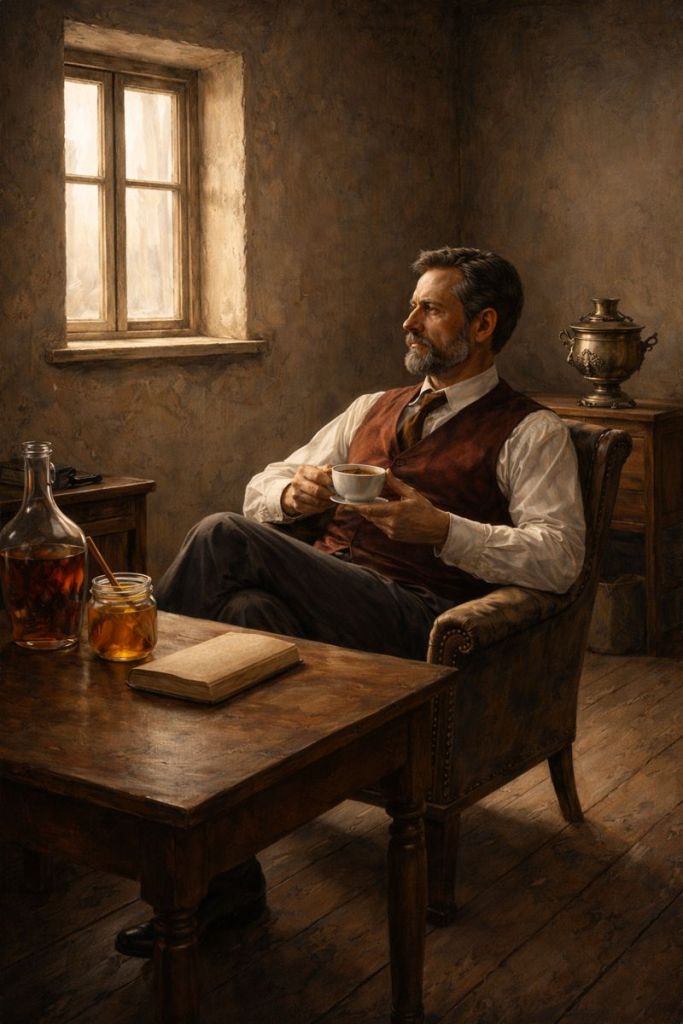
I first met Count Alexander Rostoff through Ewan McGregor’s portrayal in the miniseries—his quiet grace, his sly humor, the way he could make a simple cup of tea feel like an act of rebellion. On my daily commute, I’m revisiting his story in the audiobook, listening as he arranges flowers in the Metropol lobby or guides a child through the quiet art of chess. There is something grounding in it: a life lived within boundaries, yet refused to be diminished by them. I keep thinking, as I often do, that much of living well is simply attending to the small things, the ordinary rituals that anchor us when the world beyond seems unruly.
Even as the series is remarkable—McGregor’s performance, the period detail, the delicate humor and tension—it cannot convey the full depth of Rostoff’s interior life or the richness of the Metropol itself. Towles’ storytelling is exquisite: the way he layers history, character, and small, meaningful details creates a world that feels lived-in and morally resonant. The book lingers in corners the camera cannot reach: in the cadence of dialogue, in the meticulous attention to objects, in the quiet layering of history that surrounds every character. Listening to the audiobook or reading the text allows the mind to inhabit the spaces between lines, to sense the texture of daily life and the weight of choices in ways visual media can hint at but never fully capture. Some truths, it seems, demand the patience of reading and the generosity of imagination.
Rostoff’s house arrest in early Soviet Russia turns the Metropol into a world in miniature. Outside, history convulses—ideologies rise and fall, fortunes vanish, streets fill with fear and rumor—but inside, a single man cultivates skill, friendship, and decency. He becomes a model of agency in constraint: proof that character is less about circumstance than about the choices made within it. For those who notice, the rhythm of these choices echoes patterns older than any individual, shaping and reshaping societies in ways both predictable and surprising. There is comfort in that repetition—the cyclical, almost musical motion of history—because while the external world shifts, the cultivation of virtue remains timeless.
One detail I either missed in the series—or perhaps it was absent—was that Rostoff was reading Montaigne. The thought of him quietly turning pages of the essayist, reflecting on life as both subject and laboratory, struck me. It has inspired me to return to Montaigne myself, to see how observation, curiosity, and humility can refine my own writing. There is a subtle art in noticing the world and recording it with honesty, a kind of inner cultivation that mirrors Rostoff’s approach to living amid constraint. It also illuminates another aspect of his life: while he tends carefully to his own principles, the lives of those he loves are often buffeted by the turbulence beyond his walls. Nina, her daughter, and others he quietly supports remind us that devotion is measured not only in grand gestures but in steady presence—even when circumstances around them seem to fray.
The revolutionaries treated Rostoff’s property with a peculiar mixture of disregard and forgetfulness. Most of his possessions were stripped from him, yet many were left behind, abandoned in storage, as if memory alone could not comprehend their value. The wine bottles, once carefully curated by vintage and region, were left without labels, reduced to little more than “red” and “white,” their subtle nuances and the patience of years dismissed with vulgar casualness. The external world can obliterate markers of refinement, yet it cannot erase the knowledge, the taste, or the discipline accumulated by those who cared for them. The essence endures, even if the world’s hands are clumsy or destructive.
“The external world can obliterate markers of refinement, yet it cannot erase the knowledge, the taste, or the discipline accumulated by those who cared for them.”
There are moments when the weight of it all becomes almost unbearable. At one point, Rostoff reaches the edge of despair, pressed by circumstance, the stripping of his possessions, and the relentlessness of history. It is Abram, the handyman living on the roof, bringing honey with hints of apples from Nizhny Novgorod, who literally calls him back, reminding him of home, continuity, and the enduring rhythms of life. That single taste, carrying memory and rootedness, restores perspective and infuses hope where all seemed lost. It is a small, luminous reminder that some connections endure, even across distance and time—that the essence of place, of culture, of memory, can return to us unexpectedly. Perhaps we are all, in some measure, nourished by the taste of home, even if it arrives only in memory or in the deliberate, attentive acts that anchor us when everything else feels adrift.
“It is a small, luminous reminder that some connections endure, even across distance and time.”
Listening to McGregor, I am struck by the subtle moral steadiness he brings. Rostoff is charming, yes, but he is also deliberate, attentive, and resilient. These are the same qualities that sustain people today, navigating an uncertain American present that often feels as if the rules are shifting beneath their feet. We do not face revolution in the streets, but waves of social, economic, and technological upheaval press against the familiar contours of our lives. Those who maintain principle, cultivate relationships, and practice patience—quietly, deliberately—seem best positioned to meet these tides with poise.
Rostoff’s life is, in essence, an experiment in adaptation: how to find meaning and exert influence even when the world imposes strict limits. We see a modern analog in Americans committed to long-held values: integrity, civic engagement, careful stewardship of family and community. Like Rostoff, they are not leading armies or rewriting constitutions; they are arranging the small but vital details of daily life in a way that allows character and joy to endure. The external pressures may be different, but the internal work is remarkably similar.
A careful reader will notice that I’ve lingered only about halfway through Rostoff’s story. I’ve done so on purpose, not out of negligence, but because what unfolds after that belongs more to the pleasure of discovery than to the argument I’m making here. This is not, in any case, a review so much as a meditation sparked by the book. If anything, I hope these fragments of Rostoff’s life have been an invitation—to seek out the series, or better yet, to sit with Towles’ prose itself (or, failing that, to let the audiobook’s gifted narrator carry you along, which is hardly a lesser experience).
Perhaps that is the quiet lesson of both the Metropol and our era: that history turns in cycles, often unseen until we feel the weight of its currents. Those who notice the patterns, who cultivate steadiness, who engage the world without surrendering their principles, navigate better than those who chase each headline or tremble at every change. The world beyond our walls may rage, but there is always a space within which to live fully, morally, and even joyfully. Rostoff knew it, McGregor shows it, and perhaps, in our own modern ways, so do we.
