
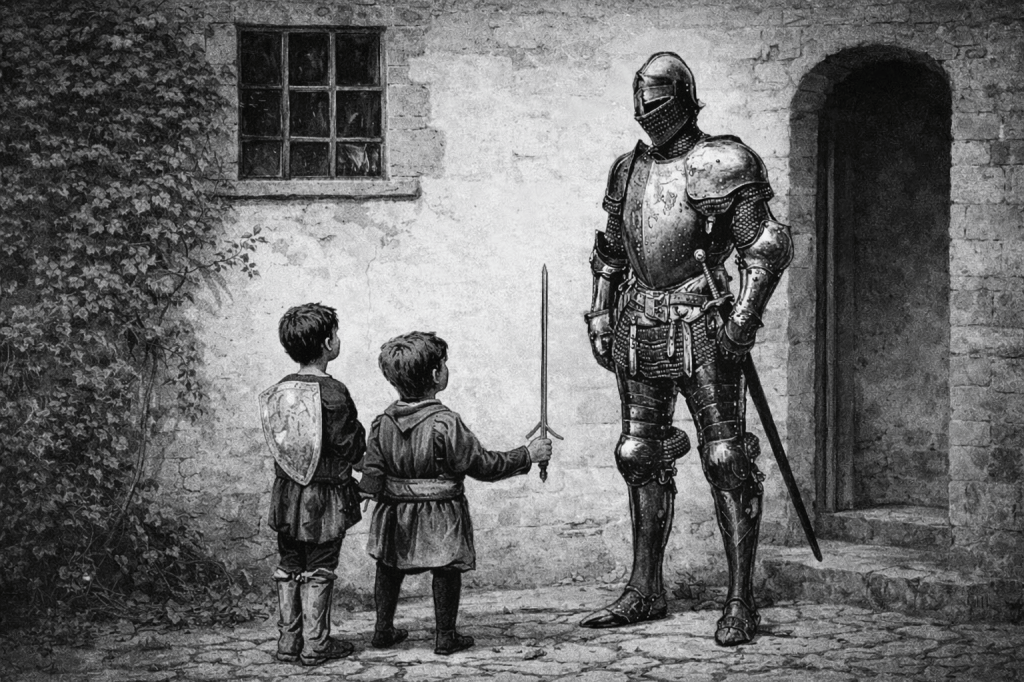
C. S. Lewis once wrote:
“Since it is so likely that (children) will meet cruel enemies, let them at least have heard of brave knights and heroic courage. Otherwise you are making their destiny not brighter but darker.”
I find myself returning to that line out of a growing unease that we may be making the world too safe for the young — and in doing so, quietly leaving them unprepared for what it will eventually demand. Lewis was not writing about fantasy. He was writing about destiny. He was saying that the stories we give the young quietly decide whether they will recognize themselves as the kind of people who can stand when the world turns hard.
Lewis did not merely argue this. He enacted it in Narnia. The Pevensie children are not protected from danger; they are sent into it. Edmund meets betrayal and must live with what he has done. Lucy walks alone into darkness. Peter is forced to decide whether he is willing to lead others into something that might kill them. Narnia is not safe. It is meaningful. Lewis gives children what our age often withholds: the chance to see themselves as capable of courage before life demands it of them.
Tolkien was doing something similar in Middle-earth. His greatest heroes are not mighty kings or seasoned warriors but hobbits — small, overlooked, fond of meals and gardens, more inclined toward comfort than conquest. And yet when the fate of the world rests on a single act of endurance, it is Frodo and Sam who walk into Mordor. Tolkien was quietly insisting that greatness is not about size or strength but about character formed under pressure. The small, if they are willing to bear weight, may be the ones who save what matters most.
What is striking about both Lewis and Tolkien is that they did not write about heroes who were already whole. Edmund betrays before he repents. Lucy trembles before she trusts. Frodo falters. Sam doubts. Boromir falls. Even Aragorn is uncertain of the very bloodline that will make him king. Their stories are not about greatness revealed, but about weakness tested. Courage is not assumed; it is learned.
That same realism drove Baden-Powell. When he returned from Africa, he did not look at British boys and see a nation of latent heroes. He saw bodies softened by city life and wills untrained by hardship. In Scouting for Boys he was blunt about what that meant: a people who could not carry burdens, keep their nerve, or serve something larger than themselves would not endure. War was already gathering, though few yet knew it, and Scouting was not designed as a hobby. It was built as a forge.
- Lewis trained courage in the imagination.
- Tolkien trained it in myth.
- Baden-Powell trained it in mud, rope, fire, and cold nights.
All three, in their very different ways, were wrestling with the same uneasy truth: the world is not gentle, and goodness must be made strong if it is to survive.
When the First World War arrived, that theory was tested. The earliest Scouts became couriers, stretcher-bearers, and soldiers. They volunteered in extraordinary numbers. They were not fearless, but they were practiced in endurance. They had already learned that discomfort is not an emergency and that duty does not vanish when fear arrives. Scouting did not make them violent. It made them reliable.
This essay is not an argument about who matters more. It is a reflection on what I have been given to tend. My life, my work, and this small corner of the internet have been shaped by the task of praising honorable masculinity and refining gentlemanliness — and, if I am honest, trying to turn myself into a better gentleman. That is not a claim about anyone else’s worth. It is simply the field in which I have been called to plow. Time will tell if I see the fruits of my labor.
I was not a Scout as a boy, so I don’t have a nostalgic memory of some towering Scoutmaster from my childhood. What I have instead is a quieter and more demanding standard: the kind of Scout leader described in Baden-Powell’s Scouting for Boys and the early Scoutmaster handbooks. I find myself measuring my own leadership against those pages — men who did not perform authority but carried it, who did not demand respect but somehow received it. That is the kind of man I am still trying to become.
If I am honest, much of what I do in Scouting is not pleasant. Were it not for the hope of seeing my son grow into the man I pray he will become, I doubt I would choose many of its discomforts for myself. As I move closer to half a century of life, sleeping on the ground hurts more than it used to, cold feels colder, and long days feel longer. I endure it because I want him to be formed by something harder and truer than convenience. But somewhere along the trail it has become clear that this discipline is not only for him. I still need it. The path toward being a gentleman does not end with youth. It continues wherever a man is willing to accept difficulty rather than retreat from it.
That realization has changed the way I think about heroism. I don’t know whether our age dislikes heroes, but I do know something about discomfort around the idea of being one. As a Veteran who never saw combat, I feel uneasy when people thank me for my service. I don’t feel heroic. I simply did what my country asked of me. That tension between duty and glory is something Lewis and Baden-Powell understood far better than we do. They were not trying to manufacture legends. They were trying to form men who would do what needed doing when the moment came, whether anyone noticed or not.
Lewis, Tolkien, and Baden-Powell belonged to a world that had learned its lessons the hard way. They did not write or build out of nostalgia. They wrote and built out of memory — the memory of what happens when people are not ready for what comes. What they left behind was not a theory, but a set of tools: stories, disciplines, and habits meant to steady the young when the ground began to shake.
I sometimes wonder whether we have begun to misplace those tools. Not because we have become worse, but because life has become smoother, and smoothness is a terrible teacher. It hides what earlier generations learned by pain.
When I look at my son, I do not see a future crisis. I see a boy who will one day meet a world that will not ask his permission before testing him. One gift I can give him is not protection from that moment, but some share in the hard-earned wisdom of those who have already faced it.
Lewis would have recognized the danger. A world that still produces cruel enemies cannot afford to stop forming brave knights.
- Fantasy gives children aspiration.
- Scouting gives them formation.
- One trains the imagination for courage.
- The other trains the will for it.
The world has not become safer. The cruel enemies have not gone away.
I am not sure I know how to do that well. I only know that I no longer want to pretend it isn’t necessary.
