
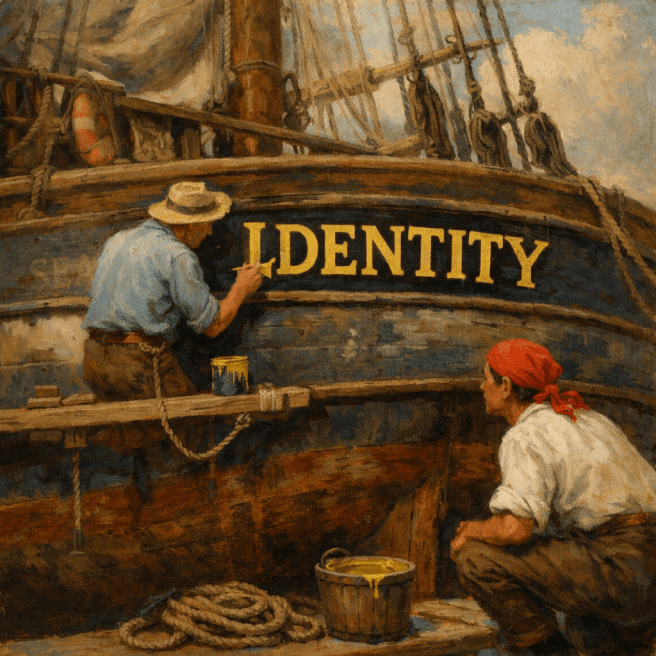
Names fascinate me because they promise clarity while quietly concealing continuity. A new label suggests a new reality, yet the older structure often remains intact beneath the paint. Watching institutions rename themselves feels a bit like standing on a riverbank; the surface moves quickly, but the current below keeps its direction.
The renewed use of the phrase “Department of War” in public language first caught my attention not because it introduced something novel, but because it revealed how easily rhetoric can outpace law. The United States still maintains a Department of Defense as a matter of statute, a structure rooted in the National Security Act of 19471 and its later amendments. That legislation reorganized the former War and Navy Departments into a unified defense establishment, illustrating how institutional identity ultimately flows through Congress rather than through branding alone.¹ An administration may adjust tone or symbolism, but the statutory name remains unchanged unless lawmakers intervene.
This tension between legal identity and cultural presentation is not limited to government. I have watched a similar development unfold within Scouting. The organization many people now encounter publicly as “Scouting America” still rests upon a federal charter granted to the Boy Scouts of America. Federal law recognizes the corporation under Title 36 of the United States Code2, preserving a historic legal identity even as the language presented to the public evolves. Two realities now exist side by side: a name anchored in statute and a name offered to the culture. Institutions rarely abandon their legal roots as quickly as they adjust their outward posture.
A third example arrives not from government or nonprofit life but from the strange theater of popular music. In 1993, Prince changed his stage name to an unpronounceable symbol during a contractual dispute with Warner Bros. Records. Many observers dismissed the move as eccentricity, another chapter in the mythology of a famously enigmatic artist. Yet the decision carried a precise purpose. Prince believed that his own name had become a corporate asset tied to his recording contract, and by adopting a new symbol he attempted to separate his artistic identity from the legal framework that governed his releases. For years he performed under that glyph, often referred to in the media as “The Artist Formerly Known as Prince,” until his contractual obligations expired and he regained the freedom to perform again under his original name in 2000.3 What appeared at first glance to be an act of personal reinvention was, in reality, a public negotiation with legal ownership and institutional power.
I find myself torn between admiration and suspicion when institutions rename themselves. Part of me recognizes that language must evolve if organizations hope to remain relevant. Another part wonders whether a new title sometimes serves as a veil, inviting us to believe that deeper transformation has already occurred. History suggests otherwise. The War Department did not simply disappear when the Department of Defense emerged; it was reorganized through deliberate legislative action shaped by a particular moment in American history. In the same way, Scouting’s broadened language reflects cultural pressure without erasing its chartered lineage. Prince’s symbol, too, reminds us that a name can become a battlefield where legal authority and personal identity collide.
Perhaps what unsettles me is how easily modern discourse confuses branding with substance. We live in an era that treats names as engines of reality, as though a revised logo or a refreshed domain could reshape the underlying institution. Yet the American system seems designed to resist such immediacy. Laws, charters, contracts, and corporate structures create friction. They slow the pace of transformation, forcing organizations—and sometimes artists—to negotiate with history even while they attempt to redefine themselves.
I am not certain whether this friction is a flaw or a safeguard. It can feel frustrating when language races ahead of law, leaving observers unsure which identity carries authority. At the same time, that very slowness prevents institutions from reinventing themselves with every cultural wind. Stability emerges not from the absence of change but from the requirement that change pass through deliberate channels.
Names, then, become a kind of confession. They reveal not only what an institution or artist wishes to emphasize, but how it wishes to be understood. Calling a military bureaucracy “Defense” suggests restraint, yet the older language of “War” carries a blunt honesty about the realities of power and projection. The shift from “Boy Scouts of America” to “Scouting America” feels different in another way. The former sounded like an identity — a clear answer to the question of who the organization was — while the latter reads almost like a statement directed outward, as if responding to the gaze of the nation itself rather than describing an internal character. It sounds less like a name and more like a posture. Prince’s unpronounceable symbol, by contrast, exposed the tension between ownership and selfhood, turning a legal dispute into a visible argument about identity. Each title tells a story, but none of them alone can rewrite the foundations beneath.
I return to the image of an old ship at sea. Crews repaint the hull, replace sails, and rename the vessel in hopes of charting a new course. Yet the keel beneath the waterline changes only through careful reconstruction. Perhaps the wiser approach is neither to celebrate nor to fear new names too quickly, but to watch patiently for the slower work of law and structure that determines whether the institution—or the artist—has truly changed.

Thank you.. very interesting…