
The recent announcement that the Department of War will condition its support for Scouting America on the rollback of certain diversity initiatives has been framed as another chapter in the culture wars. Perhaps it is. But as I have watched the debate unfold, I have found myself less interested in the political skirmish and more unsettled by a deeper question: what do we think citizenship actually is?
My unease predates the Pentagon’s announcement. When the “Citizenship in Society” merit badge was introduced, I remember feeling a quiet discomfort that I struggled to articulate. It was not outrage. It was not even primarily political. It was the sense that something in the phrasing had slipped its anchor.
Part of me understood the impulse behind it. The world is undeniably more interconnected than it once was. Cultural boundaries blur. Information moves instantly. In such a world, bounded citizenship can feel insufficient. It can seem narrow to insist too strongly on national definition when global markets, digital networks, and transnational crises entangle us daily with people we will never meet. I understand why some would want a vocabulary that reflects that complexity.
Christian thought has long held together layered loyalties — devotion to a kingdom not of this world while living faithfully within earthly polities. That tension is not new. It reminds us that ultimate allegiance and civil allegiance are not identical, even when they intersect.
And yet.
Citizenship, in its political sense, has historically meant belonging to a defined community with sovereignty, law, and shared consequence. Aristotle described the citizen as one who participates in the deliberative and judicial functions of the polis. A citizen shares in decision and bears its outcome. That is why citizenship has always implied skin in the game. It is not merely moral concern. It is reciprocal obligation under authority.
Society, by contrast, is diffuse. We participate in it; we influence it; we are shaped by it. But it is not a sovereign body. When I first saw the new badge, I could not shake the feeling that we were moving from citizenship as membership to citizenship as mood.
In conversations that followed, I began to suspect that the badge functioned less as a broad cultural necessity and more as an appeasement to a strong, though not necessarily representative, voice within the movement – a voice intent on reframing Scouting’s moral center. The Oath and Law had long served as the standard. Imperfectly lived, certainly. But central. My concern was not that society should be ignored; it was that new language subtly displaced the Oath and Law as the primary grammar of formation.
Perhaps I was too cautious. Institutional change often feels destabilizing before its fruits are visible. I am willing to admit that possibility. But the categories still matter.
To understand why they matter, it helps to go back to Robert Baden-Powell.
When he returned to Britain from the Boer War at the turn of the twentieth century, he came home celebrated as a hero. Yet beneath the public admiration lay a sobering discovery. Military recruitment during the war had exposed a troubling reality: large numbers of British boys were physically unfit for service. Malnourished. Undisciplined. Unprepared. The empire appeared formidable abroad, but its youth revealed weakness at home.
He had also witnessed something else. Young men had been thrust into conflict they had not anticipated – boys who had not been formed for responsibility before responsibility arrived. War had come whether they were ready or not.
Baden-Powell concluded that the deeper problem was not military but civic. A nation that neglects the formation of its youth eventually discovers the cost, often suddenly, often painfully. Scouting for Boys was his answer. He distinguished between “war scouts” and “peace scouts,” insisting that the skills of observation, resilience, and self-reliance were necessary not only in war but in civil life. His aim was not to produce soldiers but good citizens – young people prepared for responsibility before they knew what form that responsibility might take.
That image lingers with me.
Citizenship is not something one improvises when a crisis arrives. It is cultivated beforehand. It requires structure, discipline, and belonging to something concrete.
The older merit badges – Citizenship in the Community and Citizenship in the Nation – reflect that concreteness. A community has ordinances, leadership, shared infrastructure. A nation possesses sovereignty, law, and defined membership. These badges orient a young person toward real polities – bounded and accountable.
“Citizenship in the World” stretches the term further. I concede freely that Scouting itself transcends national borders. A Scout in Alabama and a Scout in Kenya recognize one another through shared methods and ideals. There is something genuinely beautiful in that international brotherhood. Yet each nation has its own Scouting organization, accountable to its own legal and cultural order. The movement is global; citizenship is not. Political obligation remains tied to particular sovereignty.
This is why phrases such as “global citizen” leave me unsettled. They express something noble – the desire to care beyond one’s own tribe. That instinct deserves respect. We see it taught in the Bible in the story of the Good Samaritan. As a Christian, I do believe there is a sovereign authority over all nations. But His kingdom does not operate as a worldly political order with ballot boxes and tax codes. It transcends every nation even as it judges and redeems them. There is no global civil constitution, no unified earthly sovereignty, no shared electorate before which all humanity stands politically bound. International institutions exist because nations consent to them. They do not replace the nations themselves, nor do they dissolve the particular obligations of citizenship within them.
Perhaps the world’s complexity makes bounded citizenship feel too small to some. I feel that tension. But stretching citizenship into abstraction may not strengthen civic life. It may thin it.
History offers a parallel. In the late 1960s and early 1970s, the Boy Scouts of America attempted to modernize aggressively, softening its outdoor core to appeal to shifting cultural expectations and urban demographics. The impulse was understandable. America was changing rapidly. Yet in blurring its distinctive identity, the movement lost coherence. Membership declined. Volunteers drifted away. It was only when Scouting returned to its outdoor backbone – the laboratory in which resilience, initiative, and leadership were forged – that it regained stability.
Institutions can adapt. They must. But they cannot drift too far from the structures that give them shape.
None of this matters, however, if the adults who lead do not live what they ask youth to recite. Baden-Powell understood that the Scoutmaster must be more than an instructor; he must be an example. The Oath and Law were never meant to be ornamental language. They were meant to be embodied.
Most of us fall short. I certainly do. Trustworthy. Loyal. Brave. Reverent. These are not light demands. There are days I fail them. But falling short does not invalidate the standard. It reminds me why it is necessary.
The boys Baden-Powell observed did not know what trials awaited their generation. Ours do not either. Formation happens before necessity reveals why it mattered.
Citizenship, if it is to mean anything, must remain tethered to real belonging and real responsibility. Ultimate allegiance may transcend nations. Civil allegiance does not. Young people still need to know where they stand – and what belonging asks of them.
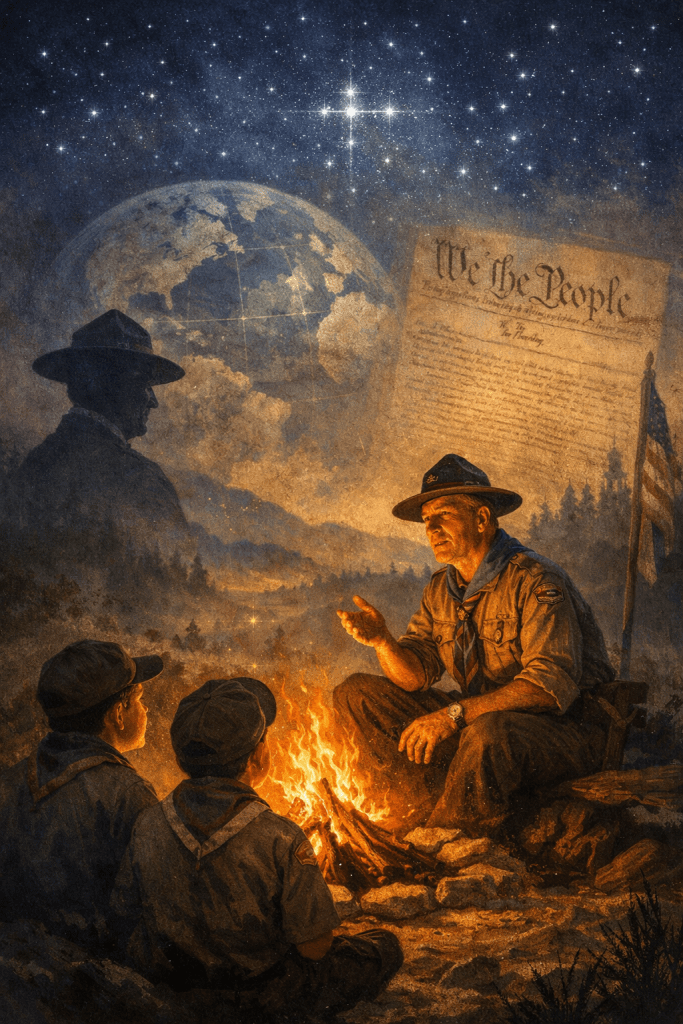
Perhaps that clarity begins not in memoranda or merit badges, but around a campfire, where an adult who has not perfected the Law nevertheless strives to live it – and invites others to try.
