
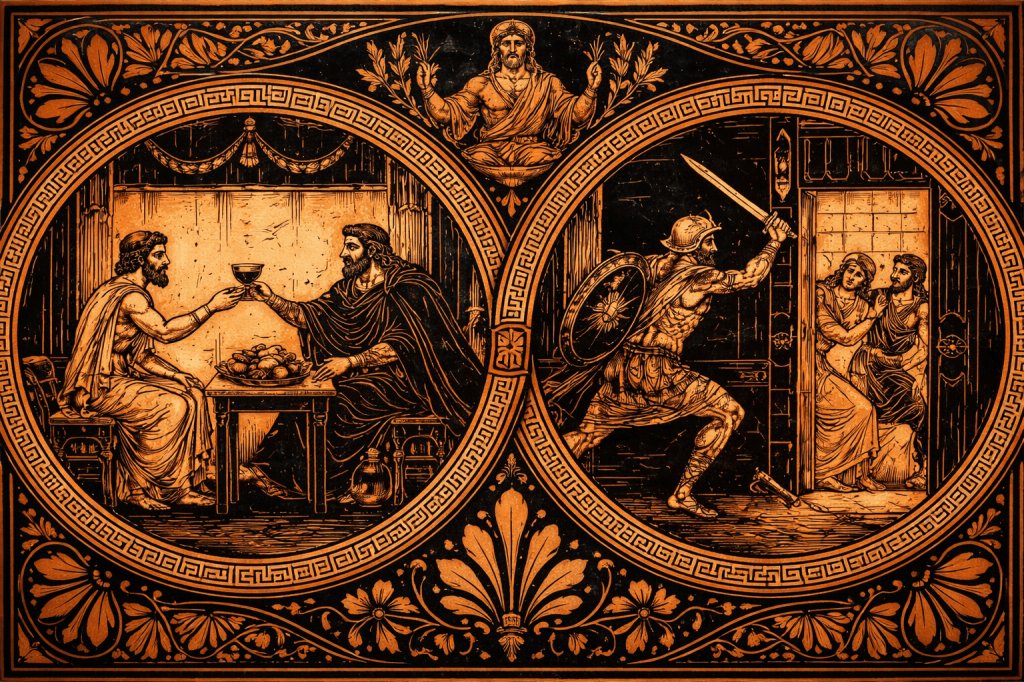
If possible, so far as it depends on you, live peaceably with all1.
This essay began, as many reflections do, not with an argument but with a voice. While listening to the audiobook of Heroes, narrated by Sir Stephen Fry himself, I was struck by how insistently Greek myth returns to the theme of hospitality—its obligations, its violations, and the punishments that follow. Heroes, the second volume in Fry’s mythological sequence (Mythos, Heroes, Troy, Odyssey), quietly accomplishes something difficult: it stitches together the fragmented remains of Greek mythology into a continuous moral landscape. Listening rather than reading, the repetitions became harder to ignore.
What emerges is a civilization deeply concerned with thresholds—who may cross them, under what conditions, and what follows when force replaces consent. Hospitality, and the breaking thereof, is not a peripheral theme in these stories. It is one of their governing anxieties.
Hospitality is one of those virtues that sounds uncomplicated until history begins to press on it. Nearly every ancient culture praised the welcome of the stranger, yet none treated that welcome as limitless. What differed was not whether hospitality mattered, but how societies understood the moment it ceased to be hospitality at all.
The Greek Threshold
In Greek thought, the stranger was a xenos2: a foreigner, a guest, someone unknown but not yet hostile. The word itself carries the tension. A xenos arrives without force, waits to be received, and submits – briefly – to the authority of the household. Hospitality (xenia3) was not kindness alone; it was a moral relationship governed by custom, restraint, and mutual recognition.
Greek literature is equally precise about what happens when those conditions fail.
When coercion enters, the xenos becomes a polemios—an enemy. The term derives from polemos4, war. This is not so much a judgment of character as a change of category. A polemios is not a guest who lingered too long; he is someone who crossed a threshold without consent.
Homer’s Odyssey turns on this distinction. The suitors are not punished for arriving. They are destroyed for refusing limits – consuming what is not theirs, threatening violence, and treating hospitality as entitlement. Odysseus does not slaughter guests. He removes invaders from his home.
What often goes unnoticed is how personal and bounded this hospitality is. Xenia operates at the scale of households and individuals. A single stranger can be assessed, welcomed, expelled. A mass cannot. When numbers grow and coordination replaces consent, the moral vocabulary begins to shift. Armies are never guests. Crowds do not receive xenia. At scale, xenia appears to disappear.
Later Greek writers clarify rather than revise the pattern. Herodotus distinguishes embassies from armies – foreigners who arrive to speak from foreigners who arrive to occupy. Thucydides records how xenia collapses the moment war begins, how moral language hardens when consent gives way to power. Aristotle later formalizes what the poets already assumed: hospitality and friendship require voluntary association. Coercion dissolves moral reciprocity. Proportion matters. Relationship cannot survive overwhelming scale.
Hospitality seems to belong to peace; war, once it begins, introduces a different grammar altogether.
The Jewish Moral Frame
The Hebrew Scriptures approach the same problem from a different direction but arrive at an equally firm boundary.
The Bible repeatedly commands care for the gēr5 – the sojourner, the resident alien. The gēr is landless and vulnerable, dwelling under the law of another people. Hospitality here is not reciprocal exchange; it is moral obligation grounded in memory. “You were strangers in Egypt6” is not poetry. It is ethical foundation.
Yet the language remains exact. The gēr is never confused with the ’ōyev7 (enemy) or the ṣar8 (oppressor). Hospitality flows toward vulnerability, not toward violence. A foreigner who seeks peace may be protected, even incorporated. A foreigner who advances injustice by force is resisted.
Here again, scale matters. The biblical imagination has room for the stranger at the gate, the family within the land. It has no category for extending hospitality to armies or hostile masses. Compassion does not erase discernment. Justice defines the terms.
The Christian Deepening
Early Christianity inherits this moral grammar intact, but presses it inward. The distinction between stranger and enemy is not abolished; it is intensified.
The New Testament radicalizes hospitality by relocating its reference point. The stranger becomes the one in whom Christ may be encountered. Hospitality is no longer merely obedience to law or custom; it becomes imitation. Yet Christianity does not pretend that enemies disappear. Jesus commands love of enemies, not denial of their existence9.
What strikes me, reading the early Christian accounts, is how little effort they make to resolve the tension they inherit.
Early Christians live inside it instead. Figures like Polycarp of Smyrna offer food and prayer to their captors without mistaking arrest for peace10. Justin Martyr prays for persecutors while naming persecution as injustice11,12. Cyprian of Carthage, during plague, urges care even for enemies – yet always as voluntary sacrifice, never as moral confusion13.
Christianity does not collapse xenos into polemios. Nor does it sanctify the sword. It insists instead that even when the distinction must be made, it is never morally comfortable. The enemy may remain an enemy – but he is no longer beyond love, prayer, or the possibility of repentance.
If Greek thought teaches where hospitality ends, and Jewish law teaches whom it protects, Christianity asks what it costs. Whether that cost can ever be borne consistently is a question the tradition itself never pretends to settle.
The Welsh Warning
The Welsh legends supply what the Greek and Jewish sources only imply: what happens when the categories collapse.
In early British tradition, King Vortigern14 invites Saxon leaders – Hengist and Horsa15 – to defend his realm. They arrive not as conquerors but as allies. As guests. As hired defenders.
What follows is not immediate betrayal but gradual transformation. Requests for land become demands. Temporary presence becomes settlement. Defense shades into domination. Hospitality, once extended, is treated as precedent rather than permission.
The legend does not frame this as simple villainy. It presents it as tragic misjudgment. Vortigern fails not because he welcomed strangers, but because he mistook armed power for peaceful presence. The guest crossed the threshold and never accepted its limits.
The result is not moral confusion but historical consequence. The island changes hands. History moves on.
The story functions as ancient stories often do—not as instruction, but as warning.
A Shared Clarity
Across these traditions, the agreement is not theological or political. It is linguistic and moral. Each culture insists on naming the moment hospitality ceases to be intelligible. That this distinction appears so consistently may suggest a shared moral insight—or it may simply reflect a shared fear, refined by long memory.
- The Greeks called it polemios.
- The Hebrews called it ’ōyev.
- The Christians refused to let the name excuse lovelessness.
- The Welsh told a story about forgetting the difference.
The ancients did not lack compassion. They lacked illusions.
They understood that civilization depends not only on opening doors, but on knowing why a door is opened – and when a threshold has been crossed without permission. The stranger knocks. The invader breaks the door. History treated those acts differently, not out of fear, but out of moral clarity.
Listening to these old stories retold in a modern voice, what lingers is not their violence but their precision. Greek myth, Jewish law, and Welsh legend all return to the same anxious question: not whether hospitality is good, but when it ceases to be intelligible.
That clarity did not make the ancient world gentle. It made it coherent. And perhaps that coherence, more than the myths themselves, is what still holds the ear.
Footnotes:
- https://www.esv.org/verses/Romans+12:18/ ↩︎
- https://biblehub.com/greek/3581.htm ↩︎
- https://biblehub.com/greek/3578.htm ↩︎
- https://biblehub.com/greek/4171.htm ↩︎
- https://biblehub.com/hebrew/1616.htm ↩︎
- https://www.esv.org/verses/Leviticus+19:34/ ↩︎
- https://biblehub.com/hebrew/341.htm ↩︎
- https://biblehub.com/hebrew/5620.htm ↩︎
- https://www.esv.org/verses/Matthew+5:44/ ↩︎
- https://www.earlychristianwritings.com/text/martyrdompolycarp-lightfoot.html ↩︎
- https://www.earlychristianwritings.com/text/justinmartyr-firstapology.html ↩︎
- https://www.earlychristianwritings.com/text/justinmartyr-secondapology.html ↩︎
- https://www.documentacatholicaomnia.eu/03d/0200-0258,_Cyprianus_Carthaginensis,_Liber_de_Mortalitate_%5bSchaff%5d,_EN.pdf ↩︎
- https://www.biography.wales/article/s-GWRT-HEY-0400 ↩︎
- https://www.englishmonarchs.co.uk/saxon_34.html ↩︎
