
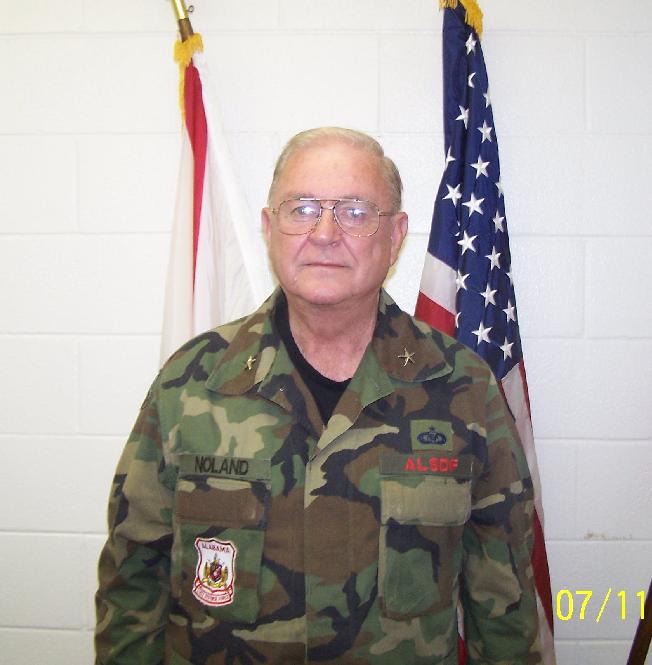
While updating my earlier posts on Honorary Colonelcy in Alabama and on the slow atrophy of the Alabama State Defense Force, I kept circling the same name: MG (AL, Ret.) Ronald G. Noland. At first he appeared only in obituaries and faculty listings. Then an archived copy of the ASDF’s own website from June 19, 2012 surfaced, still listing Major General (AL) Ronald G. Noland as Commander. He had taken command of the ASDF on March 1, 20101.
That single, stubborn webpage turned him from a footnote into a hinge in Alabama’s quiet militia history.
The archive also tells a second story. By March 10, 2013, the ASDF command page listed BG (AL) Dale E. Webb instead. Somewhere between those two dates, Noland stepped aside, passing the colors to the man who would preside over the militia’s final months before it was placed into inactive status.
So Noland was not the last general of Alabama’s forgotten militia — he was the penultimate one — the last to command it while it still possessed momentum, memory, and purpose. That distinction matters, but who he was matters more.
Ronald Gene Noland was born in 1936 in Baton Rouge, Louisiana. He came of age in the long shadow of the Second World War and entered adulthood during the early Cold War. Through Air Force ROTC at Louisiana State University, he entered military service and went on active duty in 1958, serving in both the United States and Japan. He later continued his service in the Air Force Reserve, eventually retiring at the rank of Colonel2.
But the greater portion of his life was not spent on bases or flight lines. It was spent in classrooms.
After completing his military service, Noland pursued advanced education, earning his doctorate in curriculum and instruction from the University of Southern Mississippi. He joined Auburn University, where he would spend twenty-four years as an associate professor in the Department of Curriculum and Teaching, retiring in 1991. After that, he taught for another decade at Spring Hill College in Mobile3.
In addition to his long career in education and service, Ronald G. Noland received formal recognition for both his leadership and his dedication to the Alabama State Defense Force. In 2010, he was elevated by Governor Bob Riley to the rank of Major General of the ASDF, reflecting state leadership’s confidence in his stewardship of the force’s volunteer members. He was later honored in 2011 with the O. Lee Mize Award of Excellence, named for Ola Lee Mize, an Alabama native, Medal of Honor recipient, and decorated war veteran who earned the nation’s highest award for valor during the Korean War at Outpost Harry in June 19534. Established in 2006, the O. Lee Mize Award of Excellence recognizes exemplary and highly commendable service to the state and nation by a citizen of Alabama or a member of the Alabama State Defense Force, linking Noland’s own contributions to a tradition of duty and sacrifice embodied by one of Alabama’s most honored soldiers.commitment to duty5.
That academic career is not an aside to his military one. It is the key to understanding why he ended up where he did.
A volunteer militia like the Alabama State Defense Force does not survive on budgets or weapons. It survives on institutional memory — on people who know how training is supposed to work, how standards are passed down, how a force that only exists on paper is turned into something real. For decades, Noland had made a profession of teaching people how organizations transmit knowledge and sustain themselves over time.
When he joined the ASDF in 1998, the organization was already becoming culturally invisible. The National Guard was increasingly federalized. Disaster response was being centralized. The idea that Alabama might maintain its own trained citizen militia was quietly slipping from public imagination.
Yet under Noland, the ASDF still functioned. By 2010, when he became commander, it numbered roughly 450 volunteers. Two years later, the ASDF’s own website still listed him as the man in charge.
By early 2013, Dale Webb had assumed command. Within months, the ASDF would be placed into inactive status, effectively ending its operational life.
That places Noland in a precise historical position. He was not the last general of Alabama’s forgotten militia. But he was the last one who commanded it while it still operated as a living institution, with people training, planning, and standing ready.
Most of his adult life was spent teaching people how institutions endure. In his final public role, he tried to keep one of Alabama’s oldest civil institutions alive just a little longer.
And thanks to a few stubborn pages preserved by the Internet Archive, we can still see him there, holding that fragile line between what Alabama once assumed about itself and what it quietly decided to become.
- https://web.archive.org/web/20120619145629/http://sdf.alabama.gov/ ↩︎
- https://obits.al.com/us/obituaries/mobile/name/ronald-noland-obituary?id=10402695 ↩︎
- https://www.yumpu.com/en/document/read/38320868/81mb-college-of-education-auburn-university/9 ↩︎
- https://cms.sofrep.com/specialoperations/remembering-ola-lee-mize-korean-war-moh-vietnam-special-forces/ ↩︎
- https://web.archive.org/web/20100401130908/http://sdf.alabama.gov/OLM.htm ↩︎
