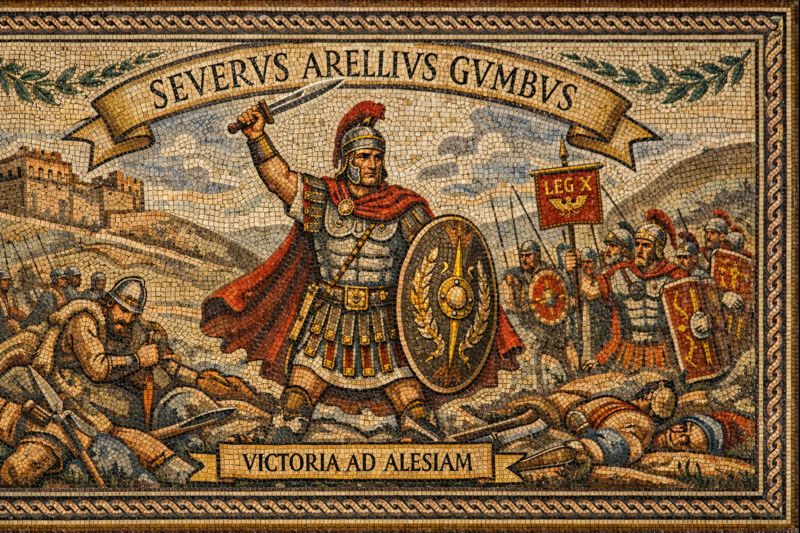
In the winter of 52 BCE, as Caesar pressed his campaign to crush the Gallic coalition, the Roman legions found themselves facing disaster near the town of Alesia—the stronghold of the chieftain Vercingetorix1.
Two armies boxed Rome in
- Inside the city walls: Vercingetorix and his starving defenders
- Outside the walls: a massive Gallic relief force
The Romans were caught in a double siege—besiegers who were themselves besieged. The situation was tactically absurd. Classical doctrine failed. Linear formations meant nothing when the enemy existed on both sides of the line.
Among the officers assigned to the outer fortifications was a little-known centurion of the Tenth Legion:
Severus Arellius Gumbus, Centurio, Legio X Equestris
His name appears nowhere in official records—but late medieval marginalia, monkish glosses, and a damaged fragment attributed to a lost book of Caesar’s Commentarii2 preserve a rumor:
There was one who bent when others broke.
The Crisis
On the fourth night of the Gallic relief assault, the outer wall was breached near Mount Rea. Roman cohorts panicked. Orders conflicted. Standards fell.
Gumbus found himself commanding fewer than forty men—cut off, surrounded, and without signal from headquarters.
Standard doctrine said: hold the line.
Standard Roman pride said: die where you stand.
Gumbus chose something stranger.
He did not hold.
He did not retreat.
He re-shaped.
The Maneuver: Flexio Totalis
Gumbus ordered his men to:
- Abandon rigid formation and break into mobile knots
- Mirror Gallic movements rather than oppose them
- Use the terrain as a jointed body, not a wall—folding around hills, snapping back through trenches, bending into ambush arcs
He treated the battlefield like something elastic.
The Gauls believed the Romans were collapsing. They surged forward.
Instead, they found themselves pulled inward—drawn into kill-zones formed by terrain and misdirection. By dawn, the Gallic spearhead had disintegrated.
The Roman counterattack followed.
Alesia fell.
Vercingetorix surrendered.
Caesar won.
And somewhere in the chaos, Severus Gumbus disappeared back into the ranks.
The Phrase
Later campfire lore claims Caesar himself remarked:
“Non semper fortis est qui rigidus est.”
Not always is the strong man the rigid one.
But among the soldiers, the story changed.
They said:
“Semper Gumbus.”
Always bend like Gumbus.
Over time, the name softened in barracks slang, traveling soldier to soldier, century to century, until:
Semper Gumbus → Semper Gumby
No marble inscription.
No triumphal arch.
Just a phrase that refused to break.
The Moral
Rigid things shatter.
Flexible things survive.
But adaptive things—they win.
And that, my friend, is how a green cartoon, a fake Latin motto, and a forgotten centurion all secretly share the same ancestry: the oldest Roman virtue of all—Practical wisdom under pressure.
Semper Gumby.
In the Words of Paul Harvey, “and now you know the rest of the story”3
Except that I, with the help of ChatGPT, concocted the story above to have something to share with my students to explain why I use the phrase “Semper Gumby” to sign off on emails and messages. If you’re a reader of this blog, you know that I’m not afraid of using legend and lore to tell stories, and to me, this one needed an interesting Roman backstory. The actual account is also interesting. The following description is based off of the Wikipedia4 entry for the phrase.
The Documented Account
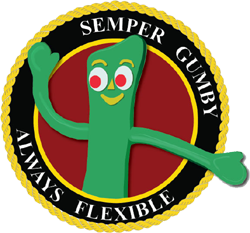
“Semper Gumby” is an informal, humorous motto often used in U.S. military and emergency response circles that literally translates (in “dog Latin”) to “Always Flexible.” The phrase is a playful riff on real Latin-based official mottos such as Semper Fidelis (“Always Faithful”), Semper Fortis (“Always Strong”), and Semper Paratus (“Always Ready”), but it isn’t proper Latin—the genuine classical phrase for “always flexible” would be Semper Flexibilis.
The term alludes to Gumby5, the pliable green clay animation character from American television created by Art Clokey, known for bending and shaping himself in every predicament. This association serves as the visual and conceptual anchor for the motto’s meaning: adaptability in the face of shifting challenges.
Although Semper Gumby isn’t an official motto of any branch of the U.S. armed forces, it circulated informally in military units as early as the late 1970s and is widely attributed to various units and service environments, including Marine Corps battalions and naval aviation squadrons. One popular early claim traces its use to 1984, when a helicopter pilot affixed a Gumby figure on his instrument panel and used the phrase to capture the need for flexibility in operations.
Today it appears not only in military slang but also in emergency management and leadership contexts to suggest that success often depends on being ready to change plans fluidly when reality shifts underneath you.
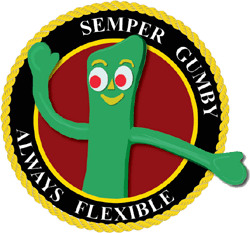
Whimsically rooted in cartoon imagery, the motto encapsulates a serious operational truth: rigid thinking fractures under pressure, whereas adaptability helps teams endure uncertainty and respond effectively.