
Some landmarks enter your life quietly. You pass them often enough that they stop being curiosities and start becoming prompts for reflection.
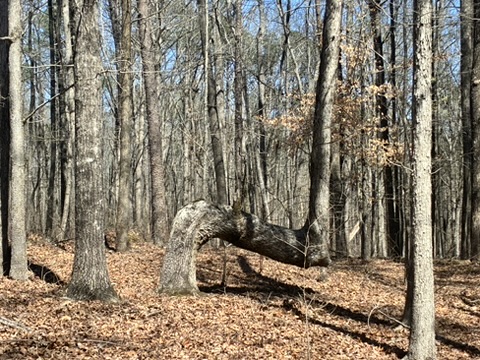
For me, one of those is a tree along a Highway 33 through Bankhead National Forest. I drive past it nearly every day. If you didn’t know what you were looking at, you might miss it entirely. The trunk runs low and horizontal for several feet before turning sharply upward again, as if the tree reconsidered its course halfway through growing.
Of course, trees don’t reconsider. People do.
Someone bent that sapling long ago so it would grow into a marker tree. Before survey lines, road signs, or GPS satellites, travelers sometimes shaped young trees so that years later the trunk would point toward something important—a spring, a ford, a settlement, a trail junction. The person who bent it knew they would not always be there to guide travelers themselves. The tree would carry the message forward.
Now I pass it on an ordinary weekday drive, and the thought returns each time: whoever bent that sapling expected someone else to understand what it meant.
The remarkable thing is that the tree is still doing its job.
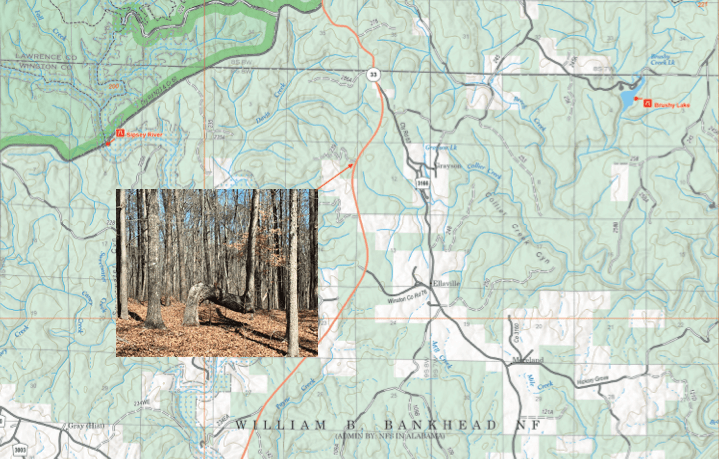
One day I finally stopped and walked over to look at it up close. Standing there, I noticed something I had never seen from the road. A few feet behind the tree are the faint, sunken traces of what was once a crossroads. Two old paths remain just visible in the forest floor. One trails off toward the northwest. The other angles slightly to the southwest. Both eventually cross the modern highway that now cuts through the forest west of the tree.
The bent trunk points east.
Standing there for a moment, I found myself wondering what that tree was pointing toward several hundred years ago. The trails are gone, and the travelers long since vanished, but the forest still remembers where people once walked. Once you start noticing those traces, they begin appearing elsewhere.
Alabama Mounds and the Roads in Between
North of the forest, not far from the Tennessee River, stands another reminder of an older world: the Oakville Indian Mounds. Today the Oakville mound rises quietly above the surrounding fields, but like the mounds at Moundville, it once stood at the center of a living settlement. Archaeologists place it within the broader Mississippian cultural world that stretched across the Southeast.
It is easy to forget how connected that world once was. Long before modern highways stitched the region together, rivers and footpaths linked towns, ceremonial centers, and trade routes across hundreds of miles.
Standing beside that bent marker tree in Bankhead, looking at the faint traces of those old crossroads, it is hard not to wonder whether that tree once marked part of such a route—perhaps guiding travelers moving between places like Oakville to the north and the larger mound complexes farther south along the Black Warrior River.
No signpost survives to confirm it. The forest offers no explanation.
Still, the possibility lingers.
I can imagine the long trade path down to Moundville. I camped there with Scouts a few years ago and will again next month. During the day it looks like a beautiful park along the Black Warrior River—wide lawns, scattered trees, and a series of symmetrical grassy hills rising above a central plaza.
But once you understand what those hills are, the place changes. Those aren’t hills. They’re platform mounds built by a thriving city nearly a thousand years ago.
One earlier visit sticks with me in particular. My son’s class visited Moundville during their annual festival. The children ran across the mounds shouting and laughing, chasing one another across the grass. At first I found myself slightly irritated. Something in me wanted them to slow down, to lower their voices, to treat the place with the quiet reverence we usually reserve for cemeteries.
For a moment it felt like watching kids play tag among gravestones.
The thought didn’t last long. Another question followed it.
If this was once a living city, what exactly were the children doing here a thousand years ago?
They probably weren’t whispering.
They were likely doing exactly the same thing — running across the plaza, climbing where they weren’t supposed to, inventing games between the houses while adults went about the serious business of life.
The city is gone now, but the sound of children playing may be one of the few things about it that has not changed very much at all.
Another memory from that visit has stayed with me. While exploring the area where reconstructed huts stand, I noticed a Native American man wearing a medicine wheel on his hat. I explained what I knew of the symbol to my son and then approached the man to ask what it meant to him.
At first he seemed slightly irritated. I had the sense that he doubted whether a couple of white visitors were genuinely interested in the meaning behind the symbol.
After a few minutes of conversation, that impression softened. He realized the interest was sincere and that I had at least attempted to learn something about Native American symbolism — especially one as widely recognized as the medicine wheel. He told me he was Seminole.
Before we parted, he gave the medicine wheel to my son.
It still hangs on his wall.

My next visit to Moundville is coming up soon. The Eastern Region Section 6 of the Order of the Arrow will have its annual Conclave there. My son and I belong to the Aracoma Lodge, for whom Moundville holds particular significance.
For a weekend, Scouts from across the Southeast will camp at the foot of the mounds, enjoying fellowship and imagining the city that once stood there.
The connections run deeper than most people realize. The powerful chief remembered in Spanish accounts as Tuskaloosa ruled in this region in the sixteenth century. His name is often translated as “Black Warrior,” and the Black Warrior River still flows beside the ancient city. Today the Black Warrior Council takes its name from that same river and landscape.
Blood and Soil
My own family history eventually crossed paths with that larger story. While researching the Blevins genealogy, I found our name appearing in records connected to early Cherokee treaty negotiations, including the Treaty of Holston. Those treaties were intended to define boundaries and preserve peace. History did not leave them intact. Expansion continued until it culminated in the forced removal remembered as the Trail of Tears.
Some Blevins families appear in the Dawes Rolls, though they seem to belong to a different branch. Even so, seeing your own surname appear in records like these complicates the story. It reminds you that history was not made by abstract forces but by ordinary people making decisions in real places.
Years ago I wrote an essay titled The Moral Right to Lands Lost in Conquest. At the time I approached the question mostly as a legal and philosophical problem. Anglo-American law has long recognized that land disputes cannot remain unsettled forever.
From a purely legal standpoint, that reasoning still seems sound to me.
ut standing in places like Moundville — or looking at the faint traces of crossroads behind a bent tree in the forest — the question begins to feel less theoretical.
Law may settle ownership, but it does not erase memory.
A Nest Over the River
A similar thought comes to mind when I cross the Captain William J. Hudson “Steamboat Bill” Memorial Bridge over the Tennessee River. Each spring I glance up toward one of the bridge’s arches where an osprey nest usually appears. Early in the season the mother bird begins assembling it stick by stick until a large bundle of branches crowns the structure.
By late summer it looks almost permanent.
Then storms and wind slowly tear it apart. By winter the nest is mostly gone.
And yet the following spring the process begins again in exactly the same place.
A new generation arrives.
The nest rises again.
The birds themselves change, but the location does not. Somehow the descendants remember where the nest belongs.
Reorienting on the Tree
All of those reflections eventually circle back to that bent tree in Bankhead.
Someone shaped that sapling expecting travelers to understand the direction it pointed. The world they lived in has vanished. Their cities faded, their trails disappeared, and their descendants live far from that forest.
Yet the tree still points down a path someone once believed was important.
Civilizations rise and fall.
Treaties are signed and broken.
Cities appear and disappear.
But the land keeps remembering the patterns people leave behind.
The ancestors are gone and the descendants removed, but the land remembers.
